The launch plan everyone could see
A website-ready SaaS success story that follows a decision, a rollout and the limits of the available proof.
Narrative structureEvidence boundariesWebsite copy

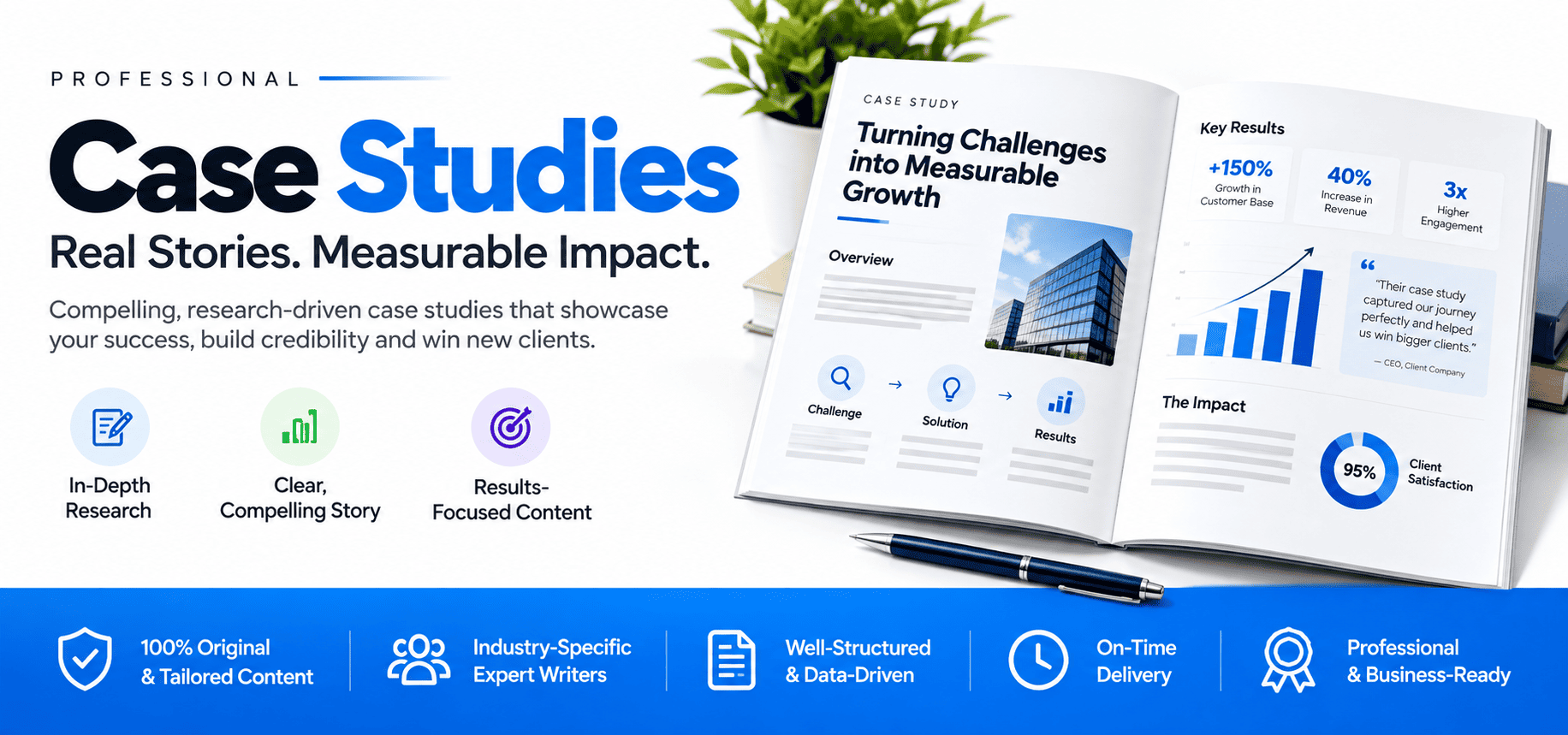
A case study is a documented account of how a real customer addressed a specific problem, implemented a product or service, and experienced an outcome. Unlike a short testimonial, it explains the context and decision process so a reader can judge relevance. The service includes interviews where included, source review, narrative development, editorial quality control and the final writing handoff.
Our service is designed for marketing leads, founders, sales enablement teams and account managers who need credible customer stories from approved evidence. You provide the available evidence and a review contact; the service includes case study writing, evidence checks, revisions and final delivery.
Share the customer's industry and situation, the initial challenge, what your team delivered, the implementation timeline, any outcome data, approved quotes or interview access, brand tone, target audience and intended publication channel. Specify confidentiality, customer naming or legal-review requirements before work starts. Customer approval to publish logos, identity and quotations remains with your organization.
We agree on the audience, story angle, evidence, approvals and the deliverable tier.
Where purchased, we conduct interviews, then organize the customer story around verified facts.
We check statements, gather consolidated feedback and revise within the agreed scope.
Receive editable story copy and package-specific adaptations for your publishing team.
B2B websites and industry landing pages use them as detailed social proof. Sales teams attach one-page stories to proposals and follow-ups. Customer success teams document implementations; SaaS companies explain onboarding or migrations; professional-service firms show how a project was approached. Each story should be specific enough to support evaluation without disclosing private customer information.
RUDRRIV EDITORIAL WORK / 05 CONCEPT EXAMPLES
Explore five original, representative case study drafts—from SaaS onboarding to service operations. Each sample demonstrates the written customer narrative, not a stock image or an invented client result. All are illustrative concepts, not commissioned client projects.
A website-ready SaaS success story that follows a decision, a rollout and the limits of the available proof.
An implementation-focused manufacturing narrative with process detail and careful separation of actions from outcomes.
A thoughtful customer spotlight built for interview-led development, without pretending an interview happened.
An identity-free customer story designed to preserve process specificity while avoiding unsupported claims.
A proposal-ready proof story with executive framing, a practical intervention and an evidence-safe takeaway.
Have the source material? We can turn approved notes, interviews and evidence into a customer story built for your buyers.
Discuss your case study briefSAAS · CUSTOMER ONBOARDING · ILLUSTRATIVE CONCEPT
A customer onboarding story about replacing scattered handoffs with one shared path to first use.
The strongest claim here is clarity of ownership—not an invented efficiency gain.
The onboarding problem was not a missing tool. In this illustrative B2B software scenario, useful details lived in too many places: a sales handover, an implementation checklist and a chain of customer emails. Each team knew its own next step, but the customer could not easily see how those steps connected. When a question crossed a team boundary, the answer depended on somebody finding the right thread.
The vendor and customer first agreed on what a successful launch needed to mean. They separated technical activation from team readiness and stable first use, then gave each milestone a named owner and a clear acceptance condition. Open decisions were captured alongside tasks, with an explicit distinction between work waiting on customer input and work owned by the delivery team.
Weekly conversations now started with the decisions that could hold up progress, rather than a tour of separate trackers. The project lead could explain what was complete, what remained uncertain and who would resolve it. The customer had a single reference point for discussing scope changes without mistaking activity for readiness. This is a story about more transparent coordination, not a claim that implementation became effortless.
Before any external version could describe a measured improvement, the team would need dated milestone records, an approved account of the handover experience and evidence of how the new process was used. A quote would require the customer’s actual words and permission. Without those inputs, the defensible ending is modest: the approach made ownership and launch criteria more explicit.
Publication check: confirm dates, milestone history, adoption evidence and customer approval.
MANUFACTURING · OPERATIONS · ILLUSTRATIVE CONCEPT
An operations case study showing how a production team can make open exceptions visible at shift change.
The handover becomes useful when the next shift knows what must be decided—not merely what happened.
In this model manufacturing engagement, supervisors recorded what a shift produced, but not always what the next team needed to decide. A machine stoppage might appear in a log without its temporary workaround. A quality hold could travel through an informal message. The information existed, yet the record rarely connected the event, its current status and the person responsible for the next action.
The improvement team did not begin by asking operators to write longer notes. It designed a short exception record with four fields: the issue observed, the immediate containment step, the unresolved decision and the named owner. Teams tested the structure during handovers, removed duplicate fields and agreed on a shared meaning for “closed.” The new process left room for urgent face-to-face escalation rather than pretending a form could replace judgment.
A clearer handover gave incoming supervisors a more practical starting point: they could distinguish a finished task from a risk still awaiting review. The story does not assume a reduction in scrap, downtime or defects. Those are separate results that would require reliable production records and an agreed comparison period. The operational achievement to examine first is whether exceptions were consistently recorded and resolved.
A publishable customer case would compare sample handover records before and after the change, document who approved the revised procedure and ask operators whether the new fields supported actual decisions. Any specific productivity claim would need plant-level validation. The narrative should also name the limits: a record improves continuity only when people use it and escalation remains timely.
Publication check: request signed procedure, example logs and approved operational evidence.
PROFESSIONAL SERVICES · ADVISORY · ILLUSTRATIVE CONCEPT
A customer-perspective advisory story about turning a broad request into a workable decision sequence.
An advisory case study is most useful when it shows how the client learned to decide.
In this illustrative professional-services story, a growing business approached an advisory team asking for a new operating model. Behind that request were different concerns. Department leads wanted clearer ownership, finance wanted predictable approvals and leadership needed to understand which decisions could be delegated. A proposal that treated “operating model” as one fixed answer would have hidden the disagreement that mattered most.
The advisers reframed the brief around a smaller question: where were decisions slowing down because authority was unclear? They mapped a handful of recurring decisions, distinguished policy from habit and invited stakeholders to explain what information they needed before acting. That created a practical sequence for the engagement—define the decision, identify its owner, agree on exceptions, then document the escalation path.
Rather than deliver a large chart and hope the organization adopted it, the team tested the model against everyday scenarios. A supplier request, an unplanned expense and a cross-team service issue revealed where boundaries still needed work. The resulting material was less impressive as a diagram and more helpful as guidance: people could see who acted first and when to ask for review.
An interview-led version would ask the customer which decision became easier, what proved difficult in adoption and which parts of the recommendation needed adjustment. Those answers have not been collected for this concept. No quotation, endorsement or performance metric is asserted. The story demonstrates the editorial route from a vague brief to a concrete, testable account of change.
Interview plan: obtain customer consent, decision examples and approval of the final narrative.
WHOLESALE · DISTRIBUTION · ILLUSTRATIVE CONCEPT
A confidentiality-conscious story about handling exceptions in a distribution returns workflow.
An unnamed customer can still have a specific problem, a clear intervention and a useful lesson.
For this fictional wholesale distribution scenario, most product returns followed a familiar route: reason recorded, goods inspected and resolution chosen. The harder cases were the ones that sat between categories—a shipment that arrived incomplete, a disputed quantity or a damaged carton with no matching note. Staff often knew what to do locally, but the case history did not always explain why an exception took a different path.
The distribution team worked from real workflow questions rather than an ambitious claim about transformation. Which facts should be captured at intake? When should an exception move to inspection? What evidence justifies credit, replacement or escalation? The revised case record separated what the sender reported from what the receiving team observed, then required a recorded reason for the final resolution.
The editorial focus is traceability. A case study can explain why the distinction between a customer report and a warehouse finding matters to everyone reviewing a disputed return. It should also acknowledge that a documented path does not settle every disagreement. The process offers a clearer explanation of decisions; it does not, by itself, establish faster refunds or fewer losses.
Because this is representative concept work, no real customer identity is being concealed. In a commissioned anonymous case, the publisher would need permission for the level of detail used and would remove any combination of identifiers that exposed the customer. Approved records, anonymized examples and a documented review path would support the final story without turning uncertainty into a marketing claim.
Publication check: confirm anonymity rules, sample record permissions and claim ownership.
FACILITIES · B2B SERVICE DELIVERY · ILLUSTRATIVE CONCEPT
A concise buyer-facing case study on how a multi-site service team clarifies work-order ownership.
The decision a buyer needs to trust: who owns the request after it changes hands?
A multi-site facilities team needs more than proof that tickets are logged. Its property contacts want to know what happens when a request moves from reception to assessment, from assessment to a contractor and from completion to customer sign-off. In this illustrative service scenario, those handoffs were treated as an ownership problem rather than a reason to promise a new platform.
The service provider defined a work-order path with a single accountable owner at every stage. Requests carried a site, urgency level, next action and escalation condition. A completion note described the work performed and what still needed confirmation. When a job moved to an external contractor, the service desk retained responsibility for communicating its status to the customer.
The value of the approach is visible in the quality of the record: an approver can follow why a request changed priority, who authorized the next step and whether the work was accepted. A strong final case would include an approved example of that decision path, alongside the customer’s assessment of its usefulness. It would not substitute a neat process diagram for actual evidence of service performance.
For a proposal, the takeaway is simple: continuity comes from explicit ownership across handoffs. Any promise about response times, cost or tenant satisfaction would require contract-specific data and customer clearance. Until then, this sample demonstrates how concise case-study writing can help a buying committee see the operational method without overstating a result.
Sales handoff: validate service scope, customer permission and any response-time statistics.
Start with complete existing evidence, add a customer interview, or commission a longer story with sales-channel adaptations. Prices cover one customer story; all packages require truthful source material and your publication approvals.
| Included | ₹1,499 Essential Source-Based Proof Story One concise customer case study from complete, approved source material. | ₹4,999 Professional Recommended Interview-Led Customer Story A deeper customer story with one guided interview and a buyer-focused narrative. | ₹11,999 Advanced Case Study & Sales Story Kit An expanded evidence-led case study plus adaptations for website and sales outreach. |
|---|---|---|---|
| Length | 400–550 words | 750–1,000 words | 1,100–1,500 words |
| Customer stories | 1 | 1 | 1 |
| Customer interviews | — | 1 × up to 30 min | Up to 2 × 30 min |
| Source & proof check | Basic | Detailed | Evidence table |
| Short website excerpt | — | Up to 120 words | 150-word abstract |
| Sales email adaptation | — | — | 1 draft |
| Social promotion drafts | — | — | 3 drafts |
| Editable DOCX | ✓ | ✓ | ✓ |
| Revision rounds | 1 | 2 | 3 |
| Estimated delivery | 3 working days | 6 working days | 9 working days |
| Package price | ₹1,499 | ₹4,999 | ₹11,999 |
Important context: The supplied testimonials are explicitly labeled samples for Product Descriptions, not for this Case Studies service. They are reproduced below with their original names, wording, ratings, countries and timelines, without presenting them as verified Case Studies reviews. No overall service rating is claimed.
Sample appreciation — We chose specialist support for Product Descriptions after realizing our internal draft was not yet ready. We needed the team to write product descriptions for a catalog with many similar items. What we appreciated most was the attention to feature-to-benefit translation, differentiation, search terms, consistency, scannability, factual accuracy, and buying context. The handoff included clean, usable files, and the final version required very little internal cleanup. The work ultimately gave us a cleaner catalog where products were easier to compare and each description had a clearer reason to buy. The result gave us a stronger foundation and reduced the amount of rewriting our internal team had to do.
Sample review — For this Product Descriptions project, we needed to write product descriptions for a catalog with many similar items. The team quickly identified the details that would matter most: feature-to-benefit translation, differentiation, search terms, consistency, scannability, factual accuracy, and buying context. Questions were specific, feedback was documented, and revisions stayed tied to the agreed objective. That discipline helped us reach a cleaner catalog where products were easier to compare and each description had a clearer reason to buy. The final work felt tailored to the brief rather than produced from a generic template.
Sample review — We brought in support for Product Descriptions with a fairly specific brief: write product descriptions for a catalog with many similar items. Instead of treating the task as generic writing, the team worked carefully through feature-to-benefit translation, differentiation, search terms, consistency, scannability, factual accuracy, and buying context. The team explained editorial choices clearly and made it easy to separate essential changes from optional preferences. The final outcome was a cleaner catalog where products were easier to compare and each description had a clearer reason to buy. Overall, the project left us with a cleaner deliverable and a process we could confidently build on.
Sample review — The Product Descriptions engagement was well structured from kickoff to handoff. Our goal was to write product descriptions for a catalog with many similar items, and the work stayed grounded in feature-to-benefit translation, differentiation, search terms, consistency, scannability, factual accuracy, and buying context. Each revision improved the work without introducing unnecessary complexity or changing the core message. We ended with a cleaner catalog where products were easier to compare and each description had a clearer reason to buy. By the end, we had a version that felt more credible, more consistent, and easier to put into production.
Sample review — We had already done some internal work before starting the Product Descriptions project, but we needed an expert pass to write product descriptions for a catalog with many similar items. The review went beyond wording and considered feature-to-benefit translation, differentiation, search terms, consistency, scannability, factual accuracy, and buying context. Milestones were easy to review, and comments were incorporated carefully without losing continuity. That gave us a cleaner catalog where products were easier to compare and each description had a clearer reason to buy. We came away with content that was clearer in purpose and much easier to review with stakeholders.
Sample review — What made the Product Descriptions work effective was the combination of editorial judgment and practical execution. The assignment was to write product descriptions for a catalog with many similar items, with particular care around feature-to-benefit translation, differentiation, search terms, consistency, scannability, factual accuracy, and buying context. Communication remained concise, and the reasoning behind major changes was clear enough for our team to learn from. The completed work delivered a cleaner catalog where products were easier to compare and each description had a clearer reason to buy. The outcome was practical, polished, and aligned with how the content would actually be used.
Sample review — Our Product Descriptions brief started with scattered notes and a clear deadline. The scope was to write product descriptions for a catalog with many similar items. The strongest part of the work was the attention to feature-to-benefit translation, differentiation, search terms, consistency, scannability, factual accuracy, and buying context. They flagged gaps early, handled conflicting feedback sensibly, and kept the work moving without rushing decisions. The delivered result was a cleaner catalog where products were easier to compare and each description had a clearer reason to buy. The finished material was ready to use and noticeably easier for our audience to understand.
Tell us which customer result you want documented, where the evidence lives and how your team plans to use the story. Rudrriv will confirm scope, interview needs and delivery steps.