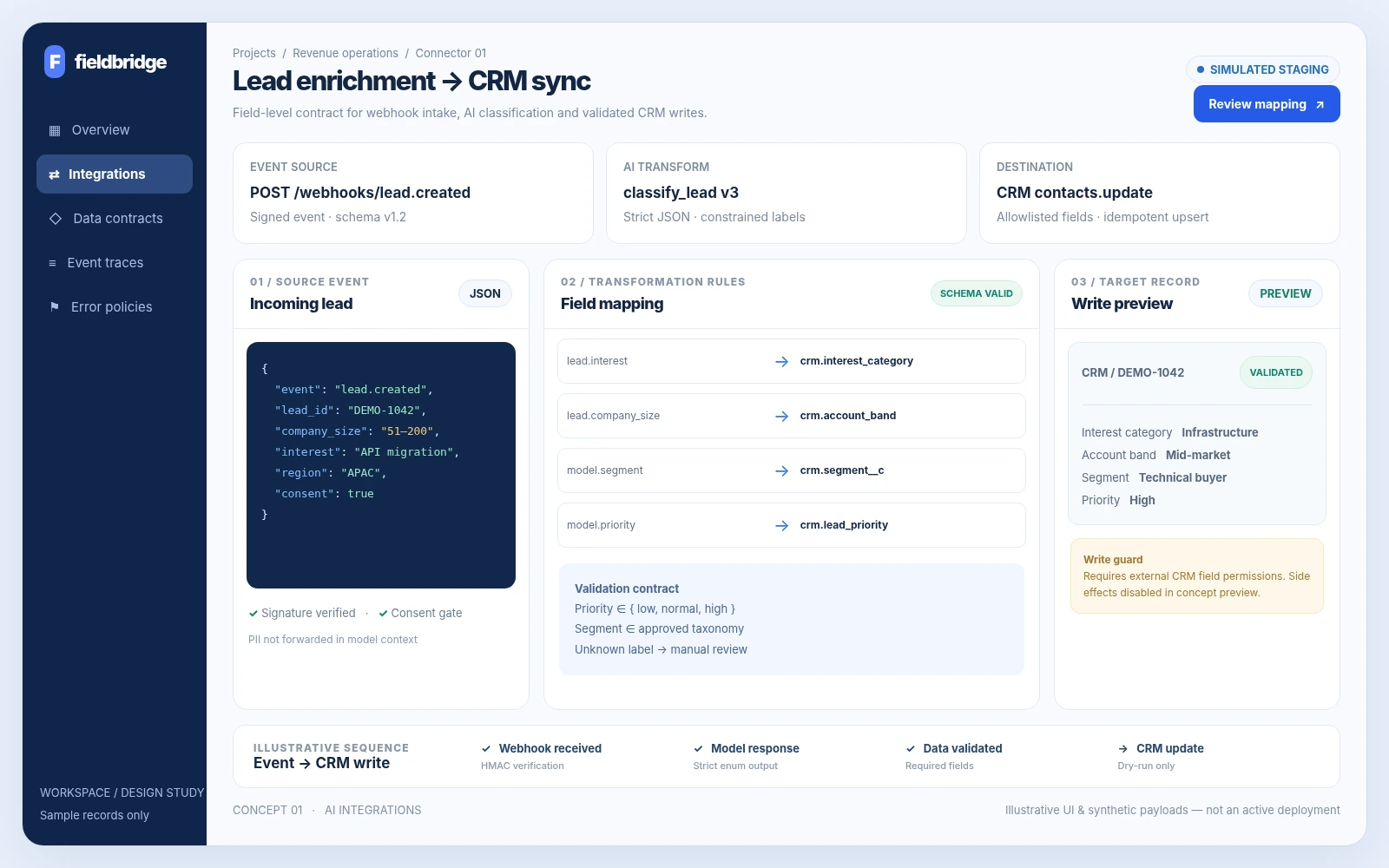
CRM & DATA MAPPING
FieldBridge — lead-to-CRM enrichment
A signed lead webhook is transformed into typed CRM fields, checked against an explicit schema, then prepared for an idempotent update.

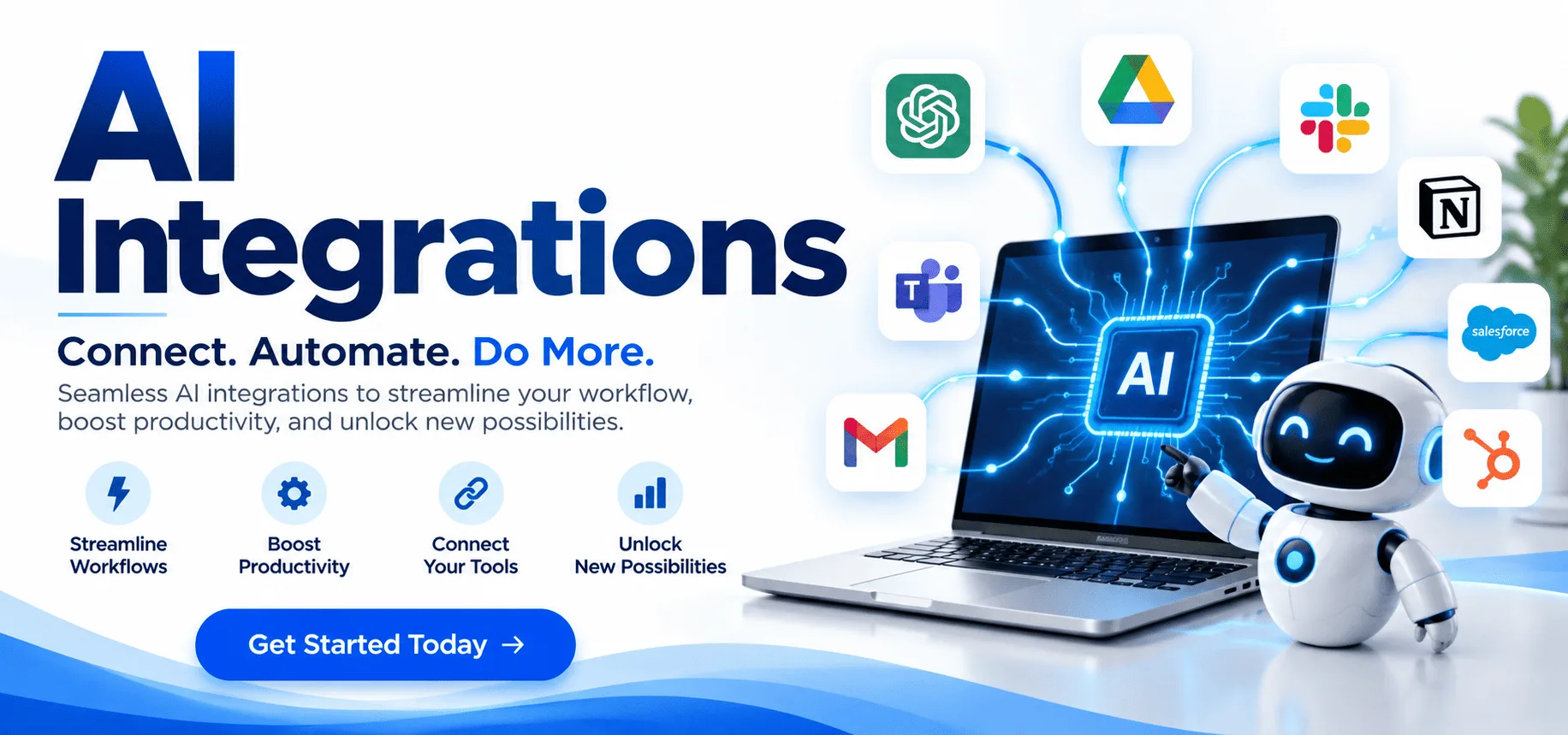
AI integration is the work of connecting a model or AI-powered capability to the software and operational systems your business already depends on. The model call is only one part of the job. A dependable integration also needs the surrounding logic for authentication, request preparation, field mapping, structured responses, event triggers, API actions, validation, logging, failure handling and a maintainable handover.
Rudrriv provides this as a professional service. You share the desired outcome, systems, technical constraints and delivery target. Rudrriv scopes the work, completes implementation and reviews the output before final delivery.
Share the business outcome, systems involved, current workflow, desired AI behavior, expected inputs and outputs, available API documentation, deployment environment, representative test cases and any security or compliance constraints. If you already prefer OpenAI, Anthropic Claude, Google Gemini or another provider, include that preference. Do not send passwords, API keys or production secrets in the enquiry form.
Rudrriv reviews objectives, connected systems, access requirements, data flow, success criteria and failure boundaries.
The assigned team implements authentication, model calls, mapping, triggers, structured outputs and agreed system connections.
Agreed scenarios are tested with validation, errors, retries, logging and fallback handling according to the selected scope.
Rudrriv completes quality review and delivers the integration, documentation and deployment guidance included in the package.
Production AI integrations must account for API permissions, model variability, response validation, rate and usage limits, latency, third-party outages, data handling rules and the consequences of any action the workflow can take. The implementation is therefore scoped around your acceptable risk and operating environment rather than around a generic demo.
Choose a tier based on how many systems and workflow paths must be connected, and how much production hardening, orchestration and deployment support the integration requires.
| Included | ₹4,999 Essential Focused AI Connection For one focused AI feature or workflow connection in an existing system. | ₹24,999 Professional Recommended Workflow Integration Suite For production-oriented workflows spanning several endpoints with stronger reliability controls. | ₹59,999 Advanced Production Integration System For broader multi-system orchestration, expanded testing and deployment handover. |
|---|---|---|---|
| AI / model connections | 1 | Up to 2 | Up to 3 |
| Business systems / endpoints | 1 | Up to 3 | Up to 6 |
| Workflow paths | 1 | Up to 3 | Up to 5 |
| Authentication & data mapping | ✓ | ✓ | ✓ |
| Structured outputs / tool calls | Basic if required | ✓ | ✓ |
| Retries / rate-limit handling | Basic | ✓ | ✓ |
| Logging | Basic | ✓ | Enhanced hooks |
| Fallback behavior | — | 1 agreed path | Multi-path where appropriate |
| Agreed test scenarios | 3 | Up to 8 | Up to 15 |
| Deployment support | Setup guidance | Staging / production guidance | Deployment support & handover |
| Documentation | Setup notes | Integration notes | Integration runbook |
| Revision rounds | 1 | 2 | 3 |
| Standard delivery | 3 business days | 7 business days | 14 business days |
| Package price | ₹4,999 | ₹24,999 | ₹59,999 |
SELECTED WORK · 05 REPRESENTATIVE CONCEPTS
Explore five distinct design studies of real-world integration deliverables: explicit data contracts, permissions, validated model outputs, safe API actions, and observable recovery paths. These are original illustrative concepts, not client case studies or live deployments.
A signed lead webhook is transformed into typed CRM fields, checked against an explicit schema, then prepared for an idempotent update.
Ticket payloads are redacted before classification; a strict queue allowlist, fallback and human review prevent unsafe customer-facing actions.
An example invoice becomes structured payable fields with total reconciliation, duplicate checks and a draft-only handoff to accounting software.
A SaaS application forwards an authenticated request through tenant-scoped retrieval, grounding and citation-aware response contracts.
An operations event crosses model classification, deterministic policy checks, human approval, an auditable action boundary and a recovery queue.
Share your current systems, API access, target fields, decision boundaries, and preferred delivery scope.
We engaged the team specifically for AI Integrations and were pleased with the balance of practical thinking and execution quality. The scope centered on a set of AI integrations connecting our existing systems and workflows. They asked sensible questions early and paid close attention to API reliability, data mapping, authentication, event triggers, model calls, logging, and fallback behavior. That preparation reduced unnecessary revision rounds and kept decisions moving. The delivered work gave us connected workflows that reduced manual handoffs without disrupting our core tools. Source materials, settings, and notes were clean, consistent, and ready for the next step in our workflow.
The experience with AI Integrations was smooth and professional from start to finish. We needed a set of AI integrations connecting our existing systems and workflows that would work in real use, not only in a demo. The team considered API reliability, data mapping, authentication, event triggers, model calls, logging, and fallback behavior throughout the project. Comments were tracked properly, and each revision improved the work without drifting from the brief. The result gave us connected workflows that reduced manual handoffs without disrupting our core tools. We also appreciated the practical handoff and the care taken to make future updates manageable.
This was our first time bringing in outside support for AI Integrations, and the service was delivered very well. We began with a rough direction for a set of AI integrations connecting our existing systems and workflows. The strongest contribution was the attention to API reliability, data mapping, authentication, event triggers, model calls, logging, and fallback behavior. Feedback was handled thoughtfully, and the team explained important choices whenever we needed context. By the end, we had connected workflows that reduced manual handoffs without disrupting our core tools. The final handoff was organized, practical, and clearly prepared for continued use.
Tell us what should connect, what the AI needs to do and how the workflow should behave in normal and failure conditions. Rudrriv will review the requirement and recommend the most suitable package or custom scope.