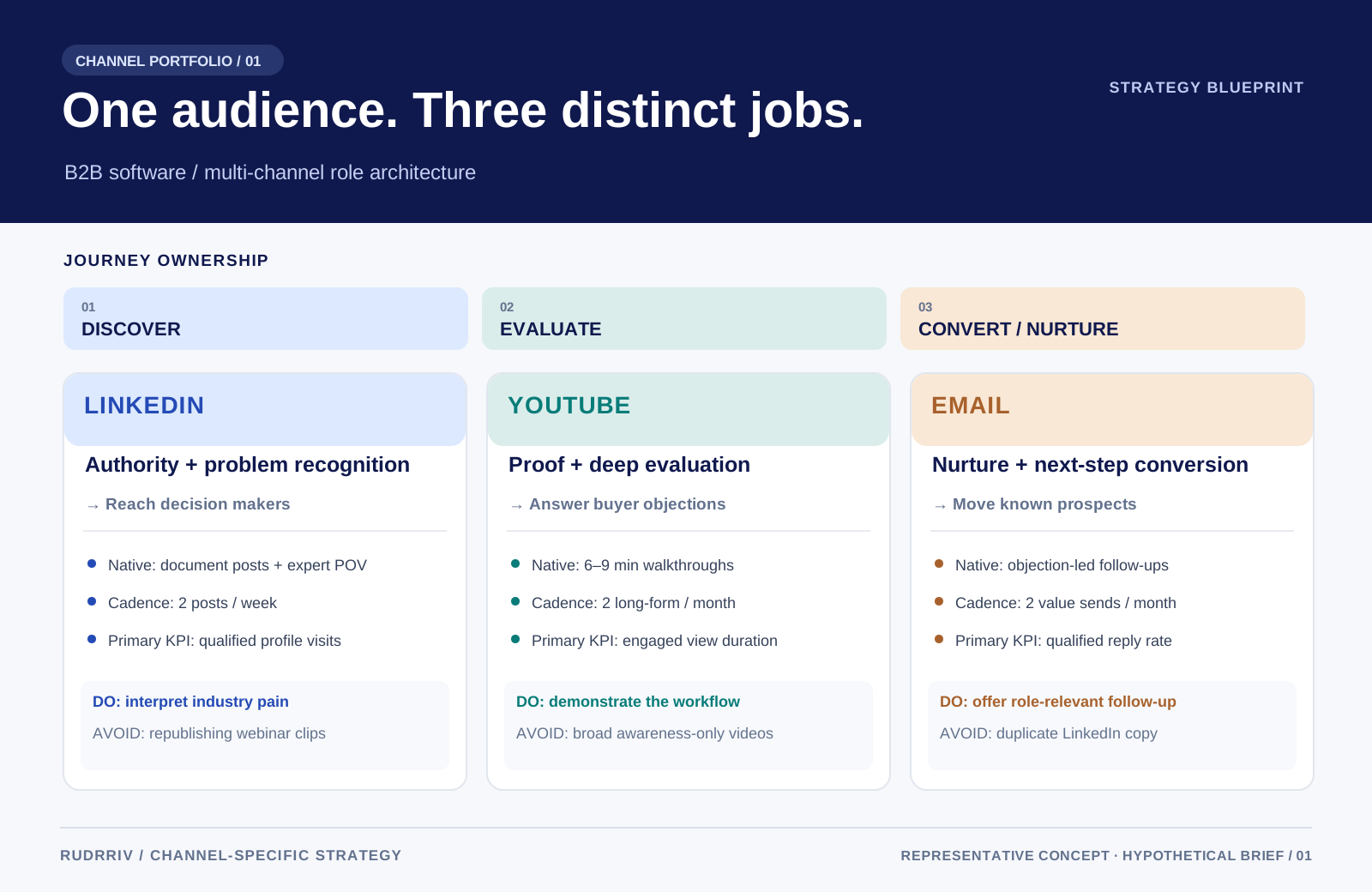
Channel portfolio blueprint
Channel Role Architecture
B2B software team · clear roles for LinkedIn, YouTube and email with journey ownership, native formats and explicit duplication boundaries.

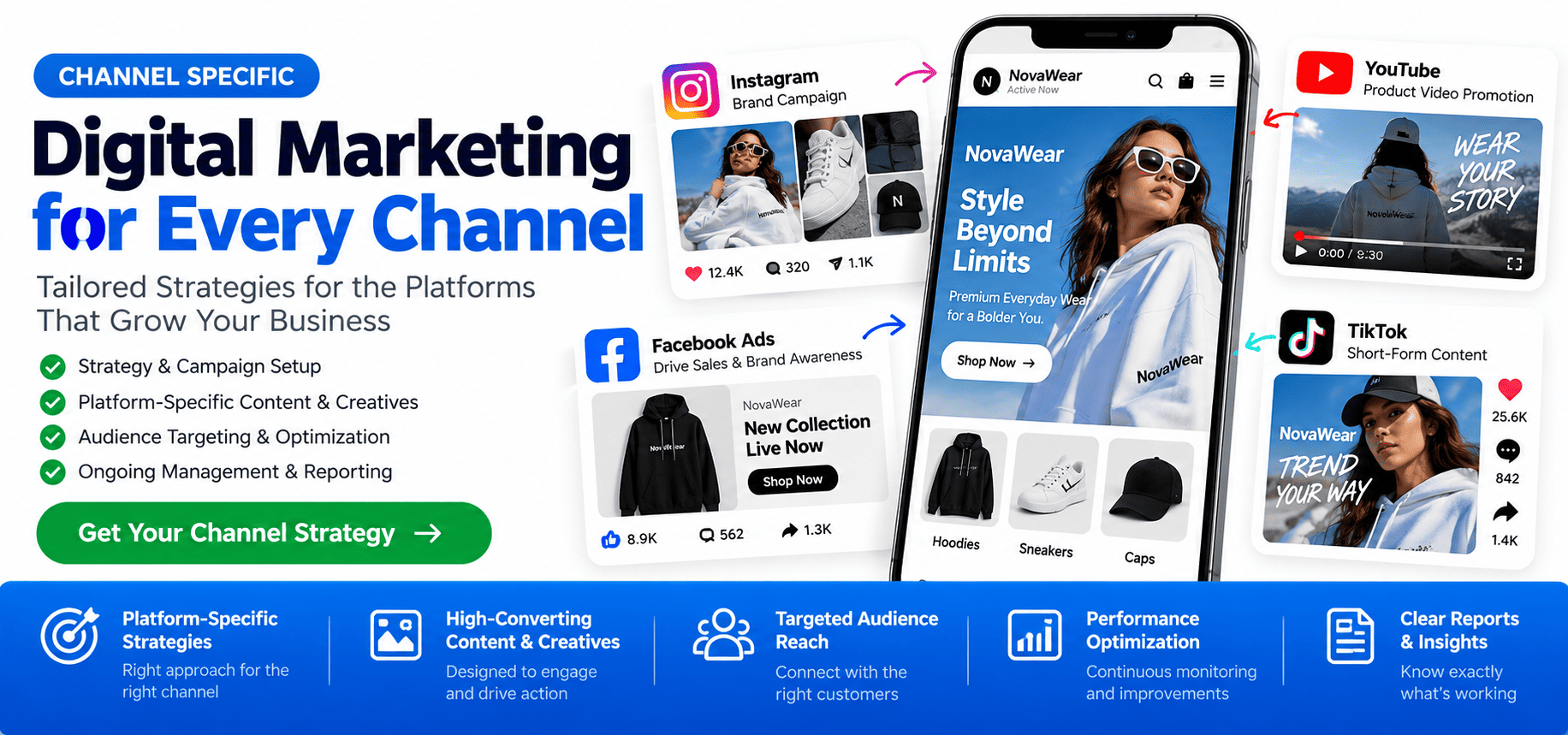
Channel-specific marketing strategy is the discipline of deciding what each platform is actually for, who it should reach, which content mechanics fit that environment, how often your team should show up and which metrics indicate that the channel is doing its job. It is useful when a business has several active platforms but the same content, cadence and success criteria are being applied everywhere.
Rudrriv turns that problem into a strategy engagement. Rudrriv reviews your objectives, audience, current presence, available data and operating constraints, then develops a channel-specific playbook that your execution team can use in day-to-day marketing. The focus is practical: channel role definition, platform fit, native formats, cadence, measurement and prioritized testing.
Share the business objective, target audience, priority products or services, current marketing channels, examples of recent content or campaigns, team capacity, brand or messaging guidance and any channel constraints. If available, provide recent channel analytics, campaign reports or access to native platform data so recommendations can be grounded in evidence rather than assumptions.
Rudrriv reviews your objective, audience, current channels, content, data and operating constraints.
Each selected channel is assigned a purpose, audience context and place in the customer journey.
Native formats, cadence, KPIs, testing priorities and practical execution guidance are documented.
Recommendations are checked for consistency, prioritized and delivered with clear next actions for your team.
The final output is written to support real operating decisions: what to prioritize, what to stop duplicating, how content should change by channel, what the team should test next and which metrics should trigger a change in direction. The strategy can guide in-house marketers, an external agency or a mixed team.
Choose the scope based on how many channels need detailed strategy and how much cross-channel coordination your team requires.
| Included | ₹4,999 Essential Single-Channel Blueprint For one priority channel that needs a clearer role, execution rules and measurement plan. | ₹9,999 Professional Recommended Multi-Channel Playbook For up to three channels that need coordinated roles, platform-specific execution and a 90-day roadmap. | ₹17,999 Advanced Channel Portfolio Strategy For up to five channels requiring deeper prioritization, cross-channel sequencing and governance. |
|---|---|---|---|
| Priority channels covered | 1 | Up to 3 | Up to 5 |
| Current-state channel review | ✓ | ✓ | ✓ |
| Channel role definition | ✓ | ✓ | ✓ |
| Audience behavior mapping | Focused | Detailed | Detailed + journey alignment |
| Native format guidance | ✓ | ✓ | ✓ |
| Posting cadence framework | ✓ | ✓ | ✓ |
| Platform-specific KPI framework | Core KPIs | Primary + secondary KPIs | KPI + decision rules |
| Testing priorities | 3 priority tests | Up to 6 priority tests | Up to 10 ranked tests |
| Cross-channel sequencing | — | ✓ | ✓ |
| Action roadmap | 30-day priorities | 90-day roadmap | 90-day roadmap + governance |
| Revision rounds | 1 | 2 | 2 |
| Standard delivery | 4 business days | 6 business days | 8 business days |
| Package price | ₹4,999 | ₹9,999 | ₹17,999 |
Five example deliverables show how platform roles, native formats, cadence, measurement and structured testing become an actionable channel playbook. All projects below are illustrative concepts, not claims of client work or results.
B2B software team · clear roles for LinkedIn, YouTube and email with journey ownership, native formats and explicit duplication boundaries.
Skincare discovery strategy translating audience intent into different Reel, carousel and Story formats, cadence and KPIs.
Four-week publishing plan for a small B2B team, including defined content jobs, discussion slots and a sustainable production rhythm.
Channel-level KPI hierarchy and diagnostic rules linking relevant discovery, engaged viewing and meaningful next steps.
Ranked channel hypotheses with accountable owners, evidence review criteria and practical 30/60/90-day decision gates.
Each project is a hypothetical brief. Metrics, channel assumptions and recommended cadences are examples for demonstration, not verified performance or universally applicable advice.
Discuss your channel playbookOur Channel-Specific project started with a mixture of ideas and unfinished decisions. The team converted that into a channel-specific marketing playbook tailored to the audience behavior and content mechanics of each priority platform and gave particular attention to native formats, posting cadence, platform-specific KPIs, and testing priorities. That structure made review sessions much more productive because we could discuss priorities instead of debating basic setup. They communicated reliably, challenged weak assumptions when needed, and kept the final deliverables tied to real execution. By the end, we stopped treating every platform the same and gained a more realistic plan for how each channel should contribute. It felt like a tailored engagement rather than a recycled playbook.
We engaged the team specifically for Channel-Specific and appreciated how practical the process was. The scope centered on a channel-specific marketing playbook tailored to the audience behavior and content mechanics of each priority platform, with detailed work on channel role definition, audience behavior, native formats, posting cadence, platform-specific KPIs, and testing priorities. Milestones were easy to review, action items were clear, and the team was transparent when a recommendation depended on data we did not yet have. That honesty made the final plan stronger. The delivered work meant that we stopped treating every platform the same and gained a more realistic plan for how each channel should contribute. Handoff notes were concise and our internal team could move forward without needing to reverse-engineer the strategy.
The experience with Channel-Specific was smooth from discovery through delivery. We needed a channel-specific marketing playbook tailored to the audience behavior and content mechanics of each priority platform that could hold up in real day-to-day use. The team considered channel role definition, audience behavior, native formats, and posting cadence while still leaving room to adjust as results came in. Feedback was tracked properly, decisions were explained, and no part of the project felt rushed just to close a milestone. The result was that we stopped treating every platform the same and gained a more realistic plan for how each channel should contribute. We also valued the way the final recommendations were separated into immediate actions, follow-up tests, and longer-term opportunities.
This was our first time outsourcing Channel-Specific, and the engagement was handled very well. We began with a broad objective, and the team shaped it into a channel-specific marketing playbook tailored to the audience behavior and content mechanics of each priority platform. The strongest contribution was the attention to native formats, posting cadence, platform-specific KPIs, and testing priorities, because those were areas where our previous approach had been inconsistent. Detailed feedback was handled thoughtfully, and the team kept scope changes under control. By the final review, we stopped treating every platform the same and gained a more realistic plan for how each channel should contribute. The output was specific enough to use immediately and flexible enough to evolve with future campaigns.
We chose this Channel-Specific service because we wanted specialist input without creating a complicated process. The team developed a channel-specific marketing playbook tailored to the audience behavior and content mechanics of each priority platform with strong judgment around channel role definition, audience behavior, native formats, posting cadence, platform-specific KPIs, and testing priorities. They followed the brief closely but also introduced better ways to organize the work when our original approach created friction. Communication was direct, review cycles stayed efficient, and ownership was always clear. The finished engagement meant that we stopped treating every platform the same and gained a more realistic plan for how each channel should contribute. Overall, the execution was dependable and the handoff gave us confidence to maintain the work internally.
The final result from our Channel-Specific project was closely aligned with what we needed. The team created a channel-specific marketing playbook tailored to the audience behavior and content mechanics of each priority platform while keeping a close eye on channel role definition, audience behavior, native formats, and posting cadence. Early recommendations were tested against our constraints before they were treated as final, which saved time later in the project. Questions were answered quickly and tradeoffs were made explicit. We ultimately reached a point where we stopped treating every platform the same and gained a more realistic plan for how each channel should contribute. The documentation was easy to navigate and gave our team a reliable reference for future decisions.
Tell us which channels you use, what you want them to achieve and where the current approach is breaking down. Rudrriv will review the scope and recommend the most suitable package or custom engagement.