
We provide Data Science & ML Services for Predictive Models and Insights

Seller
Rudrriv Technologies
★★★★★4.9 (3,657 reviews)
✓Share the business objective, available data and target output. We provide scoped analysis or model development, technical review and handoff according to the selected package.
✦Service Highlights
  • Data science delivery from problem framing and data review through model evaluation and handover.
  • Suitable for predictive analytics, classification, regression, forecasting, segmentation and related structured-data use cases.
  • Evaluation can include cross-validation, leakage checks, class-imbalance handling and business-relevant metrics.
  • Professional and Advanced scopes add deeper feature engineering, explainability and reproducible delivery assets.
  • Advanced delivery can include a Dockerised FastAPI prediction service and deployment assistance to one agreed environment.
See all reviews
A
Adrian Ng🇸🇬 Singapore★★★★★ 4.9
The strongest part of this Machine Learning engagement was how quickly the team turned a loosely defined need into a production-oriented predictive machine-learning model. The work was especially strong around feature engineering, model selection, cross-validation, class-imbalance handling, interpretability, and deployment readiness; each review tied technical decisions back to how the output would be used. The finished work gave us predictions that were more stable, explainable, and practical to use in our workflow, and the delivery of training code, evaluation notes, and a clear path for retraining made the project easy to transition to our own team.
3 months ago · Machine Learning

About This Data Science & ML Service

From Business Question to Validated Machine-Learning Output

Data Science & ML turns business data into analysis, predictive models and repeatable decision support. Rudrriv provides the technical work around your target outcome, available data and how the result will actually be used, with quality review and handover included in the selected scope.

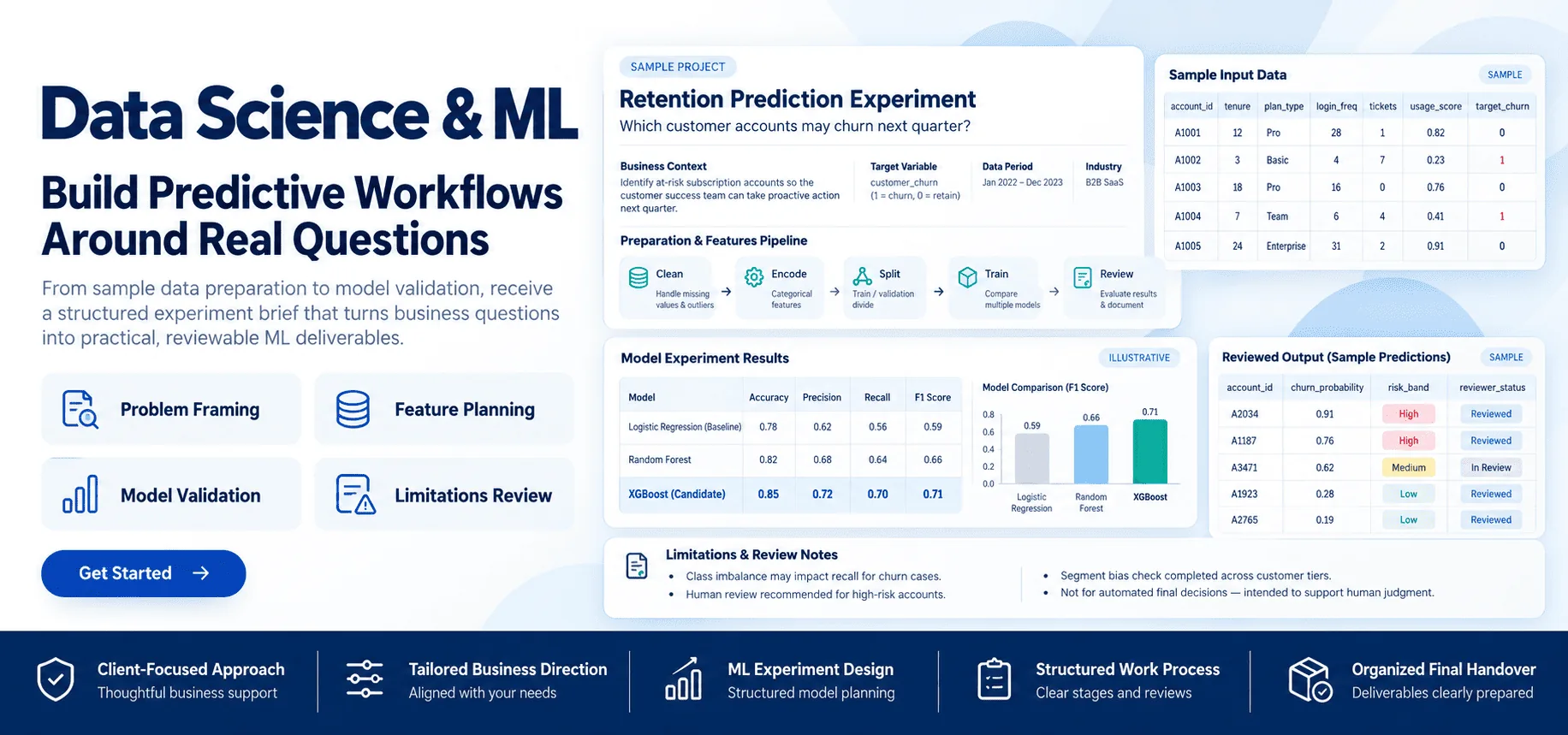
A reliable machine-learning project is not just model training. It starts by defining the prediction target and success metric, checking whether the data can support the question, establishing a simple baseline, and then comparing candidate approaches under appropriate validation. For time-dependent problems that can mean time-aware splits; for imbalanced classification it can mean precision-recall analysis and threshold review; for production use it also means reproducible preprocessing and clear handover.

What’s Included

Problem framing & data reviewClarify the target, business metric, available fields, data quality, leakage risks and modelling feasibility.
Exploration & feature engineeringProfile distributions, missingness and relationships, then create features that are appropriate for the problem and data.
Model development & validationBuild baselines, compare candidate algorithms and evaluate results using metrics that match the decision being made.
Explainability & handoverDocument important drivers, assumptions, limitations, evaluation evidence and the files your team needs to use or retrain the model.

Common Use Cases

  • Customer churn, lead scoring, propensity and conversion prediction.
  • Demand, sales, volume or capacity forecasting.
  • Risk classification, exception prioritisation and anomaly detection.
  • Customer or account segmentation for analysis and targeting.
  • Recommendation or ranking logic where the available data supports it.
  • Model evaluation, reproducibility and deployment packaging for existing ML work.

What We Need From You

Share the business objective, dataset or secure data-access method, a description of important fields, the outcome you want to predict or understand, current reporting or model logic if any, expected users of the output, preferred technology environment and any deadline or compliance constraints. If labels are missing or substantial data engineering is required, that work is scoped separately before modelling begins.

How the Delivery Works

01
Scope the objective

Define the business question, target outcome, success metric and constraints.

02
Assess the data

Review quality, labels, leakage, sample size and the work needed before modelling.

03
Build & validate

Engineer features, compare models, tune candidates and evaluate against the agreed metric.

04
Review & hand over

Quality-check results, apply included revisions and deliver code, artifacts and documentation.

Scope note: package limits assume reasonably usable structured data. Data collection, manual labelling, major data-platform work, multiple independent models, complex streaming systems and long-term MLOps are quoted separately.

Typical outputs
Code, model artifacts, evaluation notes & documentation
Suitable for
Predictive analytics, forecasting & custom ML workflows
Provided by Rudrriv
Scoped analysis or model development, quality review & delivery

Compare Packages

Choose a package based on data complexity, evaluation depth and whether you need deployment-ready packaging in addition to model development.

Included
₹9,999
Essential
Baseline Model Sprint
A focused data-science sprint for a prepared dataset, one prediction target and a validated baseline model.
₹39,999
Professional · Recommended
Predictive Model Build
A fuller predictive modelling engagement with feature engineering, tuning, explainability and reproducible handover.
₹79,999
Advanced
Production ML Delivery
A production-oriented ML delivery with deployment packaging, reproducibility, handover and retraining guidance.
Data coverage1 dataset / 1 targetUp to 3 sources / 1 targetUp to 5 sources / 1 target
Exploratory data analysis✓✓✓
Feature engineeringBasicAdvancedAdvanced
Candidate modelsUp to 23–53–5 + production selection
Cross-validation✓✓✓
Class-imbalance handlingIf needed✓✓
ExplainabilityCore feature importanceFeature importance / SHAP where suitableFeature importance / SHAP where suitable
Training codeNotebookReproducible codeReproducible code
Prediction integration—Batch inference scriptDockerised FastAPI service
Deployment assistance——1 customer-provided environment
DocumentationFindings summaryEvaluation reportModel card + retraining guide
Revision rounds123
Standard delivery5 business days10 business days15 business days
Package price

OUR WORK   /   05 REPRESENTATIVE STUDIES

Data Science & Machine Learning Portfolio

Explore five different examples of the analytical and model-development artifacts a Data Science & ML engagement can deliver—from validation and forecasting to feature design and deployment handover.

Classification evaluation

Churn propensity model review

A model-quality study with a precision–recall curve, confusion matrix, and threshold trade-offs on a synthetic holdout.

Precision–recallThreshold analysisConfusion matrix
Time-series forecasting

Weekly demand forecast

A time-aware forecast study showing observed order volume, an eight-week horizon, illustrative intervals, and backtest error.

Time-aware splitsForecast intervalsBacktesting
Feature engineering

Leakage-safe feature audit

A reproducible feature-preparation specification: missingness screening, transformation rules, target-leakage checks, and driver-review conventions.

Feature schemasLeakage controlsExplainability
Segmentation & clustering

Customer cohort discovery

An unsupervised-learning concept with distinct behavioral groups, feature-space scatter, cohort counts, and interpretation guidance.

ClusteringCohort profilingModel review
Production ML packaging

Model release & handover kit

A production-oriented model-delivery blueprint covering an inference contract, versioned artifacts, validation gates, and retraining guidance.

Inference contractReproducibilityHandover

Portfolio transparency: These five studies are representative concepts using synthetic or demonstrative data. They are not testimonials, actual client commissions, deployed production systems or claims of achieved model performance.

Need a validated model, forecast, or deployment-ready handover?Discuss a Data Science & ML project →
DATA SCIENCE & ML   /   CONCEPT STUDY

01 / 05

Frequently Asked Questions

Rudrriv provides problem framing, data review, exploratory analysis, feature engineering, model development, validation, documentation and handover according to the selected package. Production-oriented scopes can also include API packaging and deployment assistance.
Provide the datasets you want analysed, a description of each field where available, the business outcome you want to predict or improve, known data-quality issues, and any current reporting or model logic. Access credentials should be shared only through an agreed secure method.
Yes. The first step is to assess the business objective, available data, target variable, sample size, leakage risk and success criteria. If a rules-based or analytical approach is more appropriate than machine learning, the scope should reflect that rather than forcing an ML model.
This page starts at ₹9,999 for a focused baseline modelling sprint, ₹39,999 for a broader predictive model build and ₹79,999 for a production-oriented delivery. Larger datasets, labelling work, multiple models, complex integrations, cloud infrastructure or ongoing MLOps are quoted separately.
The listed packages are designed for approximately 5, 10 and 15 business days once usable data and requirements are available. Data access delays, extensive cleaning, labelling, stakeholder approvals or deployment dependencies can extend the schedule.
Depending on the problem and data, the delivery may use regression, classification, tree-based ensembles, forecasting, clustering, anomaly detection or recommendation approaches. The model family is selected based on validation results, interpretability needs, latency and operational constraints rather than preference alone.
Evaluation is tied to the use case. Depending on the task, this may include precision, recall, F1, ROC-AUC, PR-AUC, MAE, RMSE, calibration, forecast error or business-specific thresholds. Cross-validation or time-aware validation is used where appropriate, with attention to leakage and class imbalance.
Yes, the listed packages include reproducible project files appropriate to their scope. Deliverables can include notebooks or Python scripts, model artifacts, evaluation notes and documentation. The Advanced package also includes deployment packaging and retraining guidance.
The Advanced package includes assistance deploying one approved model to one customer-provided environment when the target setup is compatible with the agreed scope. Complex enterprise infrastructure, streaming systems, custom security requirements or multi-environment MLOps are scoped separately.
You receive the agreed code, model artifacts, evaluation documentation and handover guidance. Production models should be monitored for data drift, performance degradation and changing business conditions; ongoing monitoring, retraining or MLOps support can be scoped as a separate engagement.

Client Reviews

S
Sara Nasser
🇦🇪 United Arab Emirates
Machine Learning
★★★★★ 4.7   •   4 months ago

For this Machine Learning project, we needed a production-oriented predictive machine-learning model that could stand up to real operational use rather than a one-off demonstration. The team worked methodically through cross-validation, class-imbalance handling, interpretability, deployment readiness, feature engineering, and model selection. That made revisions faster because issues were isolated, documented, and resolved rather than repeatedly resurfacing. The project achieved predictions that were more stable, explainable, and practical to use in our workflow. The team also supplied training code, evaluation notes, and a clear path for retraining, so we were not left dependent on undocumented knowledge.

A
Anna Weber
🇩🇪 Germany
Machine Learning
★★★★★ 5   •   5 months ago

We chose a specialist for Machine Learning because our requirements called for a production-oriented predictive machine-learning model with measurable quality rather than a generic template. The project stayed controlled because the team treated interpretability, deployment readiness, feature engineering, model selection, cross-validation, and class-imbalance handling as core requirements, not optional polish to be added at the end. We finished the engagement with predictions that were more stable, explainable, and practical to use in our workflow. The handover of training code, evaluation notes, and a clear path for retraining was clear, complete, and more useful than a simple final file drop.

D
Daniel Brooks
🇺🇸 United States
Machine Learning
★★★★★ 5   •   3 weeks ago

Our priority in Machine Learning was reliability. The team designed a production-oriented predictive machine-learning model with that requirement visible in every stage of the project. We appreciated the discipline around feature engineering, model selection, cross-validation, class-imbalance handling, interpretability, and deployment readiness. The team kept technical detail available when we needed it, while still making review sessions understandable for business stakeholders. The project achieved predictions that were more stable, explainable, and practical to use in our workflow. The team also supplied training code, evaluation notes, and a clear path for retraining, so we were not left dependent on undocumented knowledge.

A
Amelia Turner
🇬🇧 United Kingdom
Machine Learning
★★★★★ 4.9   •   1 month ago

The scope for Machine Learning looked straightforward at first, but the underlying data issues made it more complex. The team still kept the project focused around a production-oriented predictive machine-learning model. They kept a close eye on cross-validation, class-imbalance handling, interpretability, deployment readiness, feature engineering, and model selection. Progress updates were concise, and the evidence behind important decisions was easy for us to verify. We finished the engagement with predictions that were more stable, explainable, and practical to use in our workflow. The handover of training code, evaluation notes, and a clear path for retraining was clear, complete, and more useful than a simple final file drop.

B
Benjamin Clark
🇨🇦 Canada
Machine Learning
★★★★★ 4.8   •   6 weeks ago

This was our first outsourced Machine Learning project, and we needed a production-oriented predictive machine-learning model with enough documentation for our internal team to take over confidently. A lot of value came from the attention to interpretability, deployment readiness, feature engineering, model selection, cross-validation, and class-imbalance handling. Instead of hiding uncertainty, the team documented it and showed us where additional data or different assumptions would change the result. The project achieved predictions that were more stable, explainable, and practical to use in our workflow. The team also supplied training code, evaluation notes, and a clear path for retraining, so we were not left dependent on undocumented knowledge.

M
Matilda Scott
🇦🇺 Australia
Machine Learning
★★★★★ 5   •   2 months ago

We asked the team to revisit our Machine Learning process and produce a production-oriented predictive machine-learning model; their approach was structured from discovery through final validation. The team worked methodically through feature engineering, model selection, cross-validation, class-imbalance handling, interpretability, and deployment readiness. That made revisions faster because issues were isolated, documented, and resolved rather than repeatedly resurfacing. We finished the engagement with predictions that were more stable, explainable, and practical to use in our workflow. The handover of training code, evaluation notes, and a clear path for retraining was clear, complete, and more useful than a simple final file drop.

Request a Data Science & ML Quote

Tell us what decision, prediction or analytical outcome you need, what data is available and how the result will be used. Rudrriv will review the scope and respond with the most suitable delivery approach.

Business objectiveExplain the decision, prediction, forecast or operational problem you want the project to support.
Data sources & volumeShare file types, tables, approximate row counts, history available and whether the data is already cleaned or labelled.
Target & success metricTell us what should be predicted or measured and any business threshold, accuracy goal or baseline you already use.
Current process or modelInclude existing notebooks, reports, rules, dashboards or models that the new work must replace, improve or integrate with.
Technology & deploymentNote your preferred Python stack, database, cloud provider, API needs or environment where predictions need to run.
Deadline & constraintsShare the required delivery date, stakeholder review schedule, confidentiality needs and any regulatory or operational constraints.
Helpful to include: objective, data source, target variable, approximate data volume, current tools, preferred package, deployment need and deadline. Do not send passwords or production credentials through this form.
DATA SCIENCE & ML ENQUIRY

Request a Data Science & ML Scope Assessment

Share your contact details and project requirements below. Your enquiry will be sent directly to support@rudrriv.com for review.

Please include enough detail for us to assess data readiness, modelling scope and delivery requirements. We will use your information only to respond to this enquiry.