Category Intent Architecture
Outdoor catalogue search themes mapped to durable category URLs, overlap decisions and browsing routes.

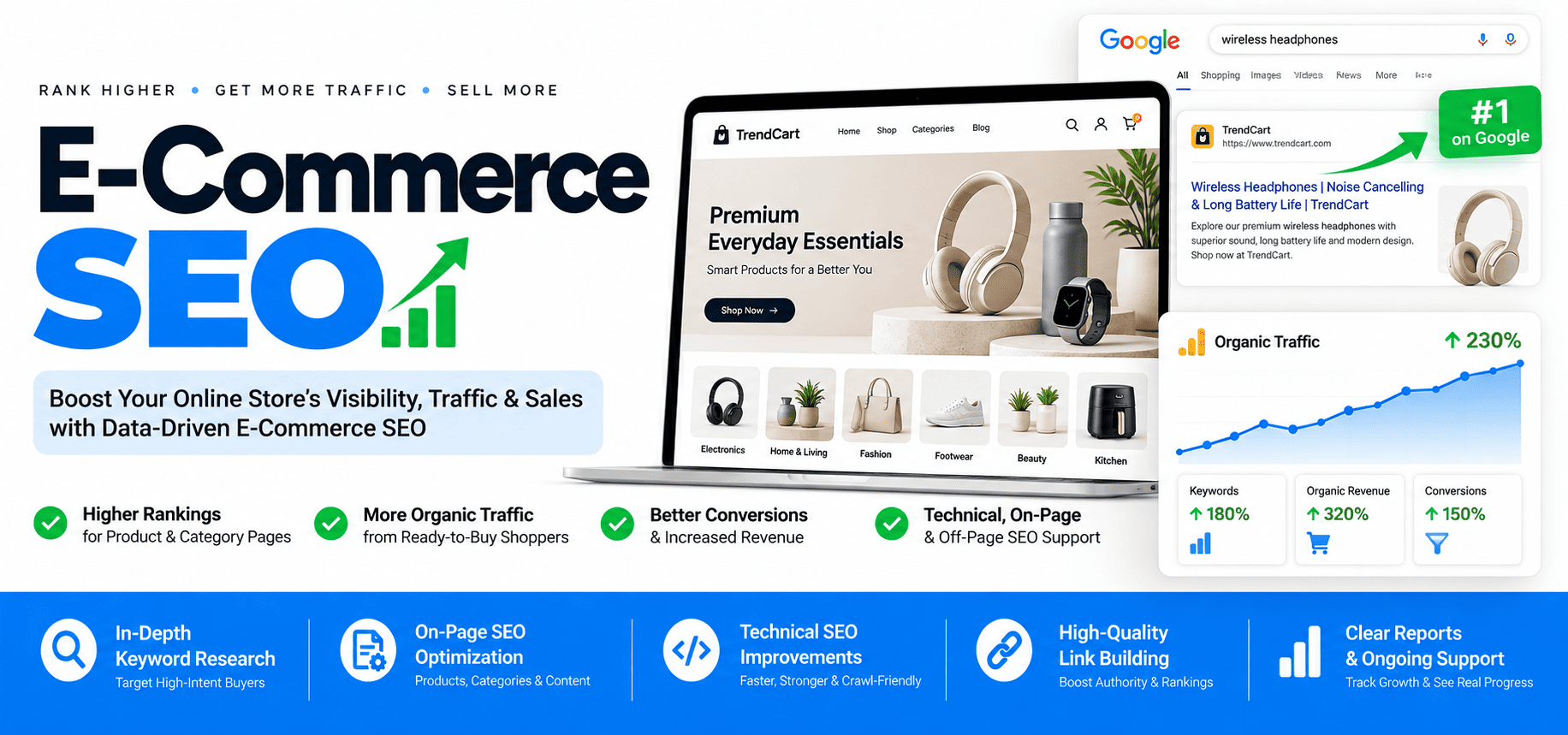
E-Commerce SEO improves the way search engines discover, interpret and rank an online store's commercial pages. Unlike a brochure website, a store may generate hundreds or thousands of category, product, variant, filter and parameter URLs. The work therefore has to connect technical crawl control with keyword mapping, category architecture, product-page quality, structured data and internal linking.
Rudrriv delivers this as a service. You share the store, business priorities and available access; Rudrriv follows the selected package workflow, checks the work against the agreed scope and delivers prioritized actions, implemented changes where access permits, and supporting documentation.
Share your store URL, ecommerce platform, approximate catalogue size, priority categories or products, target markets, business goals and known SEO issues. Access to Google Search Console, GA4, your CMS or ecommerce admin, and a development contact can make the work more actionable, but the exact access required depends on the selected scope.
We confirm goals, catalogue scope, platform constraints, access and the current crawl/indexation picture.
Commercial queries are mapped to category, collection, product and supporting pages with cannibalization risks noted.
Priority on-page and technical work is implemented where access permits or documented clearly for your development team.
We review available search and analytics signals, document completed work and define the highest-value next cycle.
The aim is to improve the store's search foundation and make commercially important pages easier to discover without creating unnecessary indexation noise. Rankings, traffic and revenue cannot be guaranteed, so recommendations are prioritized around technical evidence, search demand, catalogue structure and the business value of the pages involved.
Choose a package by the number of priority pages, keyword coverage and technical complexity that needs to be handled each month. Larger catalogues can be scoped separately.
| Included |
₹14,999per month
Essential
Store SEO Foundation
A focused monthly SEO cycle for smaller stores that need crawl, indexation and priority commercial pages cleaned up first. |
₹34,999per month
Professional Recommended
Category & Product Growth
SEO for growing stores that need category architecture, on-page execution and technical controls working together. |
₹69,999per month
Advanced
Catalogue SEO Scale
A deeper monthly programme for larger catalogues with complex filters, variants, crawl controls and broader category coverage. |
|---|---|---|---|
| Commercial keyword mapping | Up to 20 | Up to 60 | Up to 120 |
| Priority pages optimized / cycle | 5 | 15 | 30 |
| Technical crawl & indexation audit | ✓ | ✓ | ✓ |
| Category architecture review | Focused | Full | Advanced |
| Faceted navigation / crawl controls | — | ✓ | ✓ |
| Product & breadcrumb schema | Review | Implementation support | Template QA + support |
| Internal-link improvements | Priority pages | Expanded | Scaled plan |
| Search-led content briefs | 1 | 2 | 4 |
| Search Console / GA4 review | ✓ | ✓ | ✓ |
| Implementation review rounds | 1 | 2 | 2 |
| Service cycle | 30 days | 30 days | 30 days |
| Monthly price | ₹14,999 |
₹34,999 |
₹69,999 |
Explore five original, representative examples of deliverables for product and collection discoverability. These are concept samples, not verified client engagements or live platform results.
Outdoor catalogue search themes mapped to durable category URLs, overlap decisions and browsing routes.
A decision matrix for filters, sort parameters and landing-page candidates—without blocking shopping UX.
Search-led title, H1, meta description and collection copy guidance designed around real shopping intent.
Illustrative Product/Offer JSON-LD and an implementation checklist for visible-content parity and testing.
A prioritized internal-link map joining shop navigation, collection pages, buying guides and products.
E-Commerce SEO is the process of improving an online store so search engines can efficiently crawl, understand and rank its category, collection, product and supporting content pages for relevant shopping searches. It combines technical SEO, store architecture, on-page optimization, structured data, internal linking and measurement.
Online stores create SEO challenges that ordinary brochure sites often do not have, including large product catalogues, variants, filters, parameter URLs, out-of-stock products, duplicated manufacturer content and constantly changing inventory. E-Commerce SEO addresses those store-specific issues while prioritizing pages with commercial search intent.
The service can be scoped for Shopify, WooCommerce, Magento, BigCommerce and custom ecommerce platforms when the required data and administrative or developer access are available. The exact implementation path depends on the platform, theme, apps, extensions and technical constraints.
Please share the store URL, ecommerce platform, approximate product and category count, target countries or regions, priority products or categories, known SEO problems, recent migrations or redesigns, and access to relevant tools such as Google Search Console and GA4 where available.
Both can be included. Priority usually depends on search demand, current rankings, catalogue structure and business value. Category and collection pages often target broader commercial queries, while product pages are optimized for specific product and transactional searches.
Rudrriv reviews how filters, sorting options and parameters create crawlable URLs, then recommends or implements appropriate controls based on the platform. The goal is to keep useful shopping filters available to users while reducing duplicate, thin or low-value URLs that can create indexation and crawl inefficiency.
Product and breadcrumb structured data are reviewed in every package, with implementation support increasing by package. Where relevant, we check whether key properties such as product identity, offers, availability and breadcrumbs are represented correctly and whether the markup matches visible page content.
SEO does not have a guaranteed ranking timeline. Technical fixes can improve crawling or indexation relatively quickly, while meaningful ranking and traffic changes often require several months because results depend on competition, site authority, catalogue quality, implementation speed and search-engine reprocessing.
No. Search rankings and organic revenue are influenced by search engines, competitors, demand, site quality and many factors outside any provider's control. Rudrriv focuses on a documented, prioritized SEO process and reports the evidence available rather than promising specific positions or sales.
The listed packages include search-led content briefs and on-page copy recommendations according to scope. Full-scale article production, digital PR, outreach or link-acquisition work is not automatically included and can be scoped separately when appropriate.
The correct treatment depends on whether a product will return, has a close replacement, carries backlinks or still attracts demand. The service can define rules for temporary out-of-stock products, permanently discontinued products, redirects, canonicalization and internal links so valuable signals are not discarded unnecessarily.
We needed help with E-commerce SEO that could bridge strategy and execution. The team delivered an organic-search plan for category, collection, and product pages across a growing online store, paying careful attention to faceted navigation, category architecture, product schema, and internal linking. They were responsive, but the real value came from the way they clarified why certain actions should happen before others. That sequencing made the plan much easier to implement. The engagement ended with a clear benefit: more commercially important store pages became discoverable without creating unnecessary indexation noise. Files, notes, and next steps were all handed over in a usable format, which made internal adoption straightforward.
The team handled our E-commerce SEO engagement with a level of detail that was useful without being overwhelming. They built an organic-search plan for category, collection, and product pages across a growing online store around product schema, internal linking, collection copy, and technical crawl controls and consistently connected tactical decisions back to the objective. When feedback introduced conflicting priorities, they highlighted the tradeoff instead of trying to satisfy both directions at once. That kept the work coherent. By completion, more commercially important store pages became discoverable without creating unnecessary indexation noise. We appreciated the professional communication and the fact that the final deliverables were designed for ongoing use, not just presentation.
We selected the team for E-commerce SEO because we needed a clearer operating approach, not just more activity. They created an organic-search plan for category, collection, and product pages across a growing online store and worked through faceted navigation, category architecture, product schema, internal linking, collection copy, and technical crawl controls with a strong focus on practical decisions. Progress was visible throughout the project, open questions were captured properly, and revisions improved the work without restarting it. The strongest outcome was that more commercially important store pages became discoverable without creating unnecessary indexation noise. The project gave us both a finished deliverable and a better way to think about future optimization.
Share your store, platform, catalogue size and search priorities. Rudrriv will assess the requirements and recommend the most appropriate package or custom scope.