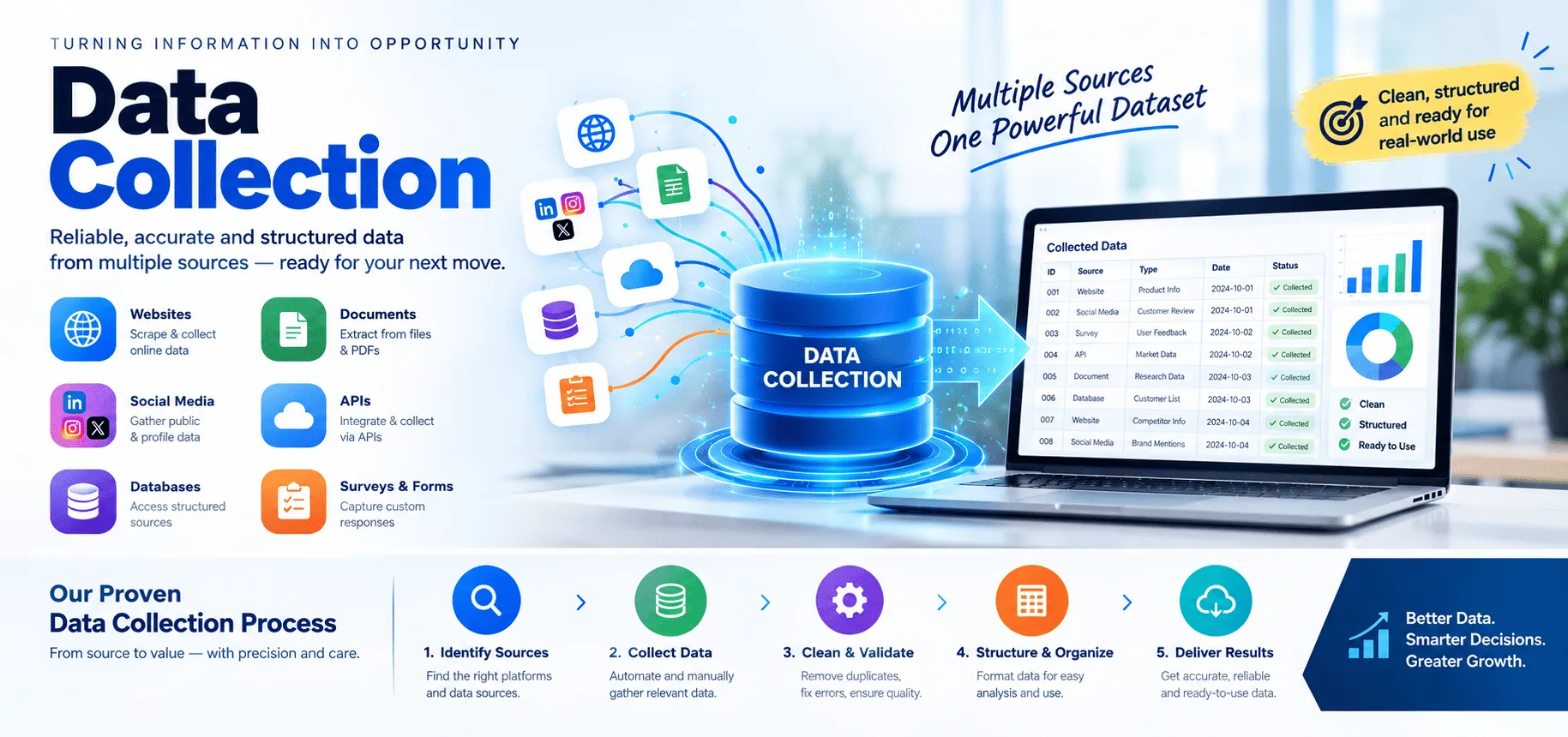
We provide Data Collection Services for Clean, Usable Datasets

Seller
Rudrriv Technologies
★★★★★4.9 (3,657 reviews)
✓Share the target fields and approved sources. We provide structured data collection, validation, quality review and final dataset delivery.
✦Data Collection Service Highlights
  • Structured data gathering from approved public, document-based, or client-provided sources.
  • Field mapping, formatting, duplicate checks, source traceability, and validation matched to your brief.
  • Useful for business research, market monitoring, product data, company lists, operational datasets, and research support.
  • Final delivery in XLSX or CSV for the standard packages, with custom formats scoped when needed.
  • Entry package from ₹999 for a clearly defined small dataset; complex survey, field, sensitive-data, or recurring work is quoted separately.

What Clients Appreciate

J
Jasmine Koh🇸🇬 Singapore
★ 4.8 / 5
We needed more than a proof of concept for Data Entry; we needed something our team could actually continue using. Throughout the engagement, they were methodical about field accuracy, standardized values, duplicate checks, validation rules, turnaround, and auditability, and revisions were incorporated without introducing new inconsistencies. We ultimately achieved clean operational records that our team could use immediately without another correction pass. The team also left us with completed records, exception notes, validation results, and organized source references, which gave us confidence in maintaining the solution.
Service: Data Entry
6 weeks ago

About This Data Collection Service

Research and data gathering built around your fields, sources, and business use

Data collection is the structured process of gathering information from defined sources and organizing it into a dataset that can actually be reviewed, imported, compared, or used by a business team. Rudrriv provides data collection from requirements through delivery using the agreed collection rules, field definitions, quality checks and handoff.

This service is designed for teams that need usable records rather than an unstructured copy-paste dump. A project may involve company information, product and pricing data, public records, market intelligence, directory research, document-based data, survey-response structuring, or other business information available through approved sources.

What's included
  • Requirement and schema review: define the target record, required fields, acceptable values, source rules, and output structure before collection begins.
  • Source assessment: identify or confirm lawful, accessible sources that match the brief and flag feasibility issues before large-scale collection.
  • Structured collection: gather information consistently using the agreed columns, naming conventions, categories, and inclusion criteria.
  • Source traceability: retain source URLs or source references where applicable so records can be reviewed and audited.
  • Data quality controls: check duplicates, missing required fields, inconsistent formats, and obvious value problems within the agreed scope.
  • Standardization: normalize fields such as dates, categories, locations, URLs, units, or text formatting when the package includes it.
  • Exception handling: document records that cannot be completed confidently instead of silently inventing or forcing uncertain values.
  • Final dataset delivery: provide the completed records and agreed supporting notes in XLSX or CSV for standard packages.
What we need from you

Share the purpose of the dataset, the type of record you need, required fields, preferred or prohibited sources, geography or date range, target volume, output format, validation rules, and deadline. If you already have a template or sample row, include it so the team can match your intended structure from the beginning.

How the collection process works
01
Define the dataset

We confirm fields, record criteria, source rules, volume, format, and quality expectations.

02
Assess sources

Approved sources are reviewed for accessibility, consistency, coverage, and collection feasibility.

03
Collect & structure

Records are gathered to the agreed schema with standardized fields and source references where applicable.

04
Validate & deliver

Duplicates, required fields, formatting, and exceptions are reviewed before the final file is handed over.

Scope boundaries and responsible collection
Standard packages are intended for structured online or document-based collection from lawful, approved sources. Projects involving respondent recruitment, primary fieldwork, paid data access, private or sensitive information, login-protected systems, large automated scraping pipelines, or regulated datasets require a separate feasibility and compliance review before scope is confirmed.
Typical source types
Public websites
directories & portals
documents and client-supplied sources
Common use cases
Market research
company & product data
operational and research datasets
Standard delivery
XLSX and CSV
source references
validation / exception notes as scoped

Compare Data Collection Packages

Choose a package based on expected record volume, number of fields, source complexity, validation depth, and the documentation you need with the final dataset.

Included
₹999
Essential
Targeted Data Collection
A focused dataset for a clearly defined list, research task, or small public-source collection.
₹2,499
Professional Recommended
Business Dataset Build
A structured multi-source dataset with broader fields, validation, and traceable source references.
₹4,999
Advanced
Multi-Source Research Dataset
A deeper collection project for larger coverage, more fields, and documented quality controls.
Record volumeUp to 100Up to 300Up to 750
Defined fieldsUp to 5Up to 8Up to 12
Source scopeFocusedMultiple approved sourcesMulti-source research
Source references✓✓✓
Deduplication✓✓✓
Field standardizationBasicIncludedIncluded
Validation passBasic✓✓
Exception / missing-field notes—✓✓
Documented collection rules——✓
Revision rounds122
Standard delivery2 business days4 business days6 business days
Final file setXLSX or CSVXLSX + CSVXLSX + CSV
Package price
₹999
₹2,499
₹4,999

SELECTED CAPABILITIES 05 CONCEPT SAMPLES

Data collection portfolio examples

A closer look at the source registers, capture sheets and review-ready datasets clients can request. These are original representative concepts with entirely synthetic data—not completed client projects or live collections.

01 / 05BUSINESS DIRECTORY COLLECTION

Company directory · research register

An auditable company-record grid with defined fields, source IDs, review dates and documented exceptions.

Field mappingSource referencesQA flags

02 / 05PRODUCT & PRICING COLLECTION

Retail offers · evidence log

Like-for-like offer capture showing product matches, pack sizes, unit prices and observation dates.

Product matchingPrice captureUnits & dates
03 / 05DOCUMENT-BASED DATA COLLECTION

Public notices · capture ledger

An annotated mock document linked to structured fields, exact page references and unresolved items.

Document fieldsPage traceabilityExceptions
04 / 05LOCATION DATA COLLECTION

Facility directory · coverage sheet

A directory-building worksheet tracking required public facility attributes and source coverage by area.

Location fieldsSource coverageMissing values
05 / 05RECURRING DATA COLLECTION

Catalog refresh · change register

Two representative collection snapshots with field-level deltas, review holds and unchanged-record tracking.

Snapshot rulesChange logReview queue
Need a dataset with defined sources and fields?Share your record type, source rules and preferred file format.
Discuss a collection brief

DATA COLLECTION · CONCEPT

Portfolio sample

Enlarged synthetic data collection artifact

Sample description

01 / 05

Portfolio illustration only · synthetic records and reference IDs · not real client data

Frequently Asked Questions About Data Collection

Rudrriv provides structured data gathering from approved public websites, directories, documents, portals and client-provided sources. The service can include field mapping, source tracking, deduplication, standardization, basic validation, exception notes and delivery in a structured file.
Share the business objective, target record type, required fields, preferred or prohibited sources, geography or date range, expected volume, output format, validation rules and deadline. A sample record or existing spreadsheet template is especially useful.
Source selection depends on the project. Typical sources include public websites, business directories, public records, documents, product pages, reports and customer-provided source lists. Collection is scoped around sources that are lawful, accessible and appropriate for the intended use.
The service is intended for lawful, authorized data collection. Rudrriv does not use the service to bypass access controls, obtain private or restricted information, or ignore applicable privacy, platform or source-use requirements. Projects involving sensitive data require appropriate permissions and a custom scope.
Quality control can include required-field checks, duplicate detection, format and value standardization, source-link review, consistency checks and a documented exception list. The exact validation rules are agreed from the fields and use case in your brief.
Standard online data collection packages on this page start at ₹999 for a small, clearly defined dataset. Larger volumes, complex sources, recurring refreshes, respondent recruitment, surveys or field collection are scoped separately because effort depends on access, geography, methodology and quality requirements.
The standard packages are planned for approximately 2 to 6 business days depending on volume and source complexity. Large, multi-source, survey, field or recurring projects receive a separate timeline after feasibility and scope review.
Standard package delivery is available in XLSX and CSV. Where a different structure such as JSON, a database import template or a client-specific schema is needed, include that requirement in the brief so it can be confirmed during scoping.
Yes, recurring collection can be scoped for datasets that need periodic updates. The team first defines the source set, fields, refresh frequency, duplicate handling and change rules so each cycle can be compared and quality-checked consistently.
Data collection focuses on finding or gathering the required information from defined sources. Data entry focuses on entering, transcribing or transferring information that already exists into a target system or format. Many projects use both, but the scope and quality checks should be defined separately.

Client Reviews from Related Data Work

The reviews below are displayed exactly from the customer feedback supplied for this page. The supplied service label for these engagements is Data Entry.

SA
Samir Aziz
🇦🇪 United Arab Emirates
Data Entry
★ 5 / 5   •   2 months ago

This was our first outsourced Data Entry project, and we needed a high-volume structured data-entry project with enough documentation for our internal team to take over confidently. The project stayed controlled because the team treated duplicate checks, validation rules, turnaround, auditability, field accuracy, and standardized values as core requirements, not optional polish to be added at the end. The delivered solution resulted in clean operational records that our team could use immediately without another correction pass. Having completed records, exception notes, validation results, and organized source references alongside it reduced follow-up questions and made ownership transfer simple.

MR
Mia Richter
🇩🇪 Germany
Data Entry
★ 4.9 / 5   •   3 months ago

We asked the team to revisit our Data Entry process and produce a high-volume structured data-entry project; their approach was structured from discovery through final validation. We appreciated the discipline around turnaround, auditability, field accuracy, standardized values, duplicate checks, and validation rules. The team kept technical detail available when we needed it, while still making review sessions understandable for business stakeholders. By delivery, we had clean operational records that our team could use immediately without another correction pass. The accompanying completed records, exception notes, validation results, and organized source references were well organized and gave our team a solid basis for future updates.

SD
Sophie de Vries
🇳🇱 Netherlands
Data Entry
★ 4.7 / 5   •   4 months ago

Our previous approach to Data Entry was producing inconsistent results, so we asked the team to build a high-volume structured data-entry project with stronger controls. They kept a close eye on field accuracy, standardized values, duplicate checks, validation rules, turnaround, and auditability. Progress updates were concise, and the evidence behind important decisions was easy for us to verify. The delivered solution resulted in clean operational records that our team could use immediately without another correction pass. Having completed records, exception notes, validation results, and organized source references alongside it reduced follow-up questions and made ownership transfer simple.

AR
Ananya Rao
🇮🇳 India
Data Entry
★ 5 / 5   •   5 months ago

We engaged the team on Data Entry to create a high-volume structured data-entry project, and they were careful not to overcomplicate the solution. A lot of value came from the attention to duplicate checks, validation rules, turnaround, auditability, field accuracy, and standardized values. Instead of hiding uncertainty, the team documented it and showed us where additional data or different assumptions would change the result. By delivery, we had clean operational records that our team could use immediately without another correction pass. The accompanying completed records, exception notes, validation results, and organized source references were well organized and gave our team a solid basis for future updates.

CA
Chloe Anderson
🇨🇦 Canada
Data Entry
★ 5 / 5   •   3 weeks ago

The Data Entry assignment involved several dependencies, but the team organized the work around a high-volume structured data-entry project and kept each milestone reviewable. The team worked methodically through turnaround, auditability, field accuracy, standardized values, duplicate checks, and validation rules. That made revisions faster because issues were isolated, documented, and resolved rather than repeatedly resurfacing. The delivered solution resulted in clean operational records that our team could use immediately without another correction pass. Having completed records, exception notes, validation results, and organized source references alongside it reduced follow-up questions and made ownership transfer simple.

HC
Henry Cooper
🇦🇺 Australia
Data Entry
★ 4.9 / 5   •   1 month ago

We hired the team for Data Entry with a clear objective: deliver a high-volume structured data-entry project without creating a solution that was too fragile to maintain. The project stayed controlled because the team treated field accuracy, standardized values, duplicate checks, validation rules, turnaround, and auditability as core requirements, not optional polish to be added at the end. By delivery, we had clean operational records that our team could use immediately without another correction pass. The accompanying completed records, exception notes, validation results, and organized source references were well organized and gave our team a solid basis for future updates.

Request a Data Collection Quote

Tell us what information you need, where it can be sourced, how the final dataset should be structured, and when you need it. Rudrriv will assess the scope and respond with the most suitable package or custom plan.

Dataset objective & record typeDescribe what the dataset will support and what one completed record should represent.
Required fields & schemaList the columns, value formats, mandatory fields, categories, and any example row or template we should follow.
Sources, geography & date rangeShare preferred or prohibited sources, target locations, industries, periods, or any access constraints that affect collection.
Volume & quality rulesInclude expected record count, duplicate handling, missing-field rules, validation requirements, and source-traceability needs.
Output format & deadlineSpecify XLSX, CSV or another required structure, plus the delivery date and whether the work is one-time or recurring.
Helpful to include: a sample source, sample record, existing spreadsheet, inclusion/exclusion rules, required fields, estimated volume, target geography, validation expectations, preferred package, and deadline.
DATA COLLECTION ENQUIRY

Request a Data Collection Assessment

Share your contact details and collection requirements below. Your enquiry will be sent directly to support@rudrriv.com for review.

Please include enough detail for us to assess source feasibility, collection effort, quality controls, and delivery timing. We will use your information only to respond to this enquiry.