
LLM ADAPTATION
Support Response Adapter
A policy-grounded response specification with a model-adaptation brief, controlled sample reply and human-review rubric.

For startups, product teams, data teams and businesses that need a generative model they can evaluate and hand over—not just an AI demo. Rudrriv provides model selection, data preparation, technical execution, quality review and delivery around your use case.
This supplied testimonial relates to Rudrriv's Time Series Analysis service and is presented as broader Data Services delivery feedback, not as a Generative Models review.
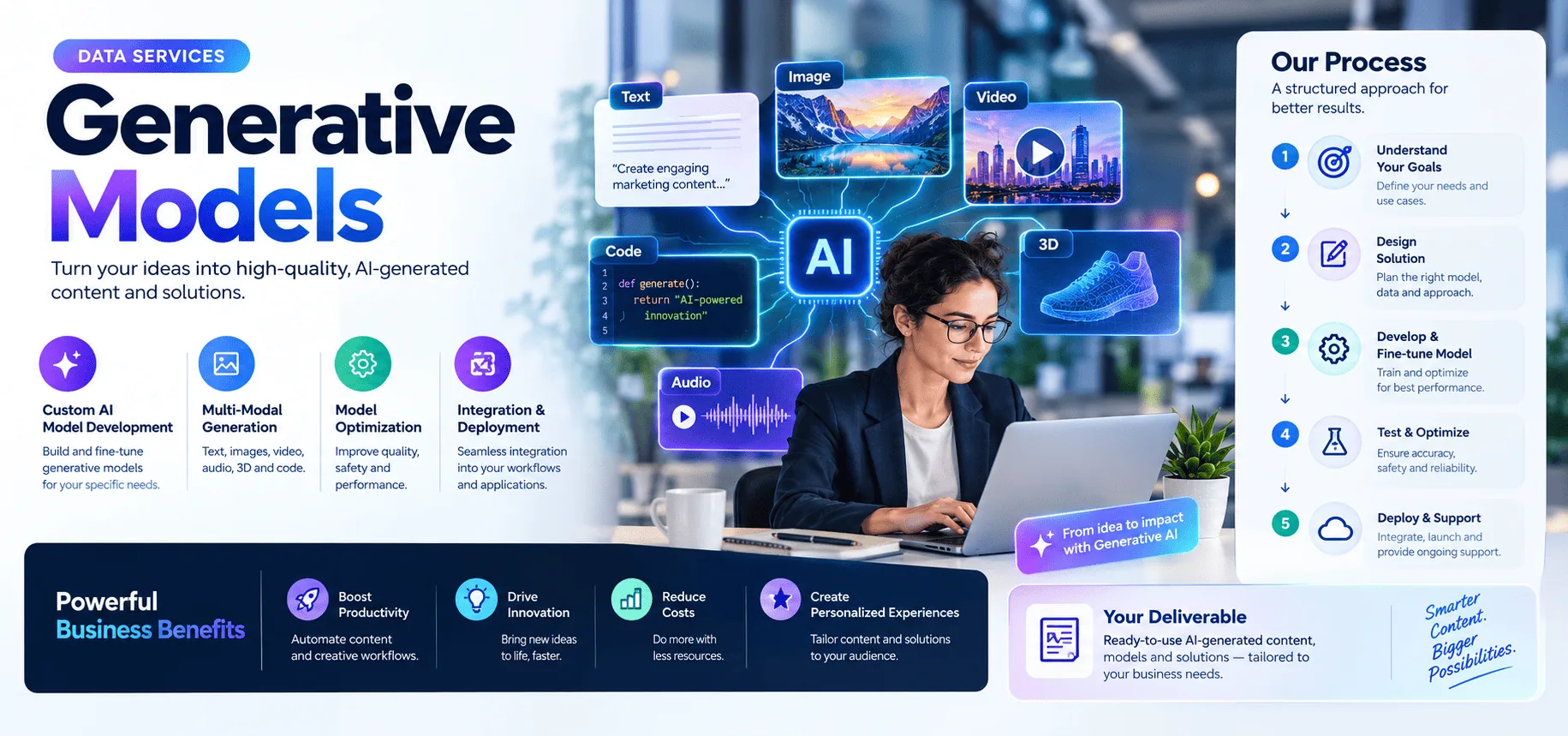
Generative models create new outputs from patterns learned in data. Depending on the task, that can mean text, images, code, audio, structured records, embeddings or domain-specific synthetic examples. A professional implementation is not just a model call: it requires a defined target behaviour, suitable data, an appropriate model family, evaluation criteria, reproducible inference and clear limits.
Rudrriv provides the service from requirements through handover. The delivery approach can assess whether your goal is best met with a foundation model, fine-tuning, retrieval, a diffusion workflow, a GAN or VAE, or a narrower generative architecture. The objective is to use the smallest technically sound approach that meets the business requirement rather than forcing expensive custom training where it is unnecessary.
Share the business objective, examples of desired and unacceptable outputs, the data you are authorized to use, expected users or systems, preferred deployment environment, latency or cost constraints, and any privacy, security, licensing or compliance requirements. If you already have a model, notebook, prompt workflow or evaluation set, include it so the team can avoid unnecessary rework.
We translate the business use case into inputs, expected outputs, constraints and measurable acceptance criteria.
Rudrriv reviews data readiness, candidate models, licensing, compute needs and the best adaptation pathway.
We create the agreed baseline or prototype, run evaluation cases, document failures and refine within the selected scope.
You receive the agreed code, model artifacts, evaluation results, documentation and deployment guidance for your package.
Generative-model projects are shaped by more than model accuracy. Dataset rights, output safety, model licensing, inference cost, latency, hardware availability, data residency and the ability to reproduce a result can all change the recommended architecture. A production-facing model should also have clear fallback behaviour, versioning and an evaluation set that can be rerun after updates.
OUR WORK · FIVE CONCEPT SAMPLES
Explore five distinct, representative examples of the model design, evaluation and handover artifacts that can be scoped through Rudrriv's Generative Models service. These are original design studies—not client commissions or verified model results.
A policy-grounded response specification with a model-adaptation brief, controlled sample reply and human-review rubric.
An image-generation direction sheet defining what a conditioned model should keep fixed and which visual attributes may vary.
Synthetic order rows with declared fields, exact validation rules and distribution counts computed from a toy dataset.
A constrained code-generation example with typed interface, deterministic reference function and explicit edge-case tests.
A proposed versioned inference pathway linking guardrails, API response structure, holdout checks and rollback planning.
Concept-only artwork using fictional instructions, authored example code and synthetic data. No actual client engagement, trained model, benchmark or deployed service is claimed.
Discuss your Generative Models project ↗Choose a package by project maturity. Essential validates one use case and establishes a baseline; Professional creates an adapted prototype; Advanced adds deeper comparison, API packaging and deployment-ready handoff.
| Included | ₹14,999 Essential Baseline Generative Model SprintFor validating a focused use case before investing in deeper adaptation. |
₹49,999 Professional Recommended Custom Model PrototypeFor teams that need a working adapted model and measured prototype results. |
₹99,999 Advanced Deployment-Ready Model BuildFor a deeper build that needs optimization, API packaging and technical handover. |
|---|---|---|---|
| Primary use cases | 1 | 1 | Up to 2 related flows |
| Candidate model review | ✓ | ✓ | Up to 2 baselines compared |
| Data-readiness / preprocessing | Representative sample | Agreed prototype dataset | Expanded agreed dataset scope |
| Baseline model / inference workflow | ✓ | ✓ | ✓ |
| Fine-tuning or model adaptation | — | ✓ | ✓ |
| Holdout evaluation | Checklist + baseline | Task-specific metrics | Metrics + regression cases |
| Reproducible source code / notebook | ✓ | ✓ | ✓ |
| Model card / limitation notes | Concise | Detailed | Detailed + operational notes |
| API packaging | — | Demo inference | FastAPI or equivalent |
| Docker / deployment configuration | — | — | ✓ |
| Revision rounds | 1 | 2 | 3 |
| Standard delivery | 5 working days | 10 working days | 15 working days |
| Post-handover clarification | 3 days | 7 days | 14 days |
| Package price | ₹14,999 |
₹49,999 |
₹99,999 |
Package prices cover the stated service scope. Third-party API charges, paid datasets, cloud infrastructure, dedicated GPU compute and enterprise platform fees are not assumed to be included unless they are explicitly listed in the final scope.
Adapt a model for structured drafting, classification-plus-generation, domain terminology, response formats or other repeatable text tasks.
Prototype text-to-image, image-to-image or conditioned generation where visual consistency, prompt controls and evaluation are defined up front.
Create representative test or augmentation data with schema constraints, distribution checks and clear separation from sensitive production records.
Evaluate or adapt a model for constrained code, configuration or transformation tasks with executable test cases and failure review.
Scope workflows that combine text, images or structured inputs where the model must preserve context across more than one modality.
Turn an experimental model into a reproducible package with versioned tests, inference code, documentation and operational handoff.
The supplied customer reviews below are specifically for Rudrriv's Time Series Analysis service. They are retained exactly as provided and shown as Data Services delivery feedback; they are not represented as reviews of Generative Models work.
We asked the team to revisit our Time Series Analysis process and produce a forecasting and time-series analysis model; their approach was structured from discovery through final validation. The team worked methodically through seasonality, missing-period handling, anomaly treatment, backtesting, and confidence intervals. That made revisions faster because issues were isolated, documented, and resolved rather than repeatedly resurfacing. The project achieved forecasts we could use with greater confidence for planning and capacity decisions. The team also supplied forecast code, backtest results, assumptions, and a repeatable update process, so we were not left dependent on undocumented knowledge.
Our previous approach to Time Series Analysis was producing inconsistent results, so we asked the team to build a forecasting and time-series analysis model with stronger controls. The project stayed controlled because the team treated anomaly treatment, backtesting, confidence intervals, trend decomposition, and seasonality as core requirements, not optional polish to be added at the end. We finished the engagement with forecasts we could use with greater confidence for planning and capacity decisions. The handover of forecast code, backtest results, assumptions, and a repeatable update process was clear, complete, and more useful than a simple final file drop.
We engaged the team on Time Series Analysis to create a forecasting and time-series analysis model, and they were careful not to overcomplicate the solution. We appreciated the discipline around confidence intervals, trend decomposition, seasonality, missing-period handling, and anomaly treatment. The team kept technical detail available when we needed it, while still making review sessions understandable for business stakeholders. The project achieved forecasts we could use with greater confidence for planning and capacity decisions. The team also supplied forecast code, backtest results, assumptions, and a repeatable update process, so we were not left dependent on undocumented knowledge.
Tell us what the model must generate, the data and systems available, how quality will be judged, and where the solution needs to run. Rudrriv will review the brief and recommend a package or custom scope.