
BRANDED LAUNCH STOREFRONT
Morrow Home — Curated Living
Shopify-style storefront concept with an editorial homepage, organized collections and shoppable product discovery.

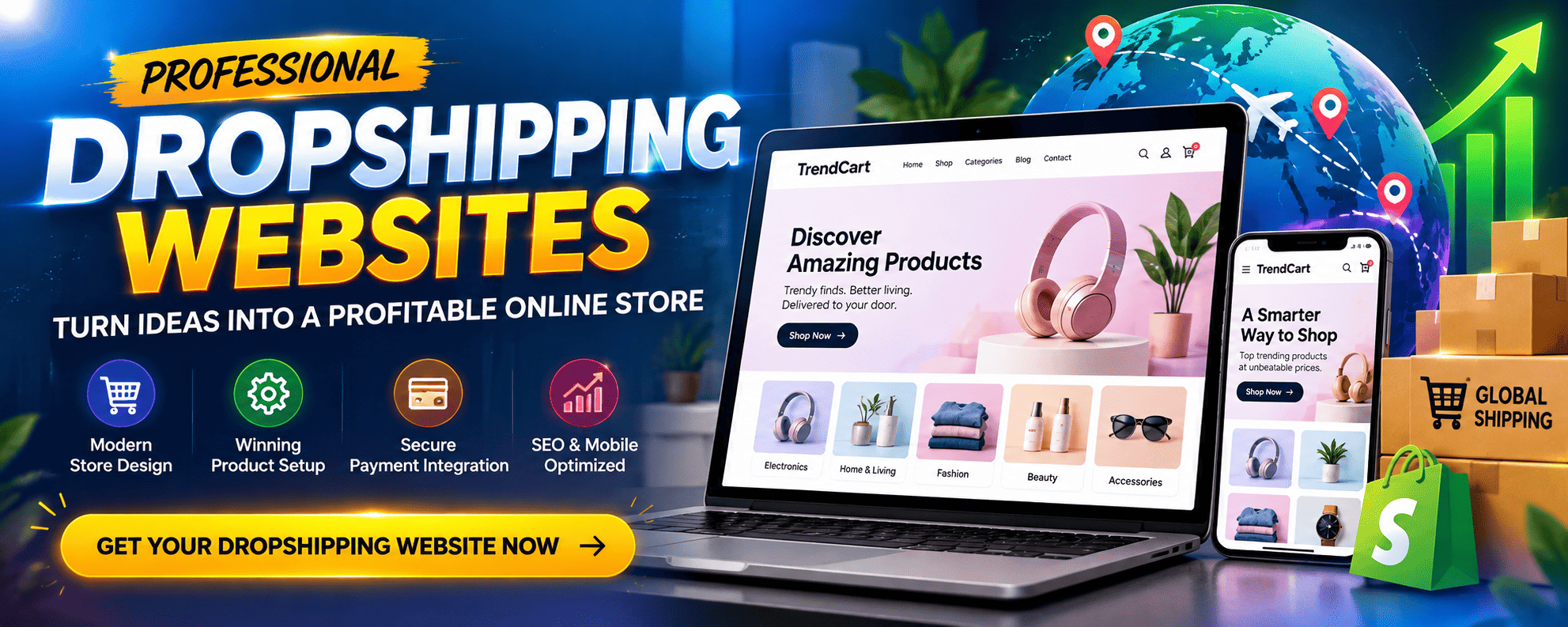
A dropshipping website is an ecommerce storefront where the seller can list products without holding every item in its own warehouse. The store takes the customer order while a supplier or fulfillment partner handles stock and shipment. The website therefore has to connect the customer-facing experience with the supplier workflow behind it.
Rudrriv provides dropshipping website development as a clearly scoped service. After the brief is confirmed, Rudrriv builds the storefront, completes the agreed integrations and QA checks, reviews the implementation and delivers the agreed store setup.
It is suitable for founders testing a niche, existing retailers adding a dropship catalog, businesses replacing a manually assembled store, and teams that need a clearer multi-supplier operating setup. The scope can be kept lean for an initial product test or expanded where catalog size, supplier count and automation requirements justify it.
Share your preferred platform or existing store access, supplier or dropshipping app details, product source, brand assets, domain information, target countries, payment and shipping preferences, required policy text, reference stores and launch deadline. If a supplier uses a custom API, ERP, private feed or undocumented workflow, include those technical details so the integration can be assessed before scope is confirmed.
Rudrriv reviews platform, products, supplier method, automation needs, target market, payment, shipping and launch requirements.
The service team configures theme sections, navigation, collections, product templates and package-specific catalog content.
Supported supplier integrations, pricing rules, inventory behavior, checkout and order-routing steps are configured and tested.
Rudrriv reviews the agreed scope, applies included revisions, checks launch-critical flows and prepares the store for handover.
A store build does not guarantee sales, product quality or supplier performance. Paid platform plans, domains, hosting, themes, apps, plugins, supplier charges, transaction fees and ad spend are separate unless a written scope says otherwise. Custom APIs, advanced ERP work, bespoke apps, extensive copywriting, product sourcing and ongoing store management can be quoted separately.
Choose the package by catalog size, supplier complexity and the depth of storefront customization you need. Paid third-party platform or app fees are separate.
| Included | ₹5,999 Essential Launch Store SetupFor a new store using one supported supplier workflow and a smaller catalog. |
₹14,999 Professional Recommended Conversion-Ready StoreFor a branded launch with a larger catalog, deeper automation and stronger QA. |
₹29,999 Advanced Multi-Supplier Growth StoreFor broader catalogs, multiple supported suppliers and a more complete operational setup. |
|---|---|---|---|
| Product imports | Up to 10 | Up to 30 | Up to 75 |
| Supported supplier integrations | 1 | Up to 2 | Up to 3 |
| Responsive theme setup | ✓ | ✓ | ✓ |
| Collection / category structure | ✓ | ✓ | ✓ |
| Pricing rules | Basic | Expanded | Expanded |
| Inventory sync rules | Where supported | Where supported | Multi-supplier where supported |
| Order-routing validation | ✓ | ✓ | ✓ |
| Custom theme sections | — | Limited | Included within scope |
| Revision rounds | 2 | 3 | 4 |
| Post-launch configuration support | 3 days | 7 days | 14 days |
| Standard delivery | 6 business days | 10 business days | 15 business days |
| Package price | ₹5,999 | ₹14,999 | ₹29,999 |
Five original, representative design concepts illustrating the storefront, catalog, supplier and checkout work that can be scoped into a dropshipping website build. These are not delivered client projects or live integrations.
Shopify-style storefront concept with an editorial homepage, organized collections and shoppable product discovery.
WooCommerce-ready product view with configurable options, supplier-fulfilled notices and conversion-focused cart entry.
A supplier onboarding view that makes product fields, margin logic and missing stock values reviewable.
Item-level supplier handoff concept covering order eligibility, split routing and unresolved fulfillment cases.
Three connected mobile shopping screens for collection browsing, product choice and shipping configuration.
We engaged the team for Dropshipping Websites with a tight set of requirements and very little room for disruption to our existing workflow. Their job was to produce a dropshipping storefront ready for launch, and they handled both the visible work and the less obvious technical details behind it. The quality showed most clearly in the way they handled supplier integration, product import structure, pricing rules, checkout experience, order routing, and mobile conversion. Their communication was practical and specific, which made technical decisions much easier for our non-technical stakeholders. The completed work gave us a store that was easier to operate and ready to test products without manual setup. There were no surprises at handoff, and the system behaved the way it had during review.
This Dropshipping Websites project started with a short list of problems, but the team helped us see the dependencies between them. We asked for a dropshipping storefront ready for launch, and the implementation was broken down in a way that made each stage easy to validate. We were particularly happy with the attention to supplier integration, product import structure, pricing rules, checkout experience, order routing, and mobile conversion. We never had to chase for status; blockers and decisions were raised early enough for us to respond. By launch, we had a store that was easier to operate and ready to test products without manual setup. The engagement saved us several rounds of trial and error and gave us a cleaner baseline for future work.
We approached this Dropshipping Websites project with a working system already in place, which meant changes had to be made carefully. The core of the engagement was a dropshipping storefront ready for launch, and the team avoided distracting us with features that were outside the goal. The team made strong decisions around supplier integration, product import structure, pricing rules, checkout experience, order routing, and mobile conversion and explained the reasoning when we asked. They responded quickly to comments and were equally comfortable saying when a requested change would create a new problem. The final result was a store that was easier to operate and ready to test products without manual setup. There were no surprises at handoff, and the system behaved the way it had during review.
Share the store platform, supplier workflow, catalog size, target market and launch requirements. Rudrriv will assess the implementation scope and respond with the most suitable package or custom plan.