
PCB defect inspection
Fine-grained surface and component review with region annotations and a human approval queue.

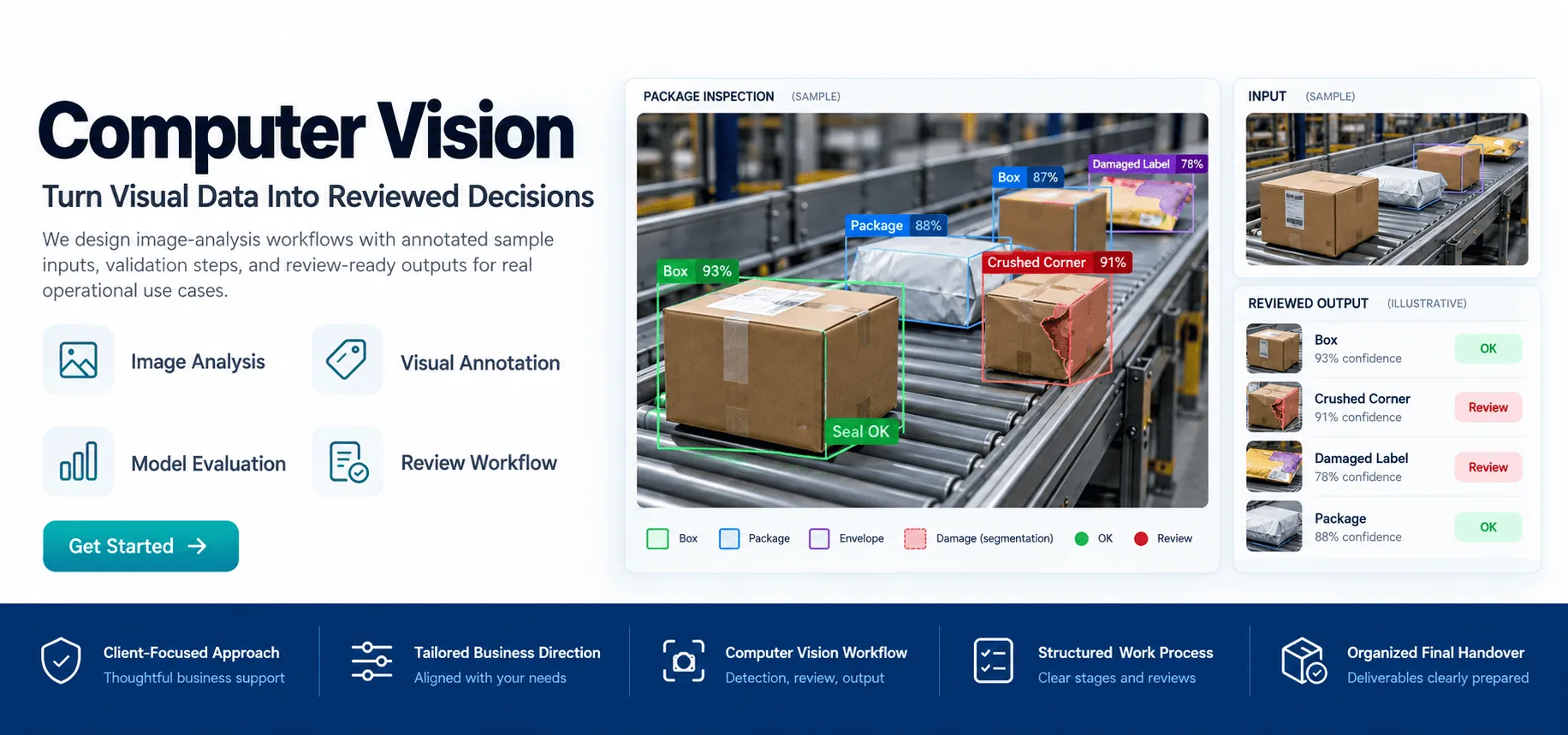
Computer vision uses software and machine-learning models to interpret images, video frames and visual documents. Businesses buy it when a repeatable visual task—such as identifying objects, classifying images, reading document fields, screening defects or monitoring defined events—needs to be measured and automated at a scale where manual review becomes slow or inconsistent.
Rudrriv provides computer vision development around the agreed visual decision, operating conditions and acceptance criteria. The work proceeds through implementation, evaluation, review and handover according to the selected scope.
Share the business outcome, representative images or video, the classes or fields you need identified, any existing labels, examples of difficult cases, the expected output format, target environment and the consequence of false positives or false negatives. For live-camera or edge projects, include camera details, resolution, frame rate, lighting conditions, available compute and any privacy, retention or network constraints.
Clarify the business action, required output, error tolerance, constraints and acceptance criteria before model work starts.
Assess image quality, labels, edge cases and deployment conditions, then choose a suitable baseline, model and evaluation plan.
Develop the agreed workflow, evaluate representative validation data and review failure patterns instead of relying on a single headline score.
Prepare approved code, model files, outputs, run instructions and integration or deployment guidance included in the selected scope.
A computer vision model that works on a curated sample may fail under different lighting, camera angles, backgrounds, resolutions or object appearances. Professional delivery therefore evaluates representative data, documents assumptions and identifies important limitations before a workflow is treated as deployment-ready. For consequential use cases, human review thresholds and monitoring should be designed alongside the model rather than added after launch.
Choose the smallest package that answers the decision in front of you. Production-scale datasets, multi-camera rollouts, custom hardware, large annotation requirements or regulated deployments should be quoted separately.
| Included | ₹8,999 Essential Vision Feasibility Sprint For a small prepared sample and one clearly defined vision task. | ₹49,999 Professional Recommended Custom Vision Prototype For teams that need a trained or tuned prototype with evaluation evidence and technical handover. | ₹1,49,999 Advanced Integrated Vision Pilot For a broader pilot that adds optimization, integration and deployment-oriented handover. |
|---|---|---|---|
| Primary scope | 1 feasibility task | 1 custom prototype | 1 integrated pilot |
| Prepared data coverage | Up to 100 samples | Up to 1,000 labeled images* | Up to 3,000 labeled images* |
| Model approach | Pretrained / baseline | Fine-tuning where suitable | Tuning + optimization |
| Evaluation summary | ✓ | ✓ | ✓ |
| Source code / notebook | ✓ | ✓ | ✓ |
| Model weights / export | When applicable | ✓ | ✓ |
| API or batch integration | — | Basic inference path | API / batch workflow |
| Edge-oriented export | — | — | Where suitable |
| Deployment notes | Run notes | Technical handover | Runbook + handover |
| Revision rounds | 1 | 2 | 3 |
| Standard delivery | 4 days | 10 days | 21 days |
| Package price | ₹8,999 | ₹49,999 | ₹1,49,999 |
*Prepared labeled data means labels are supplied in usable form. Annotation, large-scale relabeling, new camera hardware, cloud usage, third-party API fees and additional use cases are scoped separately.
See how computer vision outputs can look across inspection, detection, segmentation, OCR and image classification. These original visuals use synthetic data; they are representative concepts, not commissioned client projects or validated model results.
Fine-grained surface and component review with region annotations and a human approval queue.
Illustrative carton and parcel bounding boxes with class IDs and structured frame-level output.
Sample pixel-level scene masks separating roadway, vehicles, buildings and pedestrian zones.
A source-document verification workspace pairing bounded text regions with structured, checkable fields.
Four example component categories presented in a classification review and annotation handoff.
Representative design studies. No production deployment, measured accuracy, customer outcome or inference result is implied.
Discuss a computer vision briefService labels are shown exactly as supplied with the client feedback.
This was our first outsourced NLP project, and we needed a domain-specific NLP classification and information-extraction solution with enough documentation for our internal team to take over confidently. The project stayed controlled because the team treated evaluation design, API integration, text normalization, domain terminology, entity recognition, and ambiguity handling as core requirements, not optional polish to be added at the end. The delivered solution resulted in a text-processing workflow that categorized and extracted information with far less manual effort. Having model artifacts, preprocessing logic, evaluation results, and integration guidance alongside it reduced follow-up questions and made ownership transfer simple.
We asked the team to revisit our NLP process and produce a domain-specific NLP classification and information-extraction solution; their approach was structured from discovery through final validation. We appreciated the discipline around text normalization, domain terminology, entity recognition, ambiguity handling, evaluation design, and API integration. The team kept technical detail available when we needed it, while still making review sessions understandable for business stakeholders. By delivery, we had a text-processing workflow that categorized and extracted information with far less manual effort. The accompanying model artifacts, preprocessing logic, evaluation results, and integration guidance were well organized and gave our team a solid basis for future updates.
Our previous approach to NLP was producing inconsistent results, so we asked the team to build a domain-specific NLP classification and information-extraction solution with stronger controls. They kept a close eye on entity recognition, ambiguity handling, evaluation design, API integration, text normalization, and domain terminology. Progress updates were concise, and the evidence behind important decisions was easy for us to verify. The delivered solution resulted in a text-processing workflow that categorized and extracted information with far less manual effort. Having model artifacts, preprocessing logic, evaluation results, and integration guidance alongside it reduced follow-up questions and made ownership transfer simple.
Share the visual task, sample data, expected output and deployment context. Rudrriv will review feasibility, scope boundaries, package fit and the information needed for a reliable quote.