Knowledge-grounded AI application
Lumen Knowledge Workspace
Source-aware policy answers with permissioned retrieval, passage citations and human-review guidance.
RAG pipelineCited responsesSource permissions

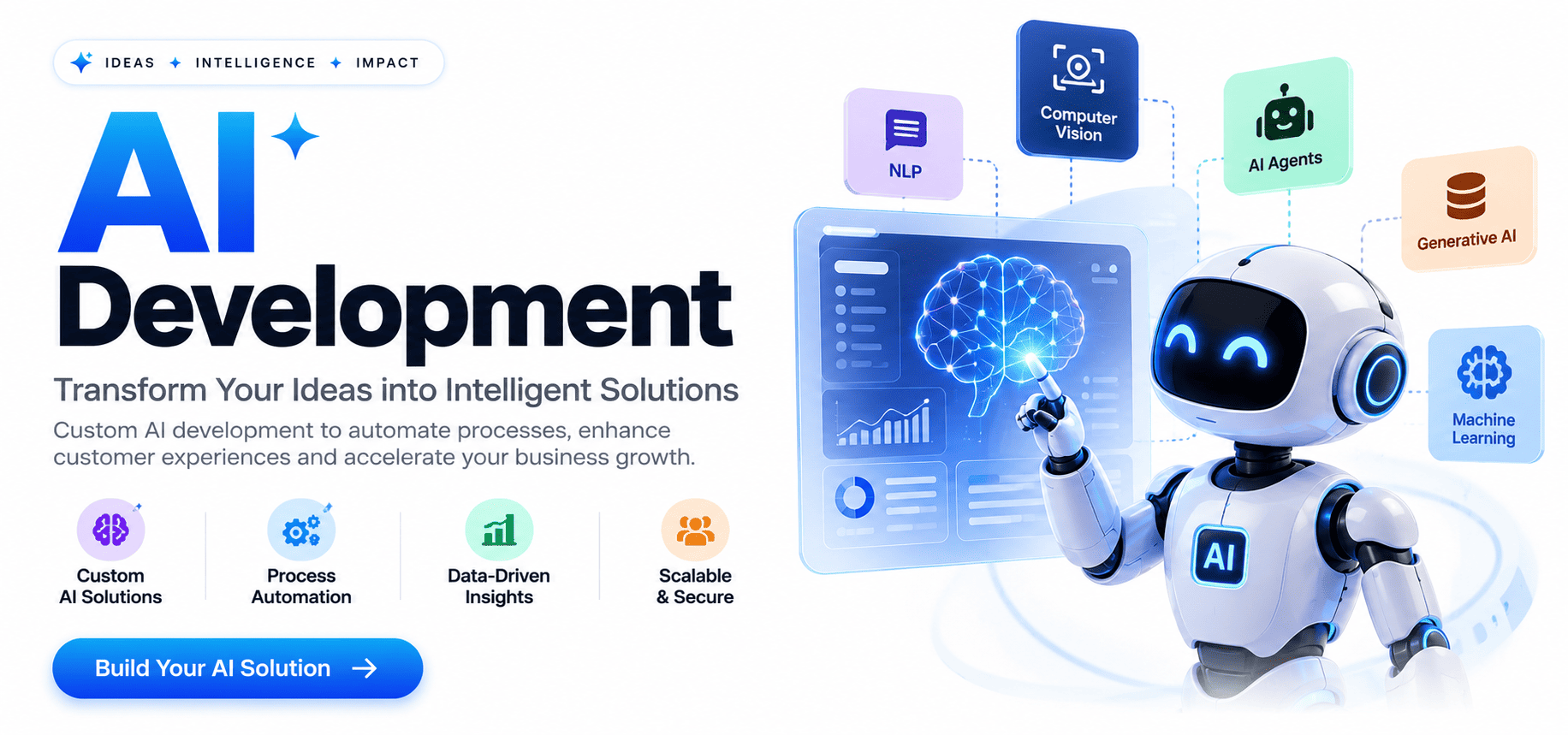
AI Development is the process of designing and building software that uses machine-learning or generative-AI capabilities inside a real product or business workflow. Depending on the problem, that may mean integrating an existing model API, building retrieval over private data, creating tool-calling logic, adding an AI feature to an existing application, or delivering a focused AI-first workflow.
Rudrriv provides this as a professional service. You share the business objective, current system and constraints; Rudrriv scopes the work, implements the agreed AI solution, reviews quality and handles delivery from brief to handover. The service covers the agreed AI, backend, integration and QA work within one defined scope.
Start with the problem rather than a model name. Share the workflow you want to improve, users, existing software, available data, examples of the desired output, actions the AI may or may not take, relevant APIs, security constraints, deployment preference and the result that will count as acceptable. If you already have a prototype, repository or prompt flow, include it so the team can assess what should be retained or rebuilt.
Rudrriv reviews the objective, users, data, systems, risk and acceptance criteria.
The service team selects the model, retrieval, tool-calling and integration pattern that fits the scope.
Implementation is tested against representative cases, with checkpoints for decisions and feedback.
Approved code, configuration and documentation are prepared for the agreed environment and owner.
Generative AI is probabilistic, so quality cannot be judged by a single successful prompt. A professional implementation defines where the system gets context, what it may do, how responses are validated, what happens when confidence is low, and which situations require a human decision. That is why evaluation, guardrails and integration behaviour are part of the development scope rather than optional polish.
Five distinct, representative AI development concepts—from grounded applications and intelligent document flows to responsible production architecture. These are illustrative design studies, not claims of completed client projects or running deployments.
Source-aware policy answers with permissioned retrieval, passage citations and human-review guidance.
An invoice-processing interface pairing document evidence with validated structured fields and reviewer intervention.
A design-time evaluation suite for comparing model outputs against grounding, refusal and formatting criteria.
A service-desk copilot that prepares context-aware drafts and proposed tool actions while preserving human control.
A reference architecture covering access checks, retrieval, model orchestration, output validation and operational controls.
All five images are original illustrative portfolio representations using hypothetical interfaces, sample content and conceptual system designs; none is offered as proof of deployed software, actual customer results or a completed commission.
Choose Essential for a narrowly defined proof of concept, Professional for the most common AI workflow MVP, or Advanced when the application needs broader integration, evaluation and production controls.
| Included | ₹49,999 Essential AI Prototype Sprint A focused proof of concept for one clearly defined AI capability using an appropriate existing model or API. |
₹1,49,999 Professional Recommended AI Workflow MVP A working AI workflow or assistant MVP with business data or tools, evaluation, guardrails and deployment support. |
₹3,99,999 Advanced Production AI Application A broader production-focused AI application with multiple workflows, integrations, evaluation and operational controls. |
|---|---|---|---|
| Primary scope | 1 focused AI use case | 1 AI workflow / assistant MVP | 1 production-focused AI application |
| AI workflows / agents | 1 simple workflow | 1 workflow | Up to 3 |
| Model / API integration | ✓ | ✓ | ✓ |
| RAG or tool calling | Optional within narrow scope | RAG or tool calling | RAG + tools as required |
| Data sources / integrations | Up to 1 | Up to 2 | Up to 4 |
| Representative evaluation cases | Up to 20 | Up to 50 | Up to 100 |
| Guardrails & failure handling | Basic | Included | Expanded + monitoring hooks |
| Deployment support | Setup notes | 1 environment | 1 production environment |
| Source code & documentation | ✓ | ✓ | ✓ |
| Revision rounds | 1 | 2 | 3 |
| Standard delivery | 7 business days | 15 business days | 30 business days |
| Post-launch stabilization | — | — | 14 calendar days |
| Package price | ₹49,999 | ₹1,49,999 | ₹3,99,999 |
We engaged the team for AI Development with a tight set of requirements and very little room for disruption to our existing workflow. Their job was to produce a custom AI-powered application, and they handled both the visible work and the less obvious technical details behind it. The work was careful around model selection, prompt design, data flow, evaluation, guardrails, and production integration, and that reduced the number of issues found late in the project. Testing was more thorough than our previous internal attempts, especially around edge cases and real usage. By launch, we had an AI solution that moved beyond a demo and performed reliably inside our actual workflow. Our internal team could take over confidently, which was an important part of the brief from the beginning.
This AI Development project started with a short list of problems, but the team helped us see the dependencies between them. We asked for a custom AI-powered application, and the implementation was broken down in a way that made each stage easy to validate. They paid close attention to model selection, prompt design, data flow, evaluation, guardrails, and production integration, which were exactly the areas we were concerned about. Feedback was incorporated carefully, and completed work did not keep regressing after each revision. We finished the project with an AI solution that moved beyond a demo and performed reliably inside our actual workflow. We would use the same team again for related work because the delivery was dependable without being over-engineered.
We approached this AI Development project with a working system already in place, which meant changes had to be made carefully. The core of the engagement was a custom AI-powered application, and the team avoided distracting us with features that were outside the goal. We were particularly happy with the attention to model selection, prompt design, data flow, evaluation, guardrails, and production integration. The project stayed organized even when we introduced new information midway through the work. The biggest improvement was an AI solution that moved beyond a demo and performed reliably inside our actual workflow. The project ended in a much better state than it began, both technically and from an ownership perspective.
Describe the business problem, existing workflow, data and systems the AI must work with. Rudrriv will review the requirement and respond with the most suitable scope, package and next steps.