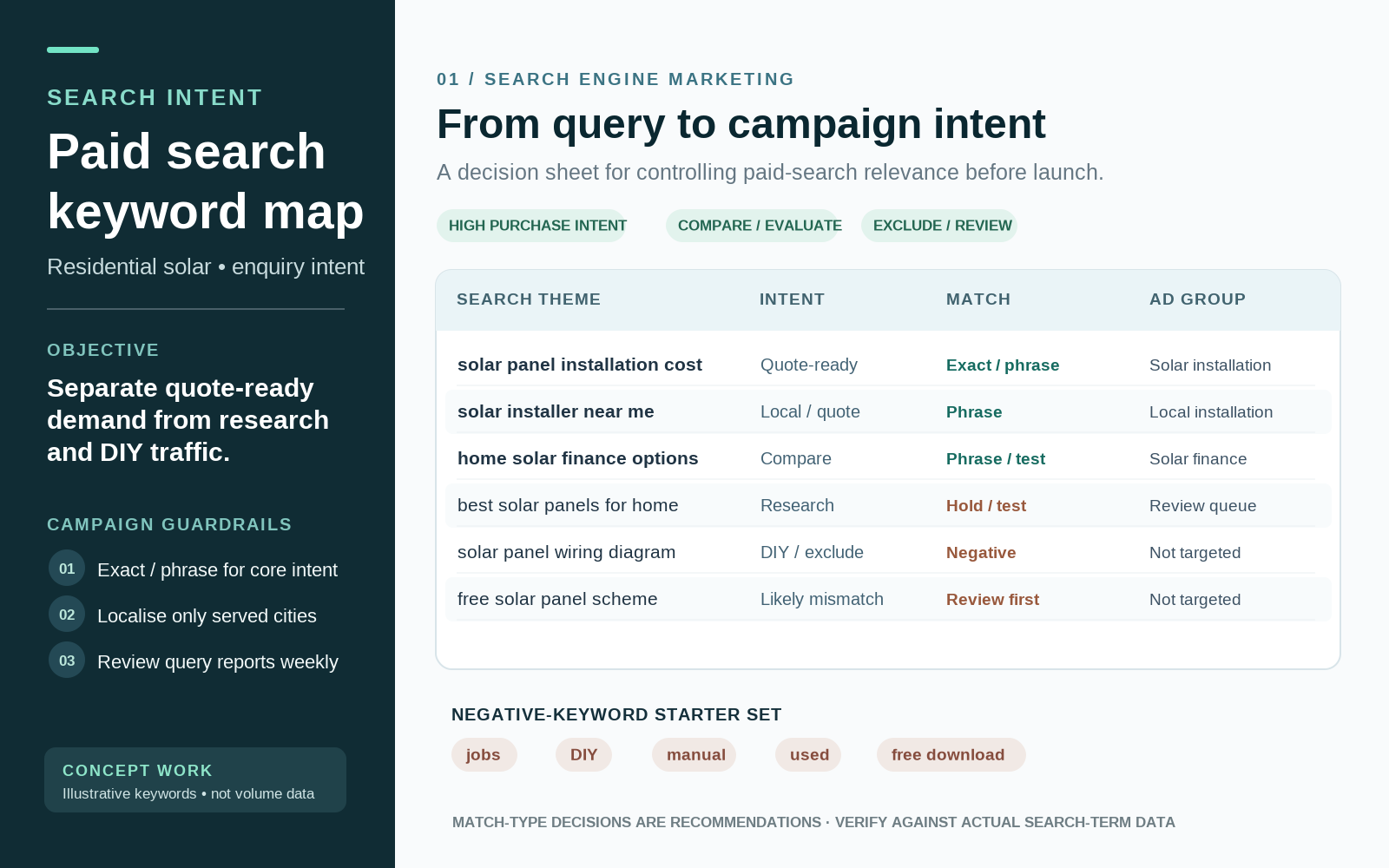
Search-demand intent map
A solar-installation query map separates quote-ready terms, research intent, match-type recommendations and negatives.

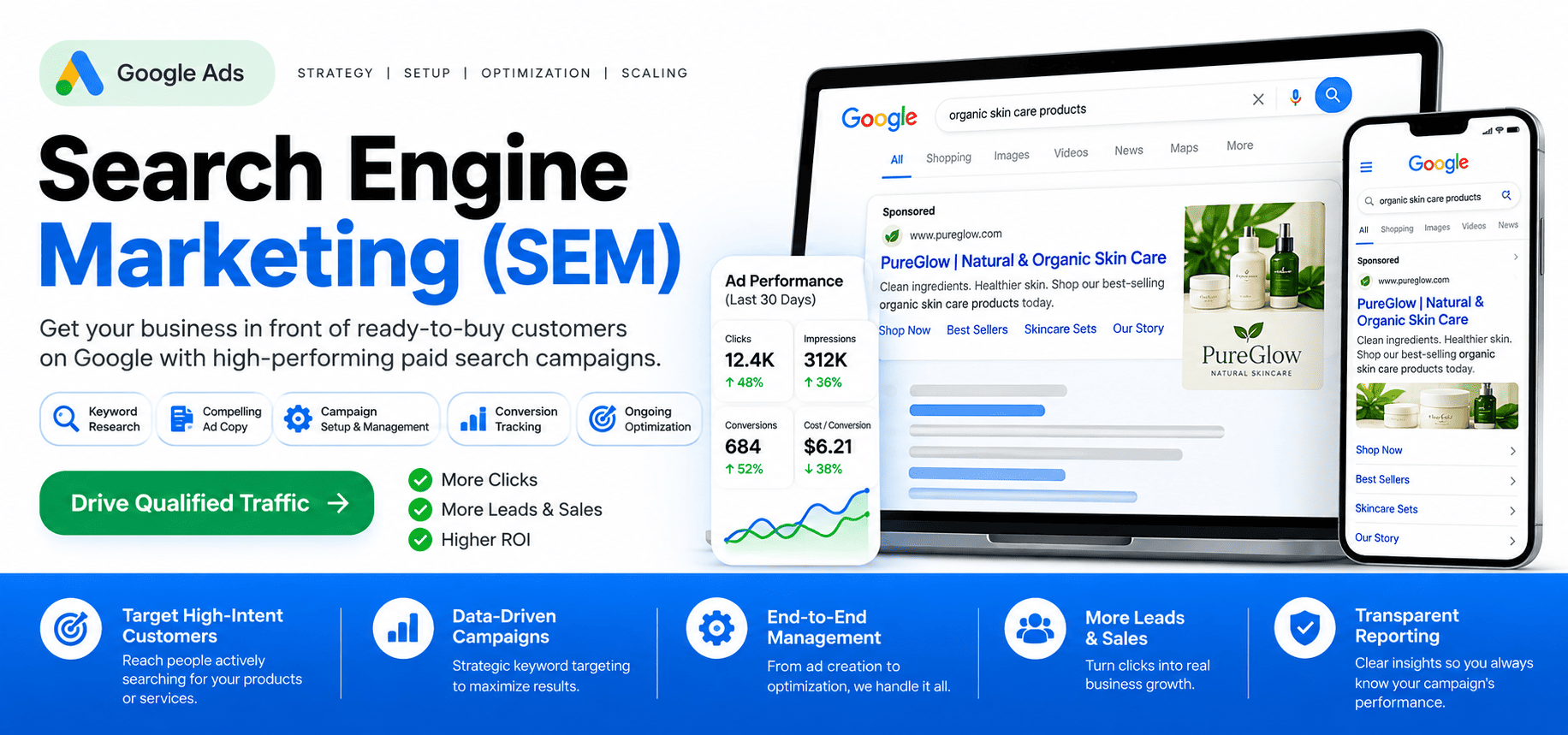
Search Engine Marketing helps businesses place paid ads in search results when potential customers are actively looking for a relevant product, service or solution. Rudrriv’s SEM service concentrates on paid search: understanding demand, structuring campaigns, matching search intent to ad messages, controlling irrelevant traffic and measuring the actions that matter after a click.
The objective is not to maximise clicks for their own sake. A professional SEM programme needs clear conversion definitions, disciplined keyword and search-term management, relevant ads, sensible budget allocation and landing pages that continue the promise made in the ad. Rudrriv provides those moving parts as one coordinated service so the customer has a single delivery path rather than a collection of disconnected contractors.
Share your business objective, priority products or services, target locations, website or landing pages, approximate monthly media budget, existing Google Ads or Microsoft Advertising details, current analytics or tag setup, and the actions that count as a qualified conversion. If an existing account is being reviewed, appropriate access and recent performance data help the team distinguish structural problems from normal auction or demand variation.
Confirm the offer, audience, locations, budget boundaries and the conversion actions used to judge performance.
Build keyword groups, negatives, campaign architecture, ads, settings and tracking dependencies for the agreed scope.
Review search terms, negatives, bids, budgets, ad messaging and conversion quality instead of chasing click volume alone.
Document performance, decisions, unresolved dependencies and the tests or budget changes recommended for the next period.
A basic search campaign can be launched quickly, but sustainable management requires ongoing interpretation of search terms, conversion data, lead quality and landing-page behaviour. Professional execution also means knowing when to expand reach, when to add negatives, when not to automate too early, and when weak performance is caused by the offer or landing page rather than the keyword list.
Choose based on campaign count, account complexity, measurement needs and monthly media spend. Package prices are management fees; advertising budget is paid separately to the ad platform.
| Included | ₹4,999 / month Essential Search Launch For one priority offer, service line or local market. |
₹11,999 / month Professional Recommended Qualified Lead Growth For growing lead-generation accounts that need stronger measurement and weekly optimisation. |
₹24,999 / month Advanced Multi-Market Performance For multiple campaigns, markets or search platforms with deeper reporting. |
|---|---|---|---|
| Paid-search campaigns | 1 | Up to 3 | Up to 6 |
| Ad groups | Up to 3 | Up to 8 | Up to 15 |
| keyword coverage | Up to 50 | Up to 150 | Up to 300 |
| Platforms | Google Ads | Google Ads | Google Ads + Microsoft Advertising where scoped |
| Keyword segmentation & match-type plan | ✓ | ✓ | ✓ |
| Negative-keyword management | Core list | Ongoing | Advanced / multi-campaign |
| Responsive search ad work | Up to 2 per ad group | Testing included | Testing across campaigns |
| Conversion tracking | Review / basic setup | GA4 / GTM setup or verification | Tracking + attribution review |
| Landing-page relevance review | — | ✓ | ✓ + lead-quality recommendations |
| Optimisation cadence | Weekly review | Weekly optimisation | Weekly optimisation |
| Reporting | Monthly | Monthly + strategy review | Fortnightly + monthly strategy review |
| Suggested media-spend scope | Up to ₹50,000 / month | Up to ₹1,50,000 / month | Up to ₹5,00,000 / month |
| Initial launch target | 5 working days | 7 working days | 10 working days |
| Setup revision rounds | 1 | 2 | 2 |
| Management cycle | 30 days | 30 days | 30 days |
| Package price | ₹4,999 / month | ₹11,999 / month | ₹24,999 / month |
Explore five practical examples of paid-search planning, campaign setup, search ad messaging, measurement and optimisation. These are original demonstration artifacts—not completed client engagements or live advertising results.
A solar-installation query map separates quote-ready terms, research intent, match-type recommendations and negatives.
A structured freight-service build connecting campaign themes, ad groups, landing pages and hypothetical budget weights.
Finished search-result copy concept with responsive search headlines, descriptions and message-to-landing-page alignment.
A conversion blueprint tracing form submissions through GTM, GA4 and Ads, with validation and double-counting safeguards.
An illustrative 30-day paid-search review prioritising lead quality, irrelevant-query exclusions and the next optimisation cycle.
Sample work only. Any search queries, media budgets, conversion counts or campaign structures shown are illustrative and must be validated for your business.
Discuss your SEM projectWe selected the team for Search Engine Marketing (SEM) because we needed a clearer operating approach, not just more activity. They created a paid-search acquisition program built around qualified demand rather than raw click volume and worked through keyword segmentation, match-type control, negative keywords, ad-message alignment, landing-page relevance, and conversion tracking with a strong focus on practical decisions. Progress was visible throughout the project, open questions were captured properly, and revisions improved the work without restarting it. The strongest outcome was that wasted search spend was reduced and campaign decisions became much easier to make from lead quality. The project gave us both a finished deliverable and a better way to think about future optimization.
We hired the team for Search Engine Marketing (SEM) to put a paid-search acquisition program built around qualified demand rather than raw click volume into practice. The brief was handled carefully, especially around keyword segmentation, match-type control, negative keywords, and ad-message alignment. They surfaced a few dependencies we had missed, explained the implications in plain language, and kept the work moving without forcing unnecessary complexity. Revisions were incorporated quickly and the rationale behind major changes was documented. The most useful outcome was that wasted search spend was reduced and campaign decisions became much easier to make from lead quality. The final materials were organized, practical, and easy for our team to continue using.
Our Search Engine Marketing (SEM) project started with a mixture of ideas and unfinished decisions. The team converted that into a paid-search acquisition program built around qualified demand rather than raw click volume and gave particular attention to negative keywords, ad-message alignment, landing-page relevance, and conversion tracking. That structure made review sessions much more productive because we could discuss priorities instead of debating basic setup. They communicated reliably, challenged weak assumptions when needed, and kept the final deliverables tied to real execution. By the end, wasted search spend was reduced and campaign decisions became much easier to make from lead quality. It felt like a tailored engagement rather than a recycled playbook.
Tell us what you want paid search to achieve, what is already running, where you want to advertise and how conversions are measured. Rudrriv will review the scope and recommend the most suitable package or a custom plan.