TRANSFER LEARNING · IMAGE CLASSIFICATION
Surface-inspection neural model study
A vision-model experiment layout combining labeled inspection tiles, a training-loss design and a class-level error-review matrix.

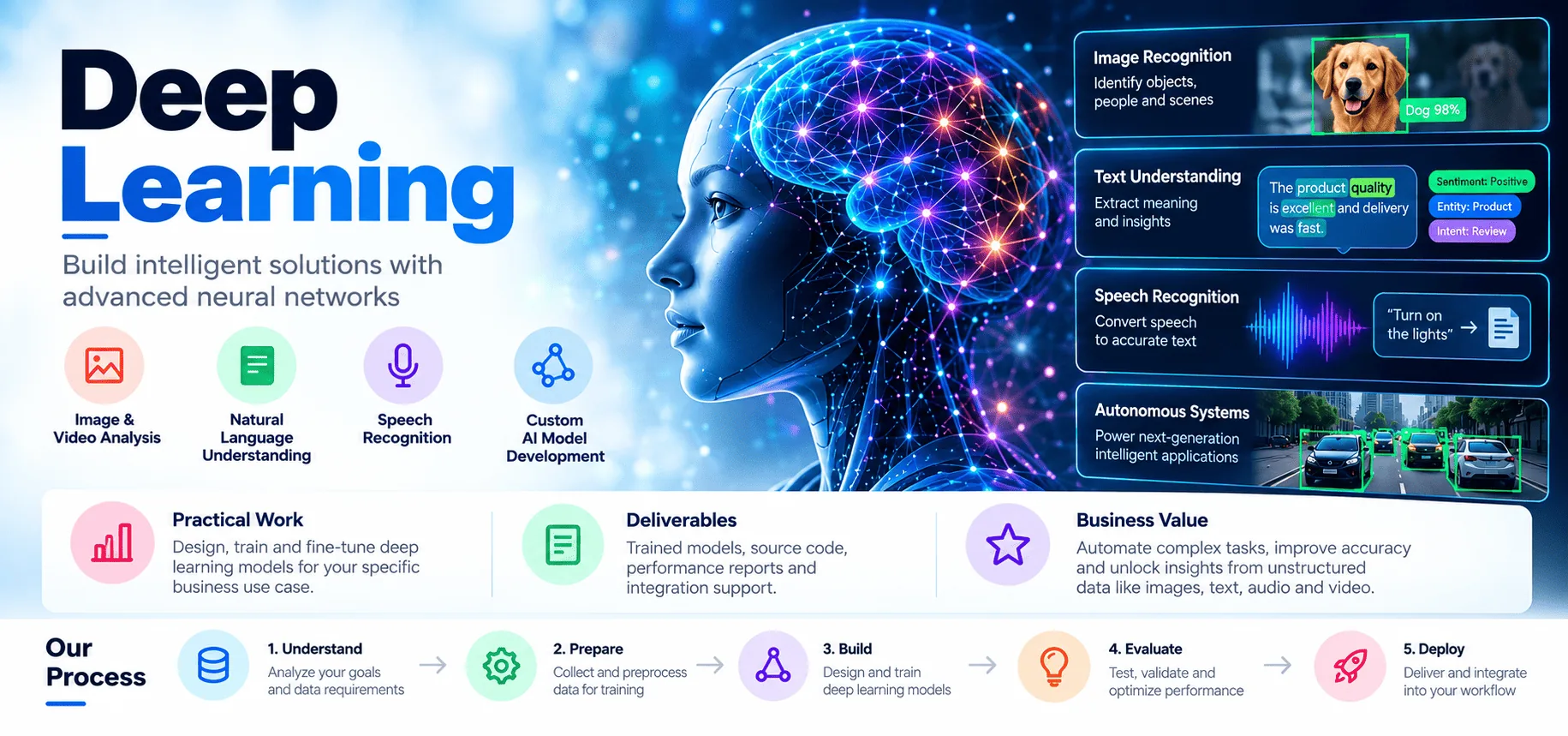
Deep learning uses multi-layer neural networks to learn complex representations from data such as images, text, audio, signals and sequences. Businesses typically purchase this service when conventional rules or simpler models are not sufficient for the pattern-recognition task, or when they need to adapt a pretrained neural model to a specific domain.
Rudrriv provides deep learning around the objective, available data, target output and technical constraints you provide. The service covers the modelling workflow, review points, quality checks and delivery of the agreed code, evidence and documentation.
Share the business objective, the exact prediction or recognition task, representative data or sample files, label definitions where relevant, target users, preferred success metrics, current technology stack, deployment environment, data-access restrictions and any privacy or compliance requirements. If the dataset is not yet ready, the first scope may need to focus on preparation, labeling strategy or feasibility rather than model training.
We clarify the business objective, target output, data inputs, constraints and evaluation criteria.
Rudrriv reviews readiness, chooses an appropriate baseline or architecture and confirms experiment boundaries.
Models are trained and evaluated against agreed metrics, with error patterns and limitations made reviewable.
Approved code, model artifacts, evaluation evidence and operating guidance are prepared for the selected scope.
Deep learning projects are sensitive to dataset size and quality, annotation consistency, model architecture, training time, compute requirements, target latency, deployment environment and the cost of mistakes. For that reason, a credible scope distinguishes a quick baseline from a reusable prototype and a deployment-oriented build. Large-scale data labeling, extensive cloud/GPU consumption, regulated validation, production monitoring infrastructure or multi-system integration may require a custom quote beyond the standard packages.
Choose the smallest scope that answers the real technical question. The Essential plan validates a focused task, Professional builds a reusable prototype, and Advanced extends the work toward integration and deployment readiness.
| Included | ₹9,999 Essential Deep Learning Baseline Sprint A focused feasibility and baseline engagement for one clearly defined deep-learning task using a prepared customer dataset. |
₹1,49,999 Professional Recommended Custom Deep Learning Prototype A custom prototype with model experimentation, training, validation, error analysis and reusable technical handoff. |
₹2,99,999 Advanced Deployment-Ready Deep Learning Build A broader implementation for teams that need a tested model workflow, packaging, integration support and operational guidance. |
|---|---|---|---|
| Primary scope | Feasibility + baseline | Custom prototype | Broader implementation |
| Prepared datasets | 1 | 1 primary dataset | 1 primary + agreed supporting inputs |
| Model approaches | 1 | Up to 2 | Up to 3 |
| Transfer learning / fine-tuning | As appropriate | Included when appropriate | Included when appropriate |
| Training + validation workflow | ✓ | ✓ | ✓ |
| Error analysis | Core findings | Detailed | Detailed + robustness review |
| Reusable source code | ✓ | ✓ | ✓ |
| Inference workflow | Notebook / script | Notebook / script | API or batch workflow |
| Deployment support | — | Handoff guidance | One target environment |
| Monitoring / retraining guidance | — | Basic recommendations | Operational guidance |
| Review rounds | 1 review round | 2 review rounds | 3 review rounds |
| Standard delivery | 5 business days | 15 business days | 25 business days |
| Package price | ₹9,999 | ₹1,49,999 | ₹2,99,999 |
Package pricing assumes a clearly defined task and accessible customer data. Substantial cloud/GPU usage, paid third-party services, large-scale annotation, regulated validation or wider production integration is scoped separately before chargeable work is added.
Explore five representative neural-model deliverables covering computer vision, transformer fine-tuning, sequence learning, embeddings and inference packaging. All examples use synthetic or schematic content; they are not completed client projects, tested benchmarks or production results.
A vision-model experiment layout combining labeled inspection tiles, a training-loss design and a class-level error-review matrix.
A support-ticket classification concept with token-level review, a pretrained encoder pathway and proposed validation checks.
A sequence-learning reference design illustrating rolling windows, a temporal CNN–GRU approach and horizon-specific error review.
An embedding-model design showing projected feature neighborhoods, retrieval triplets and contrastive-training review criteria.
A proposed model-serving contract with preprocessing stages, versioned model artifacts, validation gates and reproducibility checks.
What these examples show: possible deliverables and review methods—not trained-model results or client case studies.
Discuss a deep learning project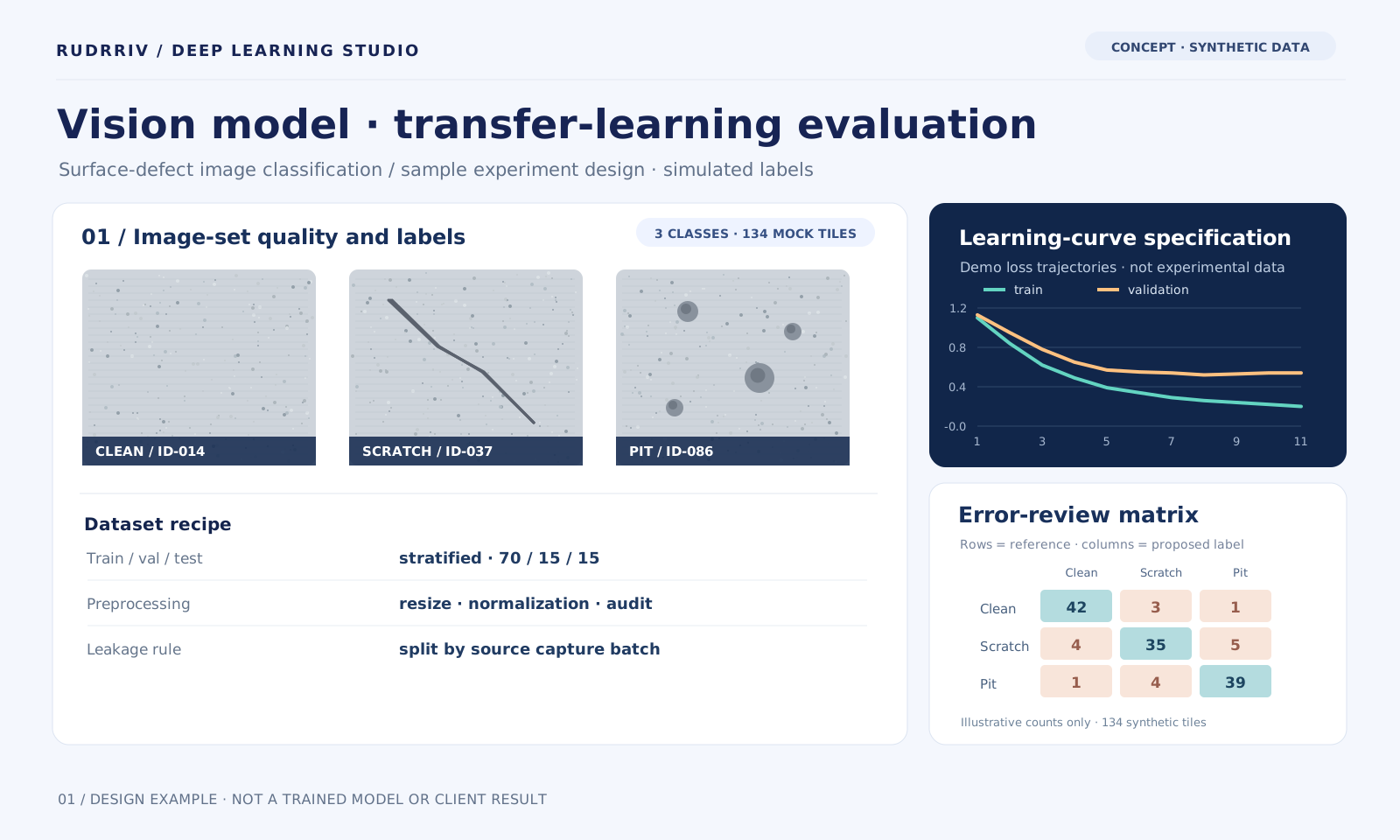
The supplied feedback below relates to Rudrriv's Generative Models service and is presented with the original service label, customer details, rating, timeline and review wording unchanged.
The Generative Models assignment involved several dependencies, but the team organized the work around a controlled generative-model workflow for business content and prototyping and kept each milestone reviewable. We appreciated the discipline around conditioning strategy, training-data quality, output consistency, error controls, evaluation criteria, and guardrails. The team kept technical detail available when we needed it, while still making review sessions understandable for business stakeholders. The outcome was more consistent generated outputs that were useful for real work instead of just demonstrations, and the inclusion of prompt and model configurations, test cases, evaluation notes, and operating guidance made it possible for us to keep improving the work internally.
We hired the team for Generative Models with a clear objective: deliver a controlled generative-model workflow for business content and prototyping without creating a solution that was too fragile to maintain. They kept a close eye on output consistency, error controls, evaluation criteria, guardrails, conditioning strategy, and training-data quality. Progress updates were concise, and the evidence behind important decisions was easy for us to verify. In the end, the work provided more consistent generated outputs that were useful for real work instead of just demonstrations. The documented prompt and model configurations, test cases, evaluation notes, and operating guidance made the result easy to verify, reuse, and extend.
Tell us the prediction or recognition task, available data, success criteria, technology constraints and delivery goal. Rudrriv will review the requirement and respond with the most suitable package or a custom scope.