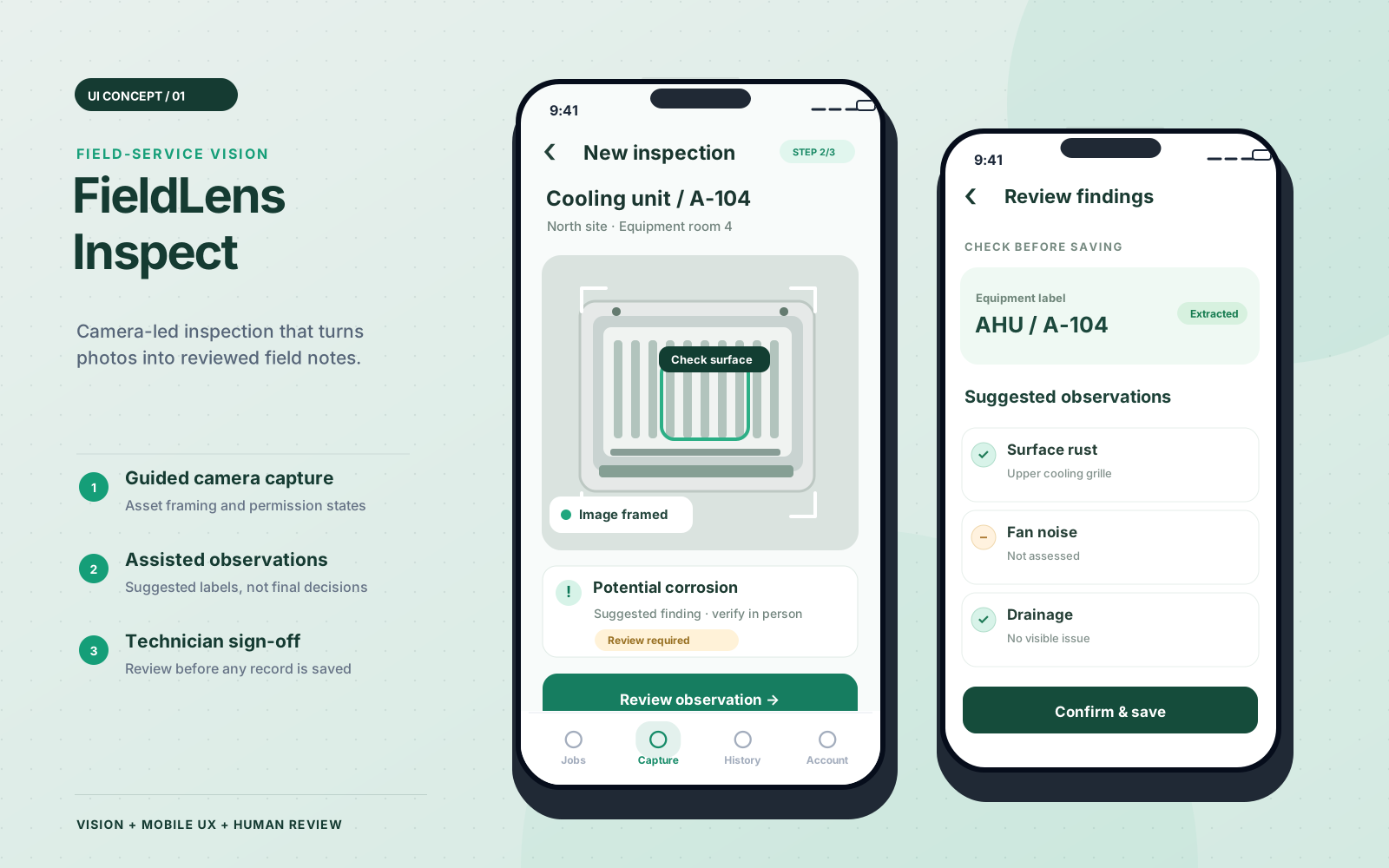
FieldLens Inspect
A technician-focused inspection concept: capture equipment details, review AI-suggested findings and confirm before saving.

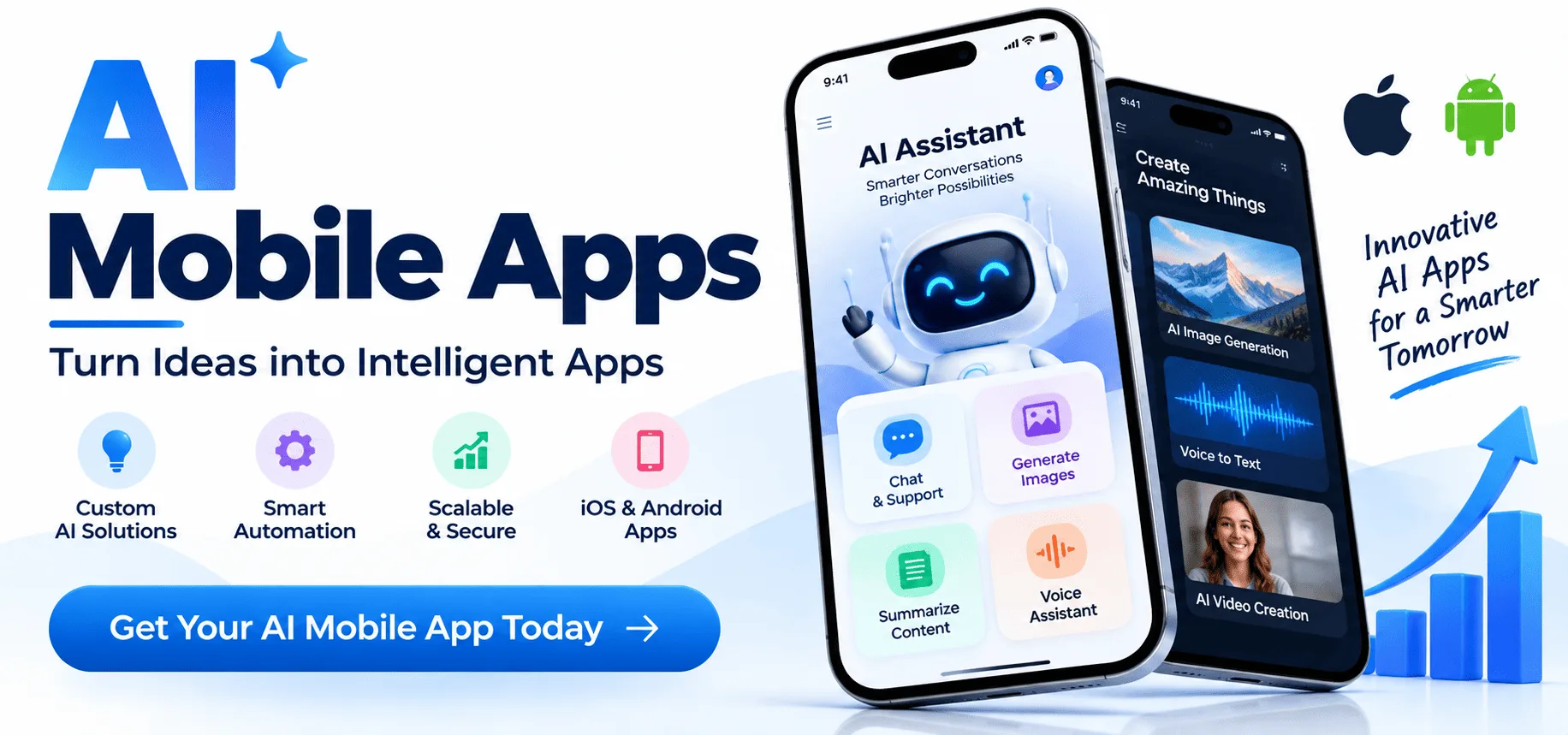
AI mobile app development combines standard mobile product engineering with artificial intelligence that helps users complete a real task. Depending on the project, that may mean an in-app assistant, smart search, recommendations, document or image analysis, voice interactions, classification, prediction, or an AI-assisted business workflow. The challenge is not only connecting a model. The app also has to manage user intent, permissions, latency, failures, privacy, cost, offline states, validation and release requirements on real devices.
Rudrriv provides the work as one professional service covering the agreed UX, mobile development, backend integration and AI scope. We assess the scope, complete the agreed implementation, perform quality review, and provide the build and handoff package.
Share the business goal, target users, required platforms, must-have screens, the AI task you want users to complete, any existing codebase or backend, model or API preferences if you have them, data or knowledge sources, integrations, security or compliance constraints, reference products and the target release date. If you are adding AI to an existing app, repository access and current technical documentation help us scope the work accurately.
Clarify users, AI use case, platforms, integrations, constraints and acceptance criteria before building.
Map mobile states, data flow, model/API boundaries, permissions, fallbacks and the implementation approach.
Implement the agreed app screens, logic, AI workflow, backend connections and tracked delivery checkpoints.
Review functional and AI cases, resolve agreed issues, prepare the release output and deliver the documented handoff.
A production AI feature needs decisions about model choice, response time, token or inference cost, data retention, permission prompts, sensitive inputs, unreliable outputs, rate limits, offline behaviour and app-store policy. Rudrriv treats these as product and engineering requirements rather than hiding them behind an “AI integration” label. The right approach can use a hosted model API, a retrieval workflow, on-device machine learning, or a hybrid design depending on the use case.
SELECTED CONCEPTS 05 MOBILE EXPERIENCES
Explore five original, representative product-design concepts—from on-device camera workflows to reviewable AI features. These are design demonstrations, not claims of completed client deployments or tested app builds.
A technician-focused inspection concept: capture equipment details, review AI-suggested findings and confirm before saving.
An iOS-and-Android shopping concept with preference-aware meal discovery, editable suggestions and guided basket substitutions.
A mobile knowledge-search concept pairing a private document library with traceable excerpts, sources and verification prompts.
A speech-assisted operations concept that captures a draft, extracts reviewable shift tasks and queues an approved handover.
A driver-first route concept combining stop details, an editable AI briefing, job checklists and connectivity-aware task states.
Have a mobile workflow in mind? Share the platform, user journey and AI task. We will scope the engineering, integrations and release needs around your product.
Discuss your AI mobile appChoose by product stage and technical depth. Essential is for one focused AI feature in an existing app, Professional is for a one-platform MVP, and Advanced is for a broader cross-platform product.
| Included | ₹69,999 Essential AI Feature Starter A focused AI feature integration for an existing mobile app, covering one defined workflow, interface states, secure model/API connection and tested handoff. |
₹4,49,999 Professional Recommended AI Mobile MVP A launch-ready AI mobile MVP for one target platform, with product flows, UX implementation, backend services, one core AI workflow, QA and release-ready handoff. |
₹9,99,999 Advanced Cross-Platform AI Product A broader cross-platform AI product build for iOS and Android with multiple AI workflows, deeper backend integration, production controls, release support and documented handoff. |
|---|---|---|---|
| Starting point | Existing app | New MVP or app extension | New cross-platform product |
| Platforms | 1 existing target | iOS or Android | iOS + Android |
| Core screens / affected states | Up to 3 | Up to 8 | Up to 14 |
| AI workflows | 1 | 1 | Up to 3 |
| Backend / API integration | Defined existing integration | Included for agreed MVP scope | Custom orchestration for agreed scope |
| Authentication & app data | Use existing setup | Included | Included |
| Private knowledge / RAG | — | — | 1 approved workflow where suitable |
| Offline / degraded mode | Basic fallback states | Connectivity-aware handling | Strategy for non-AI flows |
| AI evaluation & error states | Defined functional checks | Representative evaluation cases | Broader evaluation and production controls |
| Real-device QA | Defined test flows | Included | Included + release-readiness checks |
| Store release support | Handoff only | Release candidate preparation | Submission support |
| Source code & documentation | Changed source + notes | Source code + build notes | Source code + documented handoff |
| Revision rounds | 2 | 3 | 4 |
| Planned delivery | 3 weeks | 8 weeks | 12 weeks |
| Package price | ₹69,999 | ₹4,49,999 | ₹9,99,999 |
The best architecture depends on the task, data and risk level. These are common patterns the service can scope without assuming every product needs the same AI stack.
AI assistants, guided onboarding, customer-service flows and in-app copilots with clear escalation or fallback states.
Mobile experiences that answer questions from approved content, documents, product data or internal knowledge.
Personalised suggestions for products, content, next actions or workflows using agreed signals and business rules.
Photo-based classification, extraction, inspection or assisted field workflows using mobile cameras and suitable AI services.
Speech input, summaries, guided actions and voice-assisted experiences where latency, privacy and usability support the use case.
Mobile tools for field, sales, service or internal teams that combine forms, business data and AI-assisted decisions with human review.
We needed outside support for AI Mobile Apps and chose this team because their proposed approach was concrete and easy to evaluate. The scope focused on an AI-enabled mobile application, with sensible checks before anything was moved into production. Details involving mobile UX, model/API integration, response latency, permissions, offline considerations, and release readiness were tested and reviewed rather than assumed to be fine. The project stayed organized even when we introduced new information midway through the work. The completed work gave us a mobile experience that made the AI feature useful, responsive, and practical on real devices. We would use the same team again for related work because the delivery was dependable without being over-engineered.
We selected this AI Mobile Apps service because we needed specialist help on a project that had already become more complex than expected. The core of the engagement was an AI-enabled mobile application, and the team avoided distracting us with features that were outside the goal. The work was careful around mobile UX, model/API integration, response latency, permissions, offline considerations, and release readiness, and that reduced the number of issues found late in the project. They responded quickly to comments and were equally comfortable saying when a requested change would create a new problem. By launch, we had a mobile experience that made the AI feature useful, responsive, and practical on real devices. The project ended in a much better state than it began, both technically and from an ownership perspective.
We engaged the team for AI Mobile Apps with a tight set of requirements and very little room for disruption to our existing workflow. The agreed deliverable was an AI-enabled mobile application, with room for a few controlled adjustments as we learned more. The quality showed most clearly in the way they handled mobile UX, model/API integration, response latency, permissions, offline considerations, and release readiness. Milestones were useful rather than ceremonial: each one gave us something concrete to review or test. The final result was a mobile experience that made the AI feature useful, responsive, and practical on real devices. The final files and notes were organized, and we were able to move directly into the next phase.
Tell us what the mobile experience should do, where AI fits, which platforms you need and what already exists. We will review the requirement and respond with the most suitable package, custom scope or next step.