
CLASSIFICATION · MODEL EVALUATION
Customer churn decision review
Review a classification threshold, confusion-matrix counts and actionable false-positive / false-negative trade-offs.
Confusion matrixPrecision / recallThreshold review

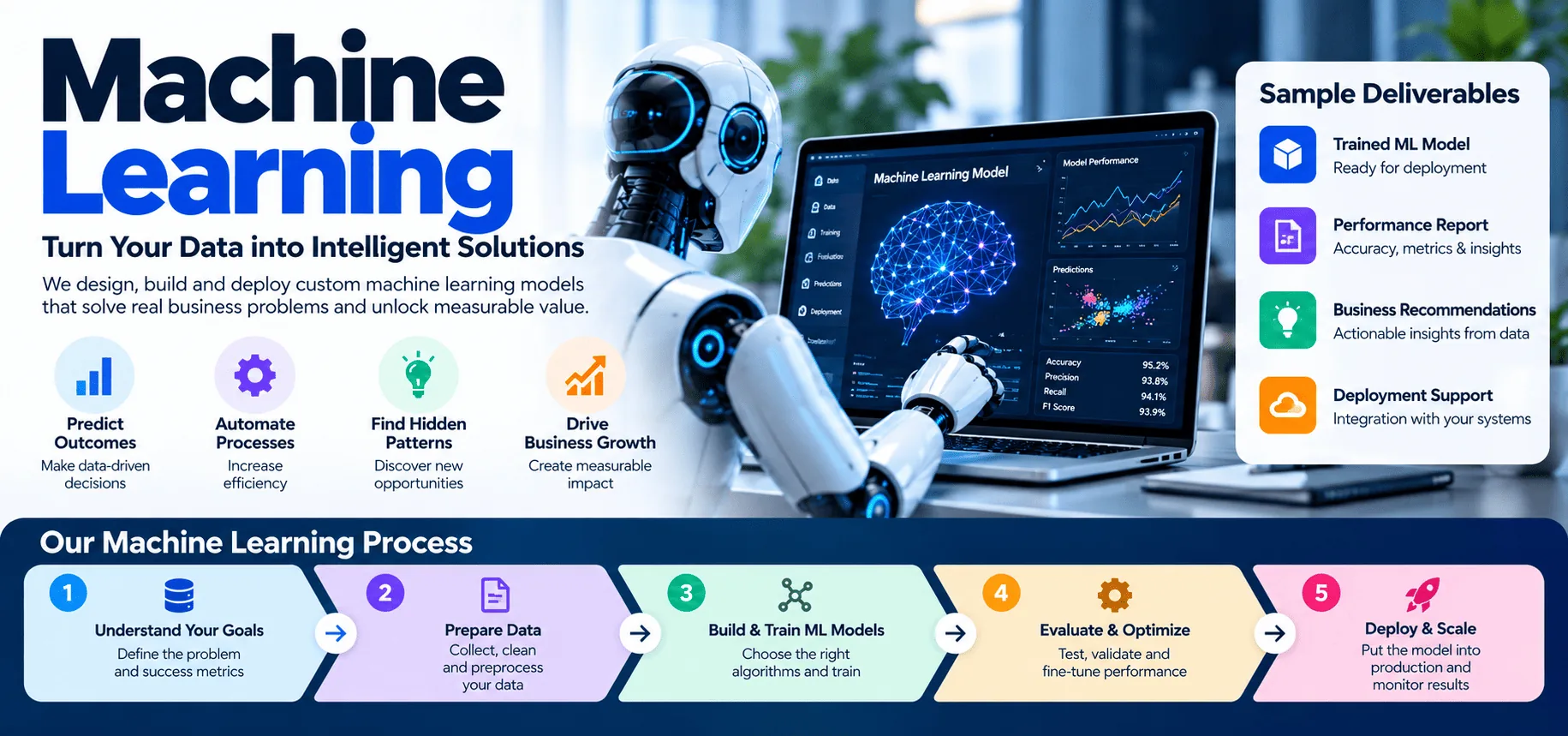
Machine learning uses patterns in historical data to estimate an outcome, assign a class, rank options, detect unusual behavior or support a forecast. Rudrriv's service is designed for businesses that have a concrete decision or workflow to improve and need the modeling work handled as a structured delivery rather than an open-ended experiment.
The work starts with the target outcome and available data. Rudrriv checks whether the problem is suitable for machine learning, prepares the agreed data, establishes a baseline, compares or tunes suitable algorithms according to package scope, validates performance on data not used for fitting, and documents what the model can and cannot support.
Share the business objective, a representative dataset or sample, the outcome you want to predict, field definitions if available, known data-quality issues, the decision or workflow that will consume the prediction, and any technical, privacy, deadline or integration constraints. Do not send passwords or highly sensitive datasets through the public enquiry form; secure access requirements can be agreed after initial scoping.
We confirm the business question, target outcome, inputs, constraints and acceptance criteria.
The team prepares the agreed data, creates a baseline and runs the model work included in your package.
We test on held-out data, inspect relevant errors or trade-offs and review results against the original goal.
Approved code, model assets, metrics and documentation are organized for your team according to the selected package.
A useful ML delivery needs more than a training score. The evaluation should reflect the business decision, class balance, cost of false positives and false negatives, data leakage risk, time ordering where relevant, and whether the model can be reproduced outside the original notebook. Production use may also require security, latency, monitoring, drift detection, retraining and integration work beyond the fixed packages.
Choose by the depth of modeling and handoff you need. These fixed tiers assume one clearly defined ML use case and usable input data; broader data engineering, labeling, deep-learning, production deployment and MLOps are custom scopes.
| Included | ₹7,999 Essential ML Baseline Model For a defined baseline on prepared tabular data. |
₹14,999 Professional Recommended Model Comparison & Tuning For buyers who need model comparison, tuning and stronger reporting. |
₹29,999 Advanced Deployment-Ready ML Handoff For a deeper validated model with reusable inference handoff assets. |
|---|---|---|---|
| Defined ML target | 1 | 1 | 1 |
| Dataset review & preprocessing | Basic | Expanded | Expanded |
| Candidate models | 1 baseline | Up to 3 | Multiple experiments |
| Hyperparameter tuning | — | ✓ | ✓ |
| Validation / testing | ✓ | ✓ | ✓ |
| Error / feature analysis | Summary | Included | Detailed |
| Reusable source code | ✓ | ✓ | ✓ |
| Serialized model artifact | — | ✓ | ✓ |
| Inference / API example | — | — | ✓ |
| Technical handoff documentation | Concise | Included | Detailed |
| Revision rounds | 1 | 2 | 3 |
| Standard delivery | 4 working days | 7 working days | 10 working days |
| Package price | ₹7,999 |
₹14,999 |
₹29,999 |
SELECTED WORK / 05 REPRESENTATIVE CONCEPTS
Explore the kinds of tangible modeling, evaluation and handoff artifacts a scoped Machine Learning engagement can produce. All five examples use synthetic data; none represents a completed customer engagement or independently validated model performance.
Review a classification threshold, confusion-matrix counts and actionable false-positive / false-negative trade-offs.
Compare a proposed weekly demand regressor against synthetic holdout values, residuals and unit-based error measures.
Inspect window-level anomaly scores, a review threshold and flagged events without implying confirmed equipment faults.
Inspect predicted-vs-observed times, trip-segment error slices and pre-dispatch feature availability.
Explore a top-five recommendation candidate list with example similarity scores and clearly synthetic relevance labels.
The supplied reviews below relate to Computer Vision work, a machine-learning application area. They are presented exactly from the provided client-review input.
We engaged the team on Computer Vision to create an image-recognition and object-detection pipeline, and they were careful not to overcomplicate the solution. They kept a close eye on edge-case handling, inference speed, deployment constraints, annotation quality, and data augmentation. Progress updates were concise, and the evidence behind important decisions was easy for us to verify. The work ultimately produced a visual inspection workflow that reduced manual review and handled real-world image variation much better. We also valued receiving tested models, inference scripts, and documented image-preparation steps, which made the solution much easier to audit and maintain.
The Computer Vision assignment involved several dependencies, but the team organized the work around an image-recognition and object-detection pipeline and kept each milestone reviewable. A lot of value came from the attention to deployment constraints, annotation quality, data augmentation, detection accuracy, and edge-case handling. Instead of hiding uncertainty, the team documented it and showed us where additional data or different assumptions would change the result. We came away with a visual inspection workflow that reduced manual review and handled real-world image variation much better. The final tested models, inference scripts, and documented image-preparation steps were practical and detailed enough for both review and ongoing operation.
We hired the team for Computer Vision with a clear objective: deliver an image-recognition and object-detection pipeline without creating a solution that was too fragile to maintain. The team worked methodically through data augmentation, detection accuracy, edge-case handling, inference speed, and deployment constraints. That made revisions faster because issues were isolated, documented, and resolved rather than repeatedly resurfacing. The work ultimately produced a visual inspection workflow that reduced manual review and handled real-world image variation much better. We also valued receiving tested models, inference scripts, and documented image-preparation steps, which made the solution much easier to audit and maintain.
Tell us what you want the model to predict or support, what data is available, how the output will be used and whether you need a fixed package or a broader implementation.