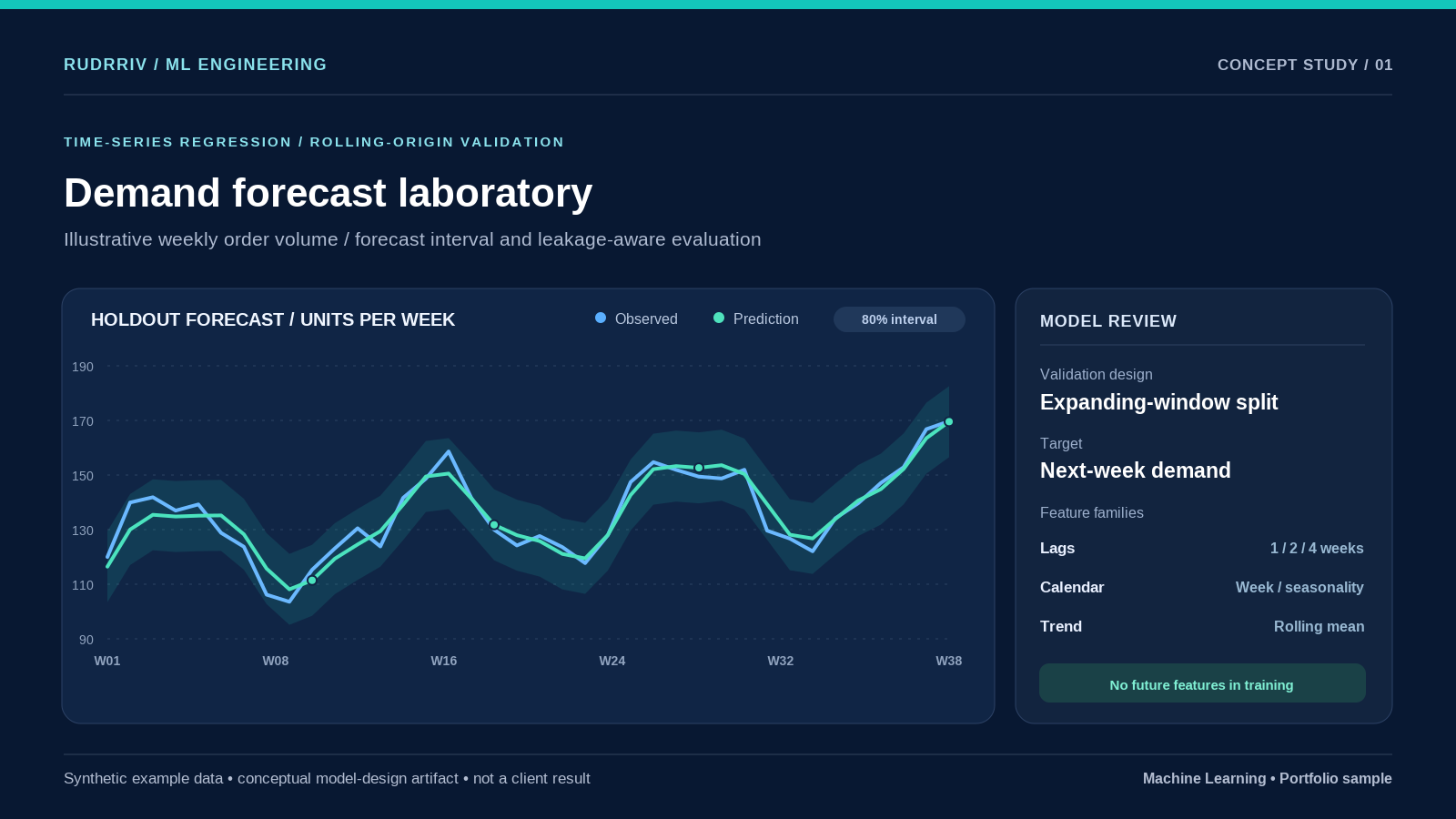
Demand forecasting with rolling validation
A weekly-demand model concept that separates historical observations, leakage-safe features and prediction intervals for decision-ready planning.

Machine learning development turns historical or labeled data into a model that can make predictions, classify cases, rank outcomes, detect patterns or support business decisions. A useful engagement is more than training an algorithm: the data must be prepared correctly, leakage and validation issues must be controlled, the model must be compared against a sensible baseline, and the final output must be documented well enough for future use.
Rudrriv handles the service from brief to delivery. Based on the selected package, the service team reviews your objective and data, prepares the modeling workflow, develops and evaluates suitable candidate models, incorporates controlled feedback and supplies the agreed code, model artifacts and documentation.
Share the business objective, the outcome you want to predict or classify, a representative dataset or sample, field definitions if available, your existing baseline or current process, the metric that matters to the business, and any constraints around privacy, technology, deployment environment or deadline. If a model or codebase already exists, include the relevant files and current evaluation results.
Rudrriv reviews the target outcome, available data, success metric, constraints and package fit before modeling begins.
The team prepares the data, engineers suitable features and develops the baseline or candidate models included in your scope.
Performance is checked with suitable metrics and validation methods, then agreed feedback is applied within the package limits.
Rudrriv delivers the agreed code, model artifacts, evaluation outputs and documentation, with deployment guidance according to scope.
Machine learning performance must be interpreted in context. A higher headline accuracy is not automatically a better business model, especially with imbalanced classes, time-dependent data or costly false positives and false negatives. The delivery therefore emphasizes the metric, validation design and error tradeoffs that matter for your use case rather than relying on a single generic score.

Choose the package based on whether you need a quick baseline, a more rigorous reusable pipeline, or a production-minded handoff with API packaging and deployment-readiness files.
| Included | βΉ1,499 Essential Baseline ML ModelFor one focused classification or regression target using a supplied structured dataset. |
βΉ7,499 Professional Recommended Validated ML PipelineFor teams that need model comparison, tuning, stronger validation and reusable inference code. |
βΉ19,499 Advanced Deployment-Ready ML PackageFor a production-minded handoff with deeper evaluation, API packaging and containerization. |
|---|---|---|---|
| Primary scope | 1 target | 1 predictive use case | 1 predictive use case + API handoff |
| Data preparation | Basic | Expanded | Production-minded |
| Candidate models | 1 baseline | Up to 3 | Up to 5 |
| Cross-validation | β | β | β |
| Hyperparameter tuning | β | β | β |
| Error analysis & metrics | Core metrics | Detailed report | Detailed + explainability where suitable |
| Reusable Python pipeline | β | β | β |
| Inference/API wrapper | β | Inference script | β |
| Containerization | β | β | β |
| Documentation | README | README + evaluation report | Technical handoff pack |
| Revision rounds | 1 | 2 | 3 |
| Standard delivery | 3 days | 7 days | 14 days |
| Package price | βΉ1,499 |
βΉ7,499 |
βΉ19,499 |
Explore five original representations of models, evaluation reports and inference handoffs. All sample data and visuals are illustrativeβnot completed client projects or verified production results.
A weekly-demand model concept that separates historical observations, leakage-safe features and prediction intervals for decision-ready planning.
An evaluation-first classification study with an ROC curve, threshold review and confusion matrix that makes false positives and missed cases visible.
Illustrative sensor windows and unsupervised anomaly scores designed for operator reviewβnot automatic claims that an equipment fault occurred.
A behavioral clustering concept combining a two-dimensional PCA projection with interpretable segment profiles for downstream analysis.
A deployment-ready handoff concept showing serialized preprocessing, estimator artifacts, schema validation and an example inference contract.
Concept artwork and engineering context.
Representative concept using synthetic data. Not a claim of client delivery, deployed software, or measured business outcomes.
Our previous attempt at Machine Learning had left several loose ends, so we wanted a more disciplined second pass. Their job was to produce a machine-learning model and evaluation pipeline, and they handled both the visible work and the less obvious technical details behind it. The quality showed most clearly in the way they handled data preparation, feature design, model selection, validation, metrics, and deployment readiness. Their communication was practical and specific, which made technical decisions much easier for our non-technical stakeholders. The biggest improvement was a model we could evaluate with confidence and a pipeline that made future iteration much easier. The project ended in a much better state than it began, both technically and from an ownership perspective.
We brought in the team for Machine Learning because we wanted a production-minded implementation, not just a proof of concept. The scope focused on a machine-learning model and evaluation pipeline, with sensible checks before anything was moved into production. Details involving data preparation, feature design, model selection, validation, metrics, and deployment readiness were tested and reviewed rather than assumed to be fine. We never had to chase for status; blockers and decisions were raised early enough for us to respond. The completed work gave us a model we could evaluate with confidence and a pipeline that made future iteration much easier. We would use the same team again for related work because the delivery was dependable without being over-engineered.
For our Machine Learning requirement, we needed someone who could make progress quickly without trading away maintainability. The core of the engagement was a machine-learning model and evaluation pipeline, and the team avoided distracting us with features that were outside the goal. The work was careful around data preparation, feature design, model selection, validation, metrics, and deployment readiness, and that reduced the number of issues found late in the project. They responded quickly to comments and were equally comfortable saying when a requested change would create a new problem. By launch, we had a model we could evaluate with confidence and a pipeline that made future iteration much easier. The project ended in a much better state than it began, both technically and from an ownership perspective.
Tell us what you want the model to predict or classify, what data you have, how success should be measured and where the output needs to be used. Rudrriv will review the scope and recommend the most appropriate delivery path.