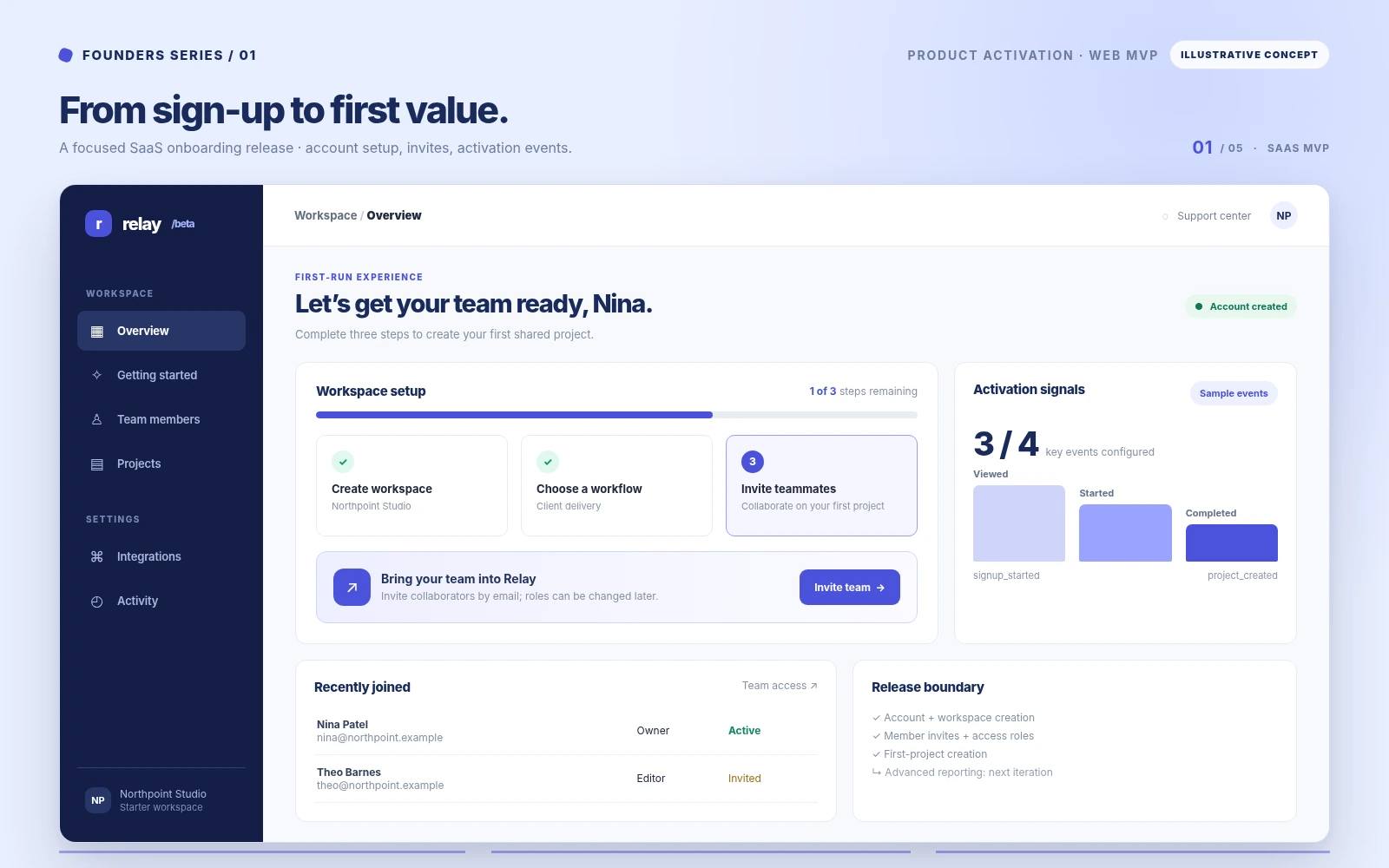
Relay — SaaS Onboarding MVP
A scoped first-run experience that takes a new customer from workspace creation to team invites and the first meaningful product event.

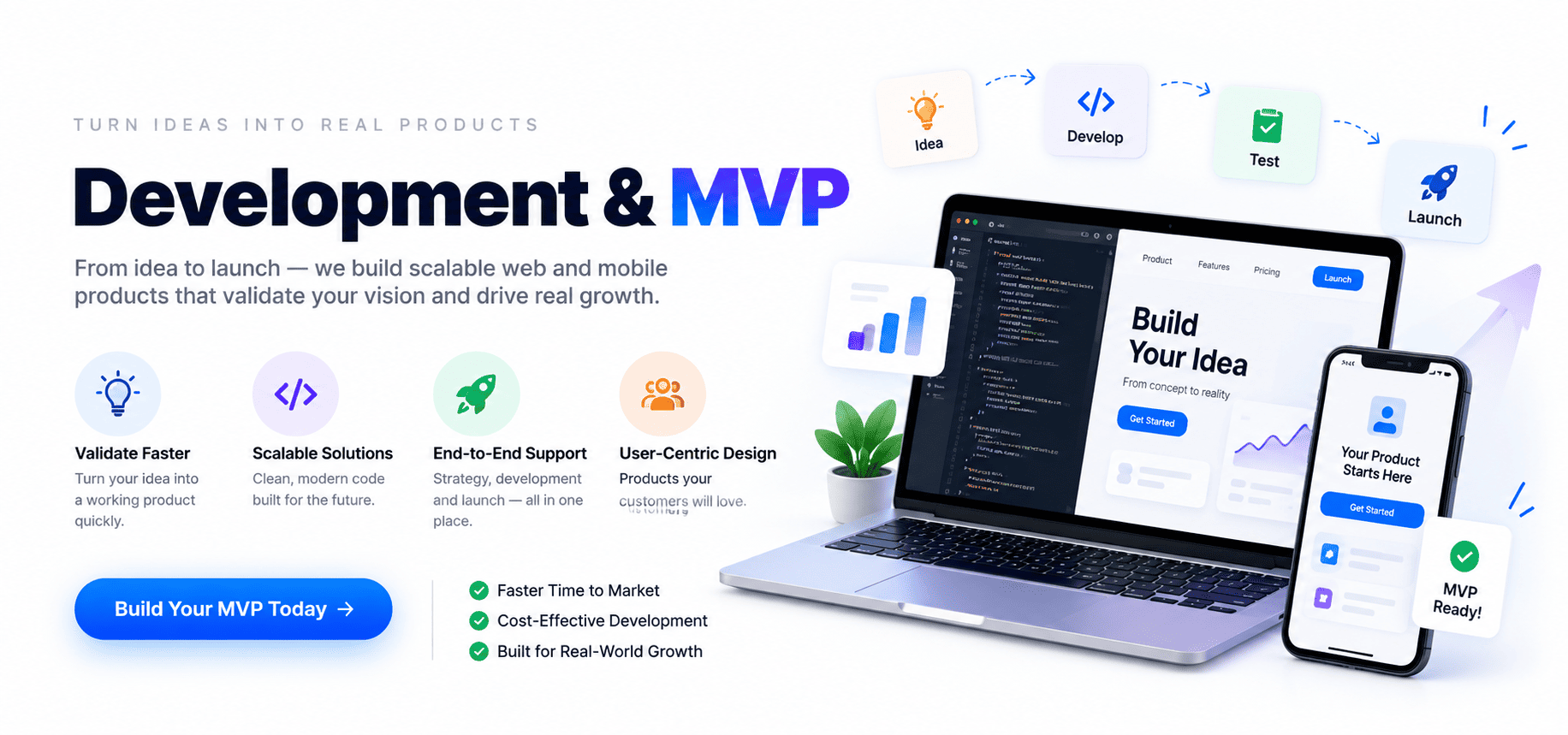
An MVP should be deliberately limited, but it still needs a coherent user journey, dependable data handling, enough technical structure to support the first release, and a way to learn from real usage. Rudrriv’s Development & MVP service is for teams that need to move from an idea, backlog or partially defined product into working software through one defined service.
The service is suitable for startup MVPs, internal business tools, customer portals, early SaaS products, booking or service workflows, marketplace pilots and other digital products where the first release must prove a specific business or user assumption. Rudrriv handles implementation, delivery sequence, reviews and handoff while the customer remains the decision-maker on product priorities.
Share the problem the product must solve, target users, the one workflow that matters most, must-have features, preferred platform, references or wireframes, existing code or APIs if any, required integrations, data or content inputs, deadline and known security, compliance or hosting constraints. If the brief is broad, Rudrriv will use the early scope stage to separate launch-critical requirements from later-phase ideas.
Confirm the product objective, user, must-have journey, assumptions, dependencies and acceptance criteria.
Map the user flow, interface states, data model and technical approach before deeper implementation begins.
Implement prioritized functionality in reviewable increments, incorporating controlled feedback without losing scope discipline.
Validate the agreed flows, prepare deployment, confirm launch events and deliver the completed code and handoff material.
Professional MVP execution is not the same as building every roadmap idea. The first release should be small enough to ship and measure, while still handling the agreed core flow responsibly. Rudrriv keeps scope control, error states, data behavior, analytics, deployment and handoff visible during delivery so the next product decision is based on a usable release rather than a polished mock-up.
These fixed scopes are designed for web-first MVPs. Mobile, multi-platform, regulated, data-migration-heavy or unusually integration-intensive products are quoted after scope review.
| Included | ₹99,999 Essential Focused MVP Sprint Validate one core product workflow with a responsive web MVP, essential data handling, analytics and production deployment. |
₹2,49,999 Professional Recommended Launch-Ready MVP Launch a fuller web MVP with two user roles, a custom backend, admin tools, up to two integrations, QA and release support. |
₹4,99,999 Advanced Growth-Ready MVP Build a broader multi-role MVP with complex workflows, up to three integrations, payment or subscription logic, CI/CD and extended launch support. |
|---|---|---|---|
| Primary platform | Responsive web | Responsive web | 1 primary platform |
| User roles | 1 | Up to 2 | Up to 3 |
| Primary screens / views | Up to 6 | Up to 12 | Up to 18 |
| Scope & acceptance criteria | ✓ | ✓ | ✓ |
| UX flow & interface implementation | Core flow | Primary + secondary flows | Multi-role flows |
| Backend & database | Essential setup | Custom backend | Modular backend |
| Third-party integrations | 1 standard | Up to 2 | Up to 3 |
| Admin tools | Basic administration | Admin dashboard | Admin + reporting |
| Payments / subscriptions | — | 1 provider if required | Payment or subscription flow |
| Product analytics | Basic events | Launch funnel events | Broader event coverage |
| Testing & release checks | Core functional QA | Functional + regression | Broader regression + release readiness |
| Deployment | Production | Staging + production | Staging + production + CI/CD |
| Revision rounds | 2 | 3 | 4 |
| Post-launch defect support | 7 days | 14 days | 30 days |
| Standard delivery | 5 weeks | 8 weeks | 12 weeks |
| Package price | ₹99,999 | ₹2,49,999 | ₹4,99,999 |
DEVELOPMENT & MVP · FIVE PRODUCT CONCEPTS
Five distinct, illustrative examples of what a deliberately scoped product release can look like—from onboarding and reservations to operations, field work and subscription flows. These are representative interface concepts, not completed client case studies or live software.
A scoped first-run experience that takes a new customer from workspace creation to team invites and the first meaningful product event.
A responsive booking journey for selecting a service, reserving a time slot and reviewing the session before confirmation.
An internal procurement pilot with request line items, role-based review stages and a transparent event history.
A paired dispatcher and technician workflow for assigning jobs, completing mobile-friendly checklists and capturing job status.
A minimal recurring-revenue workflow connecting plan selection, hosted checkout, subscription status and member access logic.
The goal of our Development and MVP project was straightforward, but the underlying technical details were not, and the team handled that well. The scope focused on a launch-ready minimum viable product, with sensible checks before anything was moved into production. They paid close attention to scope control, core user journeys, technical architecture, rapid iteration, analytics, and release planning, which were exactly the areas we were concerned about. Milestones were useful rather than ceremonial: each one gave us something concrete to review or test. By launch, we had an MVP that covered the essential workflow and gave us something credible to put in front of users. The final files and notes were organized, and we were able to move directly into the next phase.
Our Development and MVP brief was fairly specific, and the team picked up the context quickly without forcing us through unnecessary process. We asked for a launch-ready minimum viable product, and the implementation was broken down in a way that made each stage easy to validate. We were particularly happy with the attention to scope control, core user journeys, technical architecture, rapid iteration, analytics, and release planning. They kept momentum without rushing decisions that could have affected stability later. We finished the project with an MVP that covered the essential workflow and gave us something credible to put in front of users. We also appreciated that the team left clear recommendations for the next improvements instead of trying to expand the scope during delivery.
Our previous attempt at Development and MVP had left several loose ends, so we wanted a more disciplined second pass. The agreed deliverable was a launch-ready minimum viable product, with room for a few controlled adjustments as we learned more. Details involving scope control, core user journeys, technical architecture, rapid iteration, analytics, and release planning were tested and reviewed rather than assumed to be fine. Testing was more thorough than our previous internal attempts, especially around edge cases and real usage. The biggest improvement was an MVP that covered the essential workflow and gave us something credible to put in front of users. The final files and notes were organized, and we were able to move directly into the next phase.
Tell us what the first release needs to prove, who will use it and what already exists. Rudrriv will review the requirement and respond with the most suitable package, scope assumptions and next steps.