Discounted cash flow
Orion Cloud · 5-Year DCF
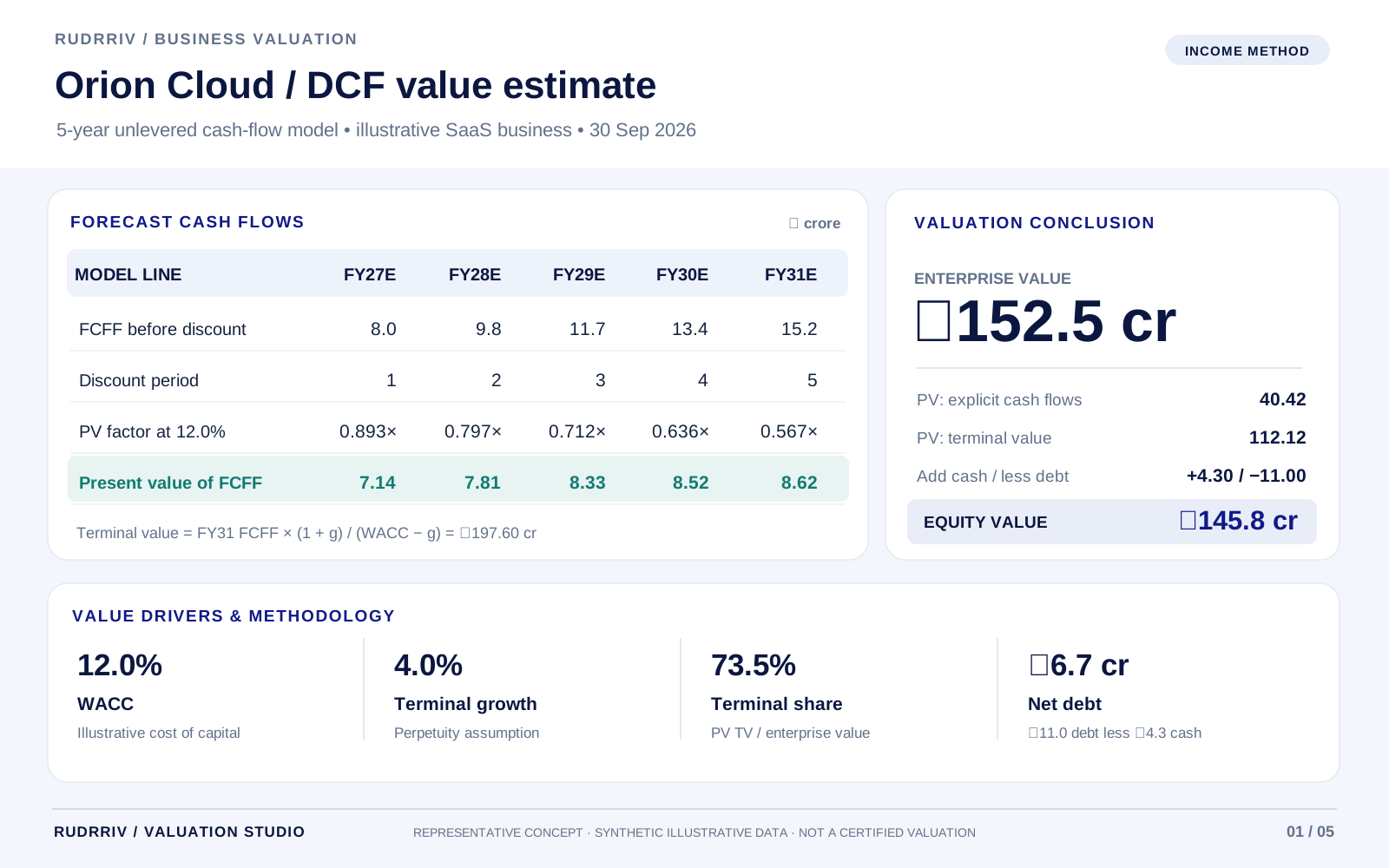
A five-year FCFF model discounts cash flows at a 12% WACC, documents terminal value and reconciles enterprise to equity value.
DCF modelWACC & terminal growthEV-to-equity bridge


A valuation is useful only when the assumptions, methods and evidence behind the number can be understood and challenged. Rudrriv's valuation service is designed for founders, finance teams, business owners and decision-makers who need a structured estimate of business or equity value within a defined service scope.
Typical inputs are recent financial statements or management accounts, an available business plan or forecast, revenue and margin assumptions, debt and cash balances, cap table or shareholding information, material assets and liabilities, and a short explanation of why the valuation is being prepared. We will tailor the data request to your scope rather than asking for information that is not relevant.
We clarify the decision, valuation date, ownership interest, audience and whether any regulated signatory is required.
Financial statements, forecasts, debt, cash, cap table and operating drivers are checked for consistency and material gaps.
Appropriate income, market or asset approaches are applied, with key assumptions documented and value drivers tested.
Rudrriv quality-checks the workings, incorporates included feedback and delivers the report and model files in your package.
DCF, comparable companies, precedent transactions and NAV answer different questions and rely on different evidence. A growth-stage operating company with credible projections may support a DCF, while an asset-heavy business may require more weight on NAV. Market approaches are useful only when the peer or transaction set is genuinely comparable. Rudrriv's team documents why a method is used, how it is cross-checked and where the limitations are.
Selected work · 05 representative concepts
Explore five different valuation workpapers and decision-ready outputs. Each preview is a fictional representative concept with synthetic assumptions and illustrative figures, not a completed client engagement or statutory valuation report.
A five-year FCFF model discounts cash flows at a 12% WACC, documents terminal value and reconciles enterprise to equity value.
A synthetic peer universe with normalized EBITDA, EV/EBITDA multiples and an indicative equity value range after net debt.
Illustrative transaction-set analysis compares control deal multiples, computes the median and translates it into a target value range.
An asset-class revaluation schedule traces book NAV to adjusted shareholder value, with liabilities clearly reconciled.
A three-case exit-multiple valuation translates projected sales into discounted enterprise values and illustrative equity estimates.
All five deliverables show synthetic sample information only. A formal valuation, regulated report or specialist sign-off must be scoped separately when required.
Discuss your valuation project ↗Choose based on the depth of evidence, number of methods, modelling detail and review support you need. Statutory certification or specialist sign-off is not included in these standard package prices.
| Included | ₹4,999 Essential Valuation SnapshotFocused analysis for an early decision or internal planning need. |
₹14,999 Professional Recommended Multi-Method ValuationBroader modelling, sensitivity analysis and editable workings. |
₹29,999 Advanced Transaction-Ready Valuation AnalysisDeeper evidence, scenarios and reconciliation for complex decisions. |
|---|---|---|---|
| Primary valuation method | 1 | Multiple, as relevant | Multiple, as relevant |
| DCF model | Where suitable | ✓ | ✓ |
| Comparable company analysis | Cross-check if available | ✓ | ✓ |
| Precedent transactions | — | Optional cross-check | ✓ where reliable |
| NAV / asset approach | If primary method | If relevant | ✓ where relevant |
| Forecast review | Key assumptions | Up to 5 years | Up to 5 years + scenarios |
| Sensitivity analysis | Basic range check | ✓ | ✓ + scenario cases |
| Enterprise-to-equity bridge | Summary | ✓ | ✓ |
| Editable Excel model | — | ✓ | ✓ |
| PDF report | Concise memo | Detailed report | Detailed report + evidence notes |
| Live walkthrough | — | — | 1 session |
| Revision rounds | 1 | 2 | 3 |
| Standard delivery | 4 business days | 7 business days | 10 business days |
| Package price | ₹4,999 |
₹14,999 |
₹29,999 |
These reviews are the supplied client feedback for Rudrriv's Valuation service. No additional review totals or sales statistics are inferred.
The final result from our Valuation project was strong and closely aligned with the brief. The team translated our requirements into a business valuation using multiple approaches supported by operating assumptions and market evidence while keeping cash flow assumptions, comparable companies, transaction benchmarks, discount rates, sensitivities, and value ranges visible throughout. Milestones were easy to review, files were organized, and changes were tracked carefully as the work developed. That work resulted in a defensible valuation range we could use in negotiations and internal planning.
We hired the team for Valuation and needed a result that could stand up to internal review. The deliverable was structured around a business valuation using multiple approaches supported by operating assumptions and market evidence; the treatment of cash flow assumptions, comparable companies, transaction benchmarks, discount rates, sensitivities, and value ranges was especially useful. They were responsive to comments and also flagged areas where our initial assumptions needed a second look. By the end, we had a defensible valuation range we could use in negotiations and internal planning.
Our Valuation brief had several moving parts, but the process stayed focused. The process combined a business valuation using multiple approaches supported by operating assumptions and market evidence with detailed review of cash flow assumptions, comparable companies, transaction benchmarks, discount rates, sensitivities, and value ranges. The handoff was practical, with enough explanation for our team to maintain the work after the engagement ended. The finished work gave us a defensible valuation range we could use in negotiations and internal planning.
Tell us why you need the valuation, what is being valued, the information you already have and whether the output must satisfy a specific investor, board, tax, legal or regulatory requirement.