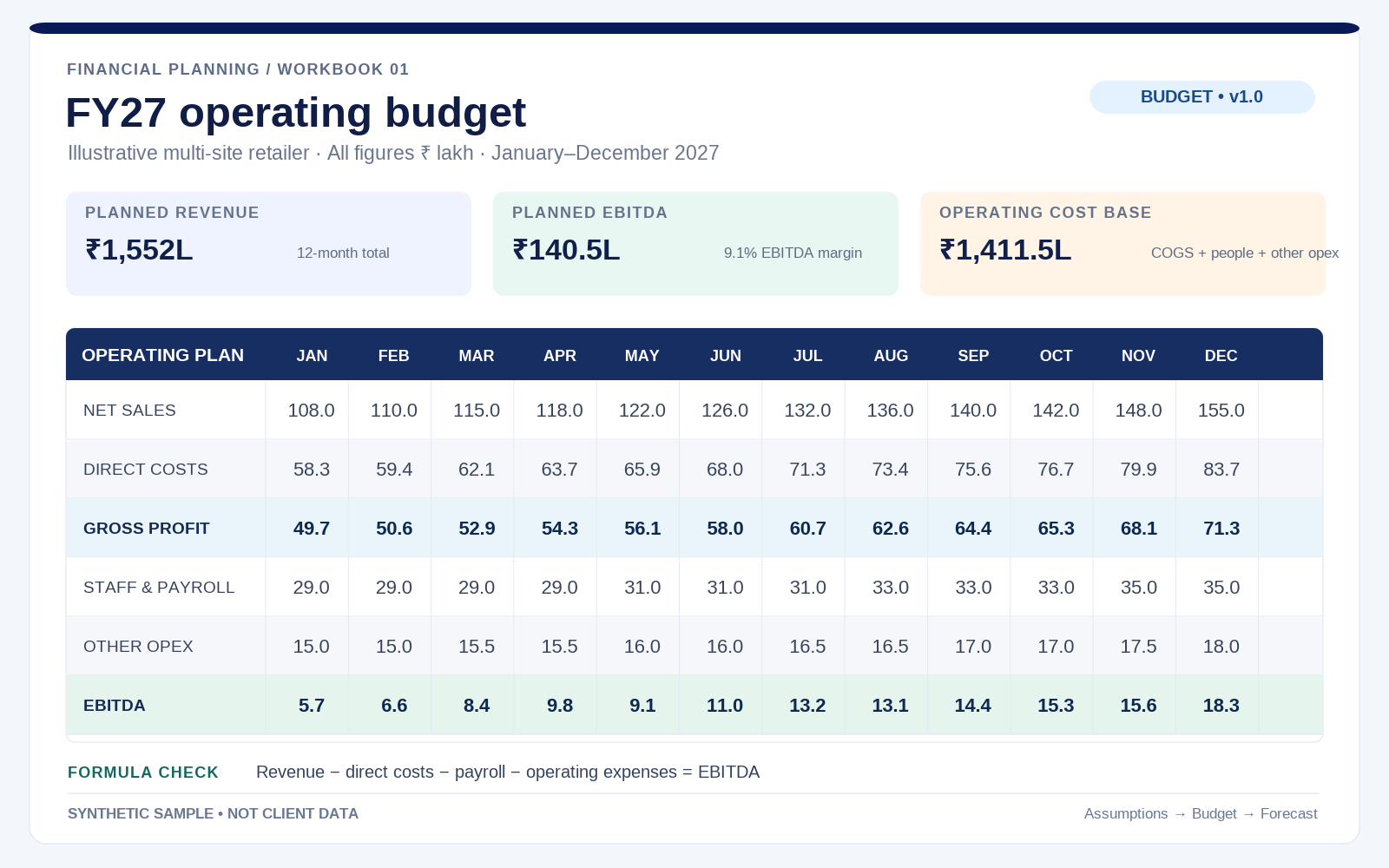
Annual operating budget workbook
A twelve-month plan that reconciles revenue, direct costs, payroll and operating expenses to planned EBITDA.


Budgeting and forecasting convert business assumptions into a structured financial plan. A budget defines the operating plan management intends to work toward; a forecast updates the expected outcome as actual results, priorities and assumptions change. The most useful models connect revenue, staffing, operating costs, seasonality, cash timing and other real drivers instead of simply extending prior-period averages.
Rudrriv provides this professional service around your planning objective and available data. The scope is confirmed, the model is built and reviewed, the deliverables are checked, and an editable model is returned for your team to continue using.
Useful inputs include recent profit-and-loss statements or management accounts, revenue history, major expense categories, payroll and headcount information, current commitments, any existing budget or forecast, known seasonality, working-capital patterns, planned hiring or investment, and management-approved assumptions. If the model is intended to answer a specific decision—such as hiring, expansion, pricing, cash runway or cost control—include that objective at the start.
Rudrriv clarifies the planning objective, forecast horizon, decision needs, available records and package fit.
Our team structures assumptions, budget schedules and forecast logic around the agreed business drivers.
Key assumptions, outputs and inconsistencies are reviewed; your consolidated feedback is incorporated within the package revision policy.
Formulas, assumptions and outputs are checked for consistency before the editable workbook and guidance are delivered.
A planning model should be understandable enough to update when conditions change. The work therefore separates assumptions from calculated outputs, keeps material drivers visible, and avoids unnecessary complexity that makes maintenance difficult. The final structure depends on your data quality, business model and selected scope.
Choose Essential for a straightforward operating plan, Professional for a reusable driver-based model with rolling forecast and variance tracking, or Advanced for a longer horizon and deeper scenario planning.
| Included | ₹4,999 Essential Budget & Forecast Starter A practical 12-month operating budget and baseline forecast for one business or entity using supplied historical data and management assumptions. |
₹9,999 Professional Recommended Driver-Based Planning Model A driver-based operating budget and rolling forecast with headcount, cash planning and a reusable budget-versus-actual structure. |
₹19,999 Advanced Integrated Planning & Scenario Model A deeper planning model for more complex businesses, connecting operating assumptions, cash needs, scenarios and management review outputs. |
|---|---|---|---|
| Business / entity coverage | 1 | 1 | 1 primary entity; custom quote for multi-entity |
| Planning horizon | 12 months | 12 months rolling | Up to 24 months |
| Operating budget | ✓ | ✓ | ✓ |
| Driver-based revenue & expense schedules | Core assumptions | ✓ | ✓ |
| Headcount & payroll plan | — | ✓ | ✓ |
| Cash-flow planning | Monthly summary | ✓ | Integrated |
| Budget vs actual structure | — | ✓ | ✓ |
| Scenario planning | — | 3 cases | Expanded scenarios + sensitivities |
| Management summary / dashboard | — | Summary view | Expanded dashboard |
| Revision rounds | 1 | 2 | 3 |
| Standard delivery | 5 business days | 7 business days | 10 business days |
| Final files | Editable workbook + notes | Editable workbook + model guide | Editable workbook + guide + dashboard |
| Package price | ₹4,999 | ₹9,999 | ₹19,999 |
See how operating budgets, driver-led forecasts and scenario analysis can translate planning assumptions into decision-ready deliverables. All five are original representative concepts using synthetic figures—not actual client engagements.
A twelve-month plan that reconciles revenue, direct costs, payroll and operating expenses to planned EBITDA.
Subscriber additions, churn and average revenue per account flow through to a transparent forward outlook.
Role-by-role start dates make the cost difference between delayed, base and faster hiring tangible.
A direct-method cash roll-forward for short-term payments, customer receipts and liquidity monitoring.
A reconciled EBITDA bridge that isolates performance gaps and informs the next forecast refresh.
Our Budgeting and Forecasting brief had several moving parts, but the process stayed focused. The scope centered on an operating budget and rolling forecast built around business drivers rather than simple historical averages. Particular care went into revenue assumptions, headcount, operating costs, seasonality, cash needs, forecast ownership, and variance tracking. The team explained the reasoning behind key choices, which made approvals easier for both finance and non-finance stakeholders. The result was a forecast the team could update and use as conditions changed.
We engaged the team specifically for Budgeting and Forecasting and were pleased with the balance of technical depth and practicality. They built the work around an operating budget and rolling forecast built around business drivers rather than simple historical averages, with consistent attention to revenue assumptions, headcount, operating costs, seasonality, cash needs, forecast ownership, and variance tracking. Milestones were easy to review, files were organized, and changes were tracked carefully as the work developed. We came away with a forecast the team could update and use as conditions changed.
The experience with Budgeting and Forecasting was smooth and professional from start to finish. The assignment covered an operating budget and rolling forecast built around business drivers rather than simple historical averages. We especially valued the focus on revenue assumptions, headcount, operating costs, seasonality, cash needs, forecast ownership, and variance tracking. They were responsive to comments and also flagged areas where our initial assumptions needed a second look. Ultimately, the engagement delivered a forecast the team could update and use as conditions changed.
Tell us what you need the budget or forecast to help you decide, what financial data is available, and how often the model needs to be updated. Rudrriv will assess the scope and recommend the most suitable package or custom engagement.