
01SIGNAL READINESSConcept work
Conversion signal readiness audit
Lead-generation signal audit mapping primary goals, tracking risks and the conditions required before a bid-strategy change.

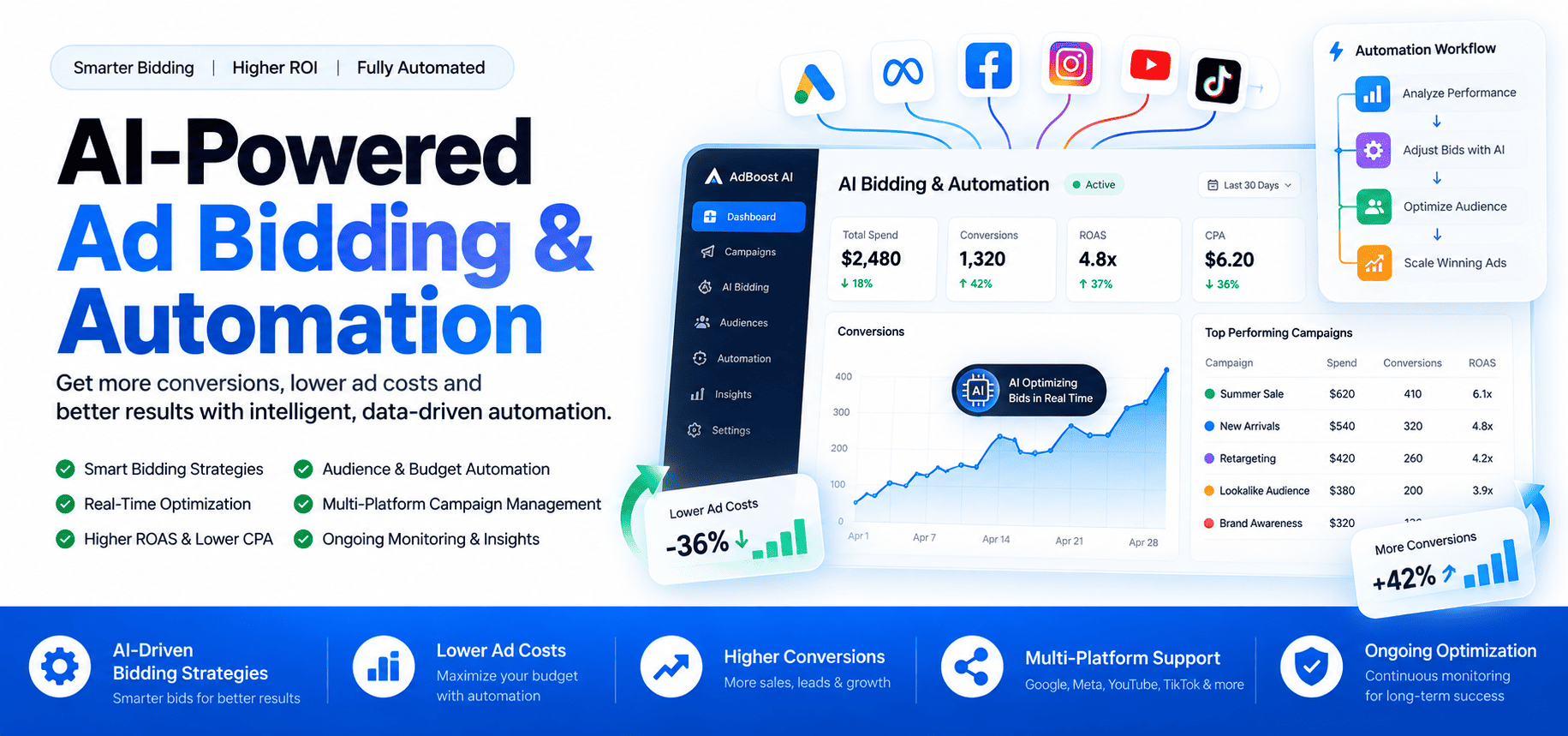
AI-powered ad bidding uses the advertising platform's machine-learning systems to adjust bids toward a defined conversion or value goal. The configuration still needs human judgment: the platform must be optimizing the right conversions, budgets need sensible limits, targets must reflect the economics of the campaign, and unusual data or spend behavior needs a response plan.
Rudrriv's service is designed for businesses that already run paid campaigns—or are preparing to scale them—and want a more systematic bidding operating model. Rudrriv reviews the account and measurement setup, implements the agreed automation, quality-checks the configuration and delivers a documented handoff.
Share the ad platform, account structure, active campaigns, business objective, current budgets, target CPA or ROAS if you use them, conversion actions, conversion values where applicable, attribution setup, recent performance context and any internal limits on spend or automated changes. If leads close offline, include the CRM or offline-conversion process so signal quality can be assessed properly.
Review conversion actions, values, attribution, campaign objectives and constraints.
Match campaigns to conversion-volume or value-based bidding strategies that fit the data.
Set budgets, rules, thresholds, exclusions or exception handling supported by the account.
Review the final configuration, document assumptions and define what the team should monitor next.
Automated bidding does not remove the need for account governance. Poor conversion signals can teach the system to pursue the wrong outcome; aggressive target or budget changes can distort learning; and outages or reporting problems can make normal automation react to bad data. The service therefore treats measurement, guardrails and monitoring as part of the bidding setup rather than as afterthoughts.
Choose based on the number of campaigns, platform complexity and the amount of monitoring, experimentation and handoff support you need. Advertising spend is separate from these service fees.
| Included | ₹4,999 Essential Bidding Foundation For a focused automated-bidding setup in one ad account. |
₹9,999 Professional Recommended Automation Control System For a broader campaign set with budget rules, testing and operating guidance. |
₹19,999 Advanced Multi-Platform Bid Operations For multi-account or multi-platform paid-media operations. |
|---|---|---|---|
| Account / platform scope | 1 account | 1 account | Up to 2 |
| Active campaign coverage | Up to 3 | Up to 8 | Up to 15 |
| Conversion-signal review | ✓ | ✓ | ✓ |
| Value / attribution review | Sanity check | Detailed | Detailed + offline inputs |
| Automated bidding setup | ✓ | ✓ | ✓ |
| Portfolio / cross-campaign structure | — | Where suitable | Where suitable |
| Budget automation guardrails | Basic | Advanced | Multi-account |
| Experiment plan | — | ✓ | ✓ |
| Anomaly / exception framework | Checklist | Thresholds + cadence | Cross-platform workflow |
| Post-launch review | — | 1 review | 2 reviews / 14 days |
| Revision rounds | 1 | 2 | 2 |
| Standard delivery | 4 business days | 7 business days | 10 business days |
| Package price | ₹4,999 |
₹9,999 |
₹19,999 |
Explore five representative artifacts from a measurement-first bidding engagement: conversion inputs, bid decisions, value logic, budget guardrails and response governance. These are original concept examples, not deployed campaigns or verified client results.
Lead-generation signal audit mapping primary goals, tracking risks and the conditions required before a bid-strategy change.
Google Ads Search campaign routing and conditional bid-strategy selection with portfolio eligibility and change controls.
Ecommerce value-input specification with synthetic order values, finance assumptions and quality controls before tROAS.
Illustrative monthly budget pacing chart, variance thresholds and approval-led responses to unexpected spend changes.
Monitoring, measurement verification and accountable escalation for hypothetical conversion drops and bidding exceptions.
How to read these samples. All figures, account models and operating scenarios are synthetic. Actual platform settings depend on measurement quality, eligibility and client approval.
Discuss your bidding setupThe team handled our AI-Powered Ad Bidding & Automation engagement with a level of detail that was useful without being overwhelming. They built an automated bidding and budget-control framework using reliable conversion signals, guardrails, and exception monitoring around budget rules, automation guardrails, anomaly checks, and attribution review and consistently connected tactical decisions back to the objective. When feedback introduced conflicting priorities, they highlighted the tradeoff instead of trying to satisfy both directions at once. That kept the work coherent. By completion, bidding became more systematic while the team retained clear controls for budget shifts and unusual performance changes. We appreciated the professional communication and the fact that the final deliverables were designed for ongoing use, not just presentation.
We selected the team for AI-Powered Ad Bidding & Automation because we needed a clearer operating approach, not just more activity. They created an automated bidding and budget-control framework using reliable conversion signals, guardrails, and exception monitoring and worked through conversion signal quality, bid strategy, budget rules, automation guardrails, anomaly checks, and attribution review with a strong focus on practical decisions. Progress was visible throughout the project, open questions were captured properly, and revisions improved the work without restarting it. The strongest outcome was that bidding became more systematic while the team retained clear controls for budget shifts and unusual performance changes. The project gave us both a finished deliverable and a better way to think about future optimization.
We hired the team for AI-Powered Ad Bidding & Automation to put an automated bidding and budget-control framework using reliable conversion signals, guardrails, and exception monitoring into practice. The brief was handled carefully, especially around conversion signal quality, bid strategy, budget rules, and automation guardrails. They surfaced a few dependencies we had missed, explained the implications in plain language, and kept the work moving without forcing unnecessary complexity. Revisions were incorporated quickly and the rationale behind major changes was documented. The most useful outcome was that bidding became more systematic while the team retained clear controls for budget shifts and unusual performance changes. The final materials were organized, practical, and easy for our team to continue using.
Share how your ad account is structured, what you optimize for and where automation is currently failing or taking too much manual effort. Rudrriv will review the brief and recommend the right scope.