
Dataset normalization
Catalog Feed Standardization
An illustrative supplier catalog with canonical SKU and price fields, duplicate rules, and explicit exception routing.

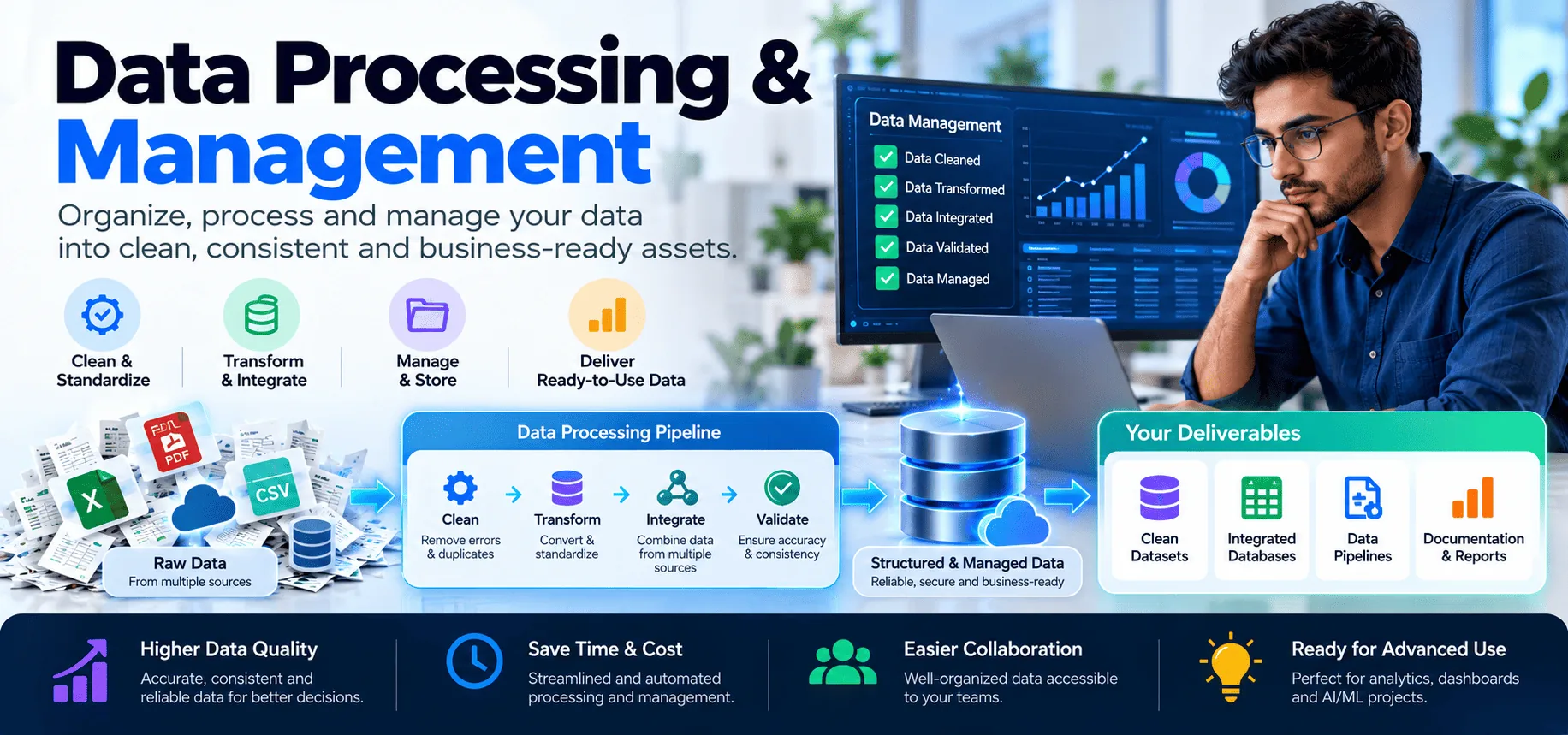
Data processing is the practical work of turning raw business information into a form that can be used reliably by people, spreadsheets, reporting tools, databases or downstream systems. Depending on the source, that may mean cleaning inconsistent values, parsing fields, standardizing formats, joining related records, removing duplicates, applying transformation logic, aggregating measures, validating results and packaging the output for reuse.
Rudrriv provides Data Processing & Management around the agreed requirement, source data and processing rules. The service covers execution, validation, review and delivery of the agreed output with the supporting material included in your package.
Send representative source files and explain what the finished data should look like. Include approximate row or file volume, output format, transformation or mapping rules, known issues, examples of expected results, recurrence frequency and deadline. If another system will consume the output, explain its column, schema or import requirements so the processing rules can be aligned before execution.
Rudrriv reviews sources, volumes, transformations, edge cases, required outputs and acceptance criteria.
Rudrriv cleans, parses, maps, transforms or aggregates the data according to scope.
Results are checked against agreed rules, with exceptions and assumptions documented where applicable.
You receive the processed files and package-specific scripts, validation material and run instructions.
The right validation depends on the dataset and the business decision that follows. A duplicate rule for customer records is different from a reconciliation rule for financial transactions, so checks are scoped around the meaning of the data rather than applied as generic cleanup. Highly ambiguous records may require your decision before they can be corrected safely.
Choose by data volume, complexity and whether you need a one-time cleaned output, reusable transformation logic or a broader automated batch workflow.
| Included | ₹1,499.00 Essential Data Cleanup & Standardization For one structured file that needs reliable cleanup and validation. |
₹4,999.00 Professional Recommended Reusable Processing Workflow For recurring files that need documented transformation logic. |
₹9,999.00 Advanced Automated Processing Pipeline For broader recurring batches with stronger controls and handover. |
|---|---|---|---|
| Data volume guideline | Up to 3,000 rows | Up to 25,000 rows | Up to 100,000 rows |
| Source files | 1 | Up to 3 | Up to 5 recurring files |
| Cleaning & standardization | ✓ | ✓ | ✓ |
| Parsing / mapping / transformations | Basic | Custom rules | Complex rules |
| Aggregation | — | ✓ | ✓ |
| Reusable processing script | — | Where appropriate | ✓ |
| Exception log | — | Basic notes | ✓ |
| Runtime optimization | — | — | ✓ |
| Documentation | Validation checklist | Validation report + run instructions | Runbook + validation + sample outputs |
| Revision rounds | 1 | 2 | 3 |
| Standard delivery | 2 days | 5 days | 7 days |
| Package price | ₹1,499.00 | ₹4,999.00 | ₹9,999.00 |
See what a well-defined processing deliverable can look like: structured exports, documented transformations, reconciled values, controlled batch runs, and practical quality evidence.
An illustrative supplier catalog with canonical SKU and price fields, duplicate rules, and explicit exception routing.
A three-row order export illustrates typed field mappings, calculated line totals, and reusable CSV transformation rules.
Transaction-level comparisons reconcile expected versus received values, preserving a ₹50 discrepancy for review.
A five-file batch manifest shows processing steps, row counts, and separate handling for flagged inventory records.
Acceptance checks, exception counts, file manifests, and run documentation are recorded as a repeatable handover pack.
Concept work only. These five artifacts use synthetic, illustrative records and do not represent completed client commissions, live system connections, measured performance, or production deployments.
Share the formats, sample inputs, validation rules and intended output. We can scope a suitable processing deliverable.
Data Processing & Management turns raw or inconsistent business data into structured, validated and reusable outputs. The work can include cleaning, parsing, standardization, deduplication, mapping, transformation, aggregation, quality checks, repeatable scripts and documented handover.
Common inputs include Excel workbooks, CSV files, JSON, XML and structured exports from business systems. If your source is a database, API, scanned document or unusual proprietary format, share the details first so the scope and access method can be assessed.
The Essential package is ₹1,499.00, Professional is ₹4,999.00 and Advanced is ₹9,999.00, inclusive of taxes as shown on this page. Larger datasets, live integrations, ongoing operations or unusually complex rules may need a custom quote.
Choose Essential for one bounded spreadsheet or CSV cleanup, Professional for recurring files that need reusable transformation logic and documentation, and Advanced for a broader automated batch workflow with stronger validation, exception handling and runtime optimization.
Yes. Professional and Advanced scopes can include reusable processing scripts when appropriate. Advanced is designed for recurring batch files and can include exception logging and runtime optimization. API orchestration, production deployment and always-on pipelines are custom-scoped.
Validation is agreed from the rules that matter to your dataset, such as required fields, data types, allowed values, duplicate logic, row counts, reconciliation totals, transformation checks and exception review. The selected package determines the depth of validation evidence and documentation included.
Share representative source files, approximate row or file volume, the required output format, transformation or mapping rules, known data-quality issues, examples of expected results, recurrence frequency and your deadline. For complex workflows, also explain downstream systems and any access constraints.
Reusable scripts are included where stated in the Professional or Advanced package and where scripting is the appropriate implementation. Essential is primarily a processed-data deliverable. The final handover follows the exact package scope agreed for your project.
Confidentiality, access controls and data-handling constraints should be discussed before files are shared. Do not place passwords, API keys or production credentials in the enquiry form. Rudrriv will scope an appropriate handover and access approach for the project requirements.
A custom quote is appropriate for very large volumes, databases, APIs, cloud platforms, streaming or near-real-time processing, complex multi-system integrations, OCR-heavy document processing, ongoing recurring operations, or requirements that fall outside the package limits shown here.
The scope for Data Processing looked straightforward at first, but the underlying data issues made it more complex. The team still kept the project focused around an automated data-processing pipeline for recurring files. We appreciated the discipline around validation, automation, runtime efficiency, parsing, and transformation logic. The team kept technical detail available when we needed it, while still making review sessions understandable for business stakeholders. The outcome was faster recurring processing with fewer errors and much less manual intervention, and the inclusion of processing scripts, validation checks, sample outputs, and simple run instructions made it possible for us to keep improving the work internally.
This was our first outsourced Data Processing project, and we needed an automated data-processing pipeline for recurring files with enough documentation for our internal team to take over confidently. They kept a close eye on runtime efficiency, parsing, transformation logic, aggregation, and validation. Progress updates were concise, and the evidence behind important decisions was easy for us to verify. In the end, the work provided faster recurring processing with fewer errors and much less manual intervention. The documented processing scripts, validation checks, sample outputs, and simple run instructions made the result easy to verify, reuse, and extend.
We asked the team to revisit our Data Processing process and produce an automated data-processing pipeline for recurring files; their approach was structured from discovery through final validation. A lot of value came from the attention to transformation logic, aggregation, validation, automation, and runtime efficiency. Instead of hiding uncertainty, the team documented it and showed us where additional data or different assumptions would change the result. The outcome was faster recurring processing with fewer errors and much less manual intervention, and the inclusion of processing scripts, validation checks, sample outputs, and simple run instructions made it possible for us to keep improving the work internally.
Tell us what data you receive, what needs to happen to it and what a successful output looks like. Rudrriv will review the scope and respond with the most suitable package or a custom plan.
PROCESSING CONCEPT SAMPLE
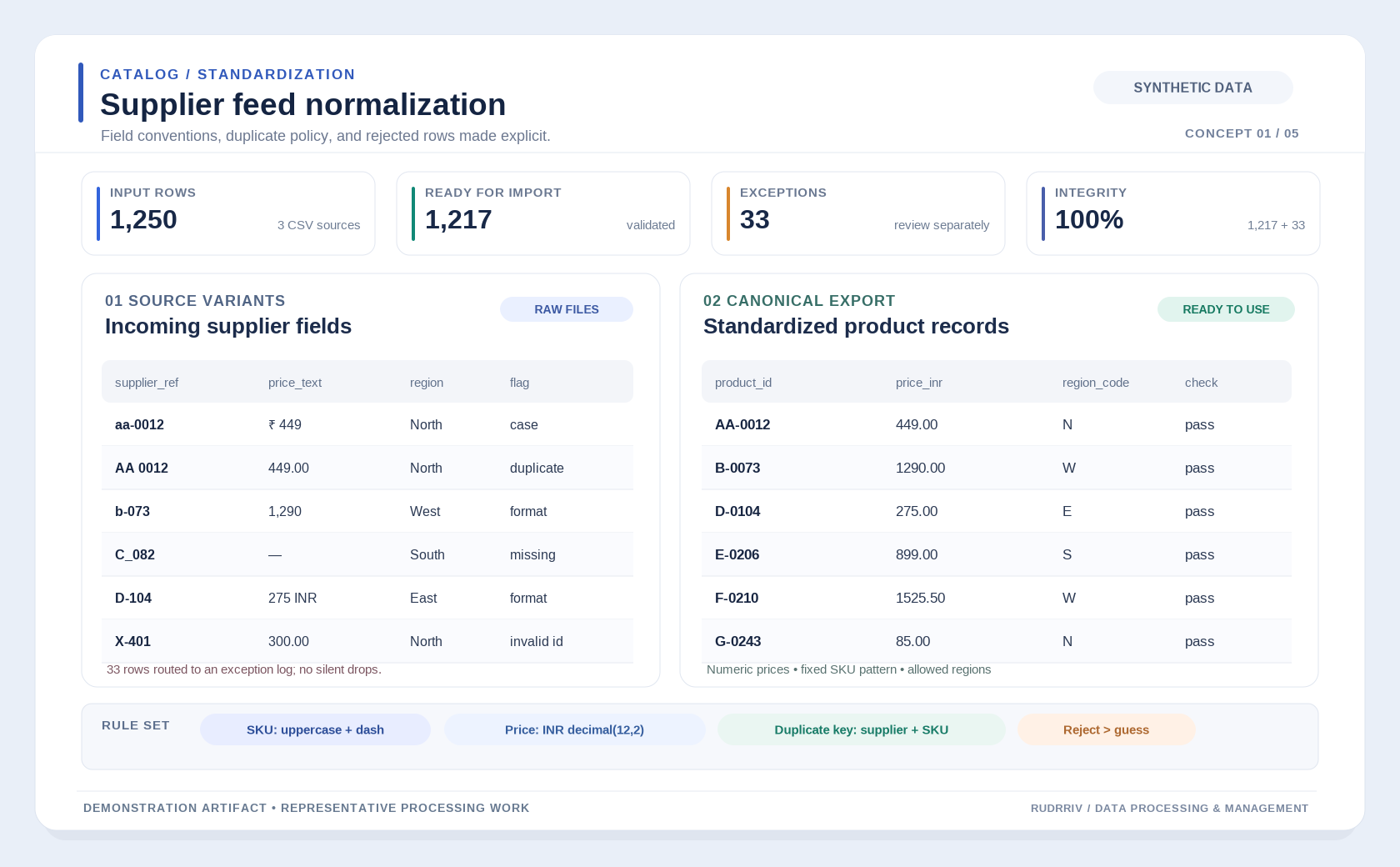
Illustrative, synthetic data processing example.
Open full resolution ↗