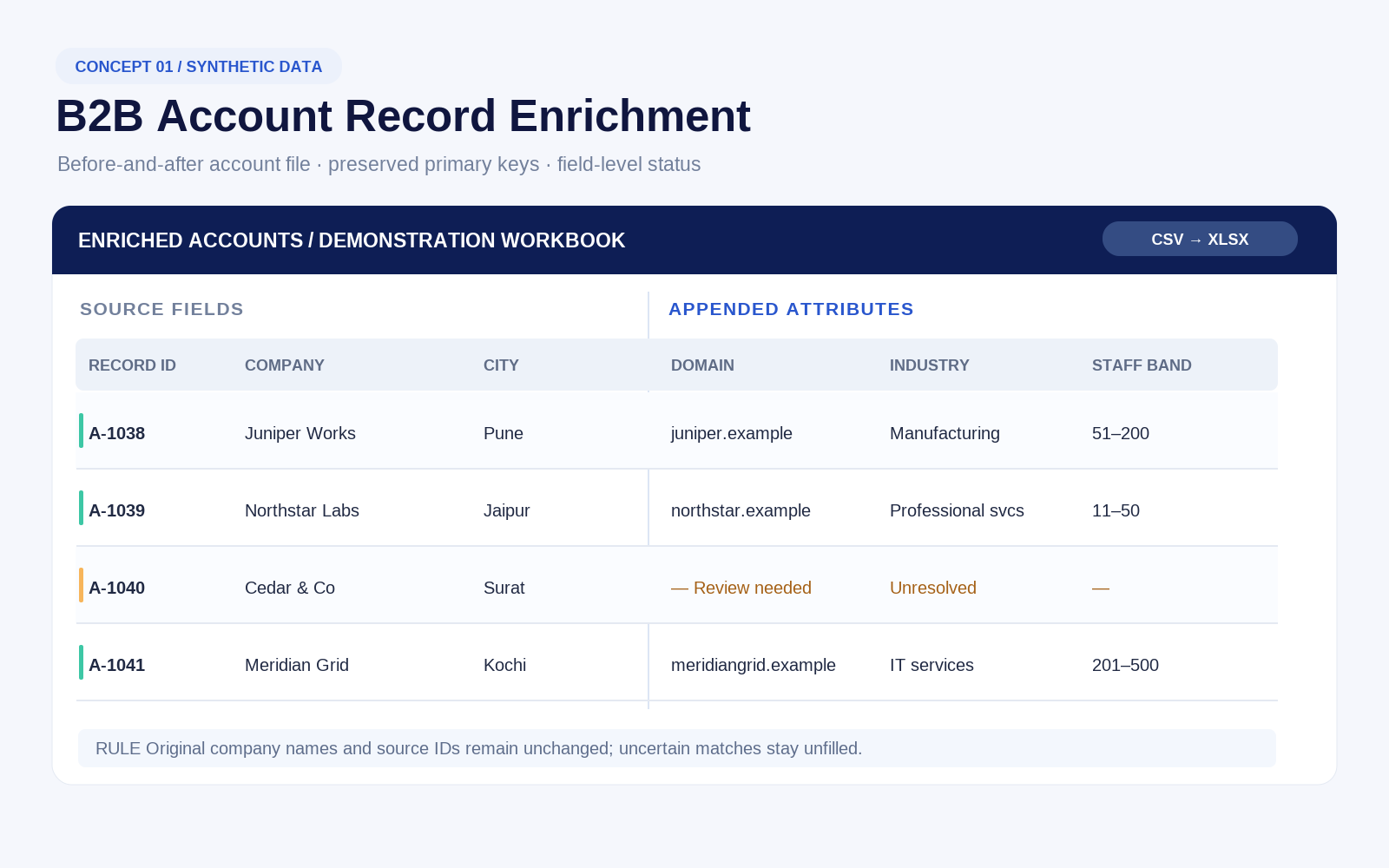
B2B Account Record Enrichment
A before-and-after workbook that appends company domains, industry classifications and size bands without changing the original CRM identifiers.

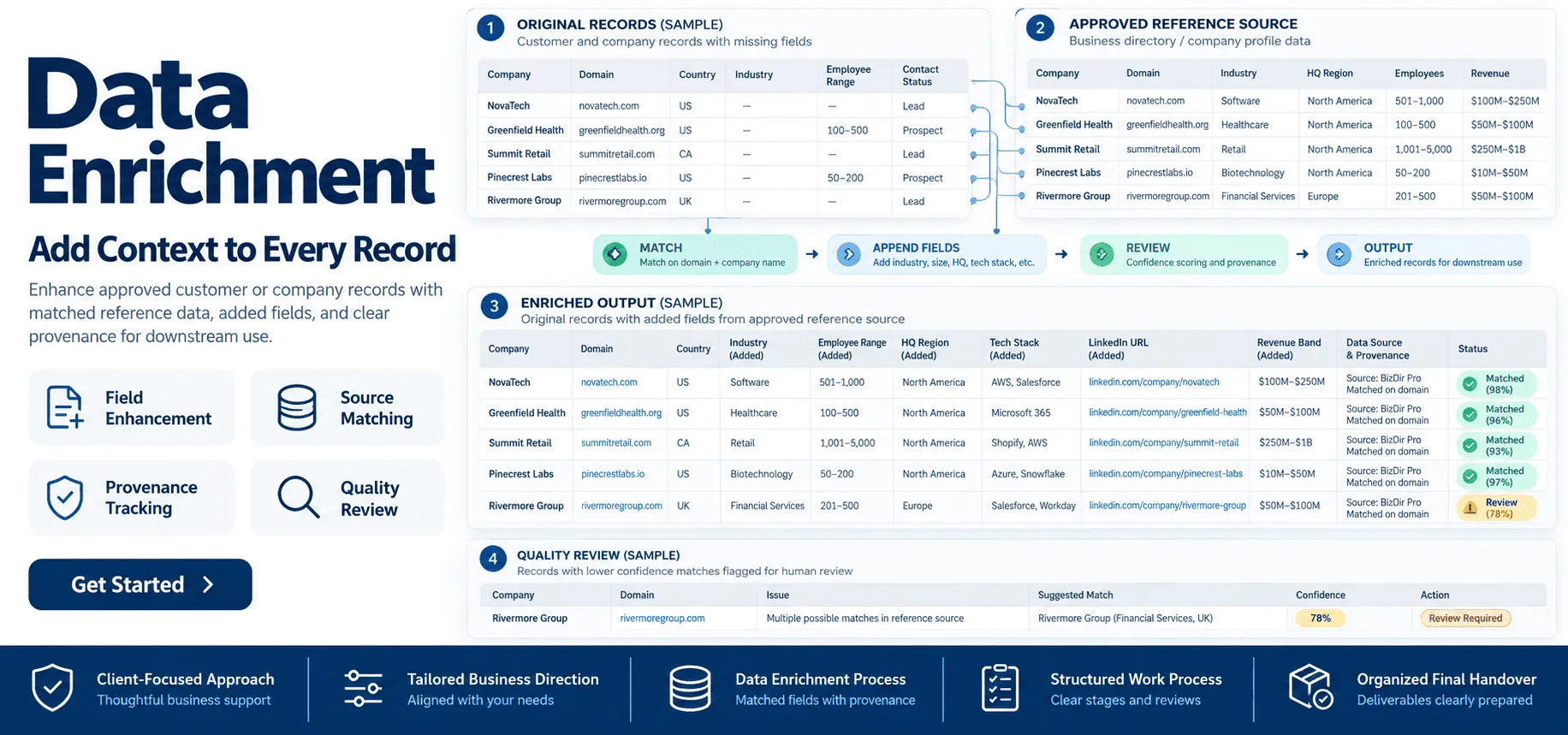
Data enrichment is the process of making an existing dataset more useful by adding missing attributes, checking important values and standardizing records against an agreed schema. It is commonly used when a CRM export, lead list, supplier file, product catalog or operational dataset contains enough identifiers to be useful but not enough context to support reliable segmentation, routing, outreach, reporting or analysis.
Rudrriv provides data enrichment around the starting file, target fields and business purpose. The service covers research, verification, standardization, quality review and delivery of the enriched dataset in the agreed format.
Depending on the dataset and lawful source availability, enrichment may cover company website and domain, industry, sub-industry, employee range, revenue band, headquarters location, business contact role/title, professional profile URL, business email, company classification, product attributes, vendor categories, geography fields or other custom business attributes. The target fields are defined during scoping rather than assumed.
For accurate scoping, send the existing file or a representative sample, the stable record key to preserve, the fields you want added or checked, any source restrictions, intended business use, required output format and deadline. If your dataset is confidential, use a masked sample for initial scoping and arrange an approved secure transfer method for production data.
Not every record can be enriched to the same depth. Match rates vary with starting identifiers, geography, niche industries, field type and source availability. Rudrriv should not guess a value simply to fill a blank; unresolved or conflicting records are more useful when they are flagged clearly. Paid database, API or licence charges may also apply when the requested data cannot be obtained from included sources.
Review identifiers, field gaps, record volume, target schema and source constraints.
Resolve the correct entities and append the approved company, contact or operational fields.
Standardize values, check duplicates and flag low-confidence, conflicting or unresolved records.
Run the final quality review and return the enriched dataset in the agreed schema and format.

Choose by record volume, number of fields and how much verification, source visibility and field mapping your workflow needs.
| Package | ₹999 Essential Essential Record EnrichmentSmall files and focused field completion. | ₹3,499 Professional Recommended Verified CRM EnrichmentMore records, fields and field-level verification. | ₹8,999 Advanced Advanced Data EnrichmentLarger datasets with mapping and source visibility. |
|---|---|---|---|
| Existing records | Up to 250 | Up to 1,000 | Up to 2,500 |
| Enrichment fields | Up to 3 | Up to 5 | Up to 8 |
| Normalization & duplicate checks | ✓ | ✓ | ✓ |
| Verification status | Basic | Key fields | Field-level + confidence flags |
| Source notes | — | Key researched fields | ✓ |
| CRM field mapping | — | Import-ready columns | Custom mapping sheet |
| Output format | CSV / XLSX | CSV / XLSX | CSV / XLSX / JSON |
| Revisions | 1 | 2 | 2 |
| Delivery | 2 business days | 4 business days | 6 business days |
| Select |
Explore five representative business-data enrichment deliverables—from append-only CRM fields and contact verification flags to firmographic coverage, catalogue enrichment and import-ready field maps.
A before-and-after workbook that appends company domains, industry classifications and size bands without changing the original CRM identifiers.
An organized enrichment handoff for standardizing job titles and documenting contact validation and unresolved-email statuses.
A field-completeness matrix and source-review trace that makes matched, missing and uncertain business attributes visible.
A normalized catalogue showing supplier identifiers, canonical product families, packaging units and location-specific review states.
An import-safe schema mapping with preserved keys, enriched columns, a change ledger and handoff notes for unresolved records.
Demonstration work. Every preview uses synthetic records and illustrative decisions, not real customer data or measured project outcomes. Scope and sources are confirmed before a commissioned enrichment job.
Discuss your enrichment dataset →Enlarged concept artifact with synthetic sample data.
Data enrichment improves an existing dataset by adding useful missing attributes, validating or standardizing fields, and making records more complete for sales, marketing, operations, analytics or CRM use.
Typical projects include company and account data, business contact fields, firmographic attributes, locations, website and domain data, role or title information, industry classifications, product or vendor attributes, and other business fields that can be researched lawfully and reliably.
Packages start at ₹999 for up to 250 existing records and three enrichment fields. The Professional package is ₹3,499 for up to 1,000 records and five fields, while Advanced is ₹8,999 for up to 2,500 records and eight fields. Larger or unusually complex datasets are quoted separately.
Provide the existing file or a representative sample, the record identifier to preserve, the fields you want added or checked, any approved or prohibited sources, the intended use of the data, required output format and deadline.
Yes. Rudrriv can work from a CRM export and return enriched columns against the original record keys. By default, corrections or suggested replacements can be delivered in separate fields so you control what is imported back into the CRM.
No. Match and verification rates depend on the starting identifiers, geography, requested fields and source availability. Records that cannot be matched or verified should be returned with a clear status rather than filled with unsupported values.
Where the scope includes contact enrichment, business emails and other contact fields can be researched and checked using suitable validation methods and approved sources. Availability varies by record, geography and permitted use.
The listed packages are planned for approximately 2, 4 and 6 business days respectively. Very large files, niche research requirements, restricted sources or complex matching rules may require a custom timeline.
Standard delivery is available in CSV or XLSX. Advanced work can also be structured as JSON when appropriate. Column names, record keys and field order can be mapped to your destination system where included in the scope.
Yes, when they are appropriate and authorized for the project. Any third-party licence, credit or API cost that is not included in the selected package is identified during scoping before work begins.
The supplied testimonials below are specifically labelled Data Processing & Management. They are shown as related data-service feedback and are not represented as Data Enrichment reviews.
Our previous approach to Data Processing & Management was producing inconsistent results, so we asked the team to build a structured data-processing workflow spanning ingestion through storage with stronger controls. A lot of value came from the attention to storage organization, scheduling, monitoring, lineage, data ingestion, and transformations. Instead of hiding uncertainty, the team documented it and showed us where additional data or different assumptions would change the result. The final result gave us a more stable data operation with fewer manual handoffs and clearer ownership of recurring processes. We received processing jobs, schedules, monitoring notes, data maps, and operating documentation, and the transition into day-to-day use was smooth.
We engaged the team on Data Processing & Management to create a structured data-processing workflow spanning ingestion through storage, and they were careful not to overcomplicate the solution. The team worked methodically through monitoring, lineage, data ingestion, transformations, storage organization, and scheduling. That made revisions faster because issues were isolated, documented, and resolved rather than repeatedly resurfacing. Most importantly, we ended up with a more stable data operation with fewer manual handoffs and clearer ownership of recurring processes. The team packaged processing jobs, schedules, monitoring notes, data maps, and operating documentation in a way that made the next stage straightforward.
The Data Processing & Management assignment involved several dependencies, but the team organized the work around a structured data-processing workflow spanning ingestion through storage and kept each milestone reviewable. The project stayed controlled because the team treated data ingestion, transformations, storage organization, scheduling, monitoring, and lineage as core requirements, not optional polish to be added at the end. The final result gave us a more stable data operation with fewer manual handoffs and clearer ownership of recurring processes. We received processing jobs, schedules, monitoring notes, data maps, and operating documentation, and the transition into day-to-day use was smooth.
Share a sample of the dataset, record volume, fields you want added or verified, output format and deadline. Rudrriv will assess the match complexity and recommend the appropriate package or custom scope.