Supply Chain Management / Operational diagnostic
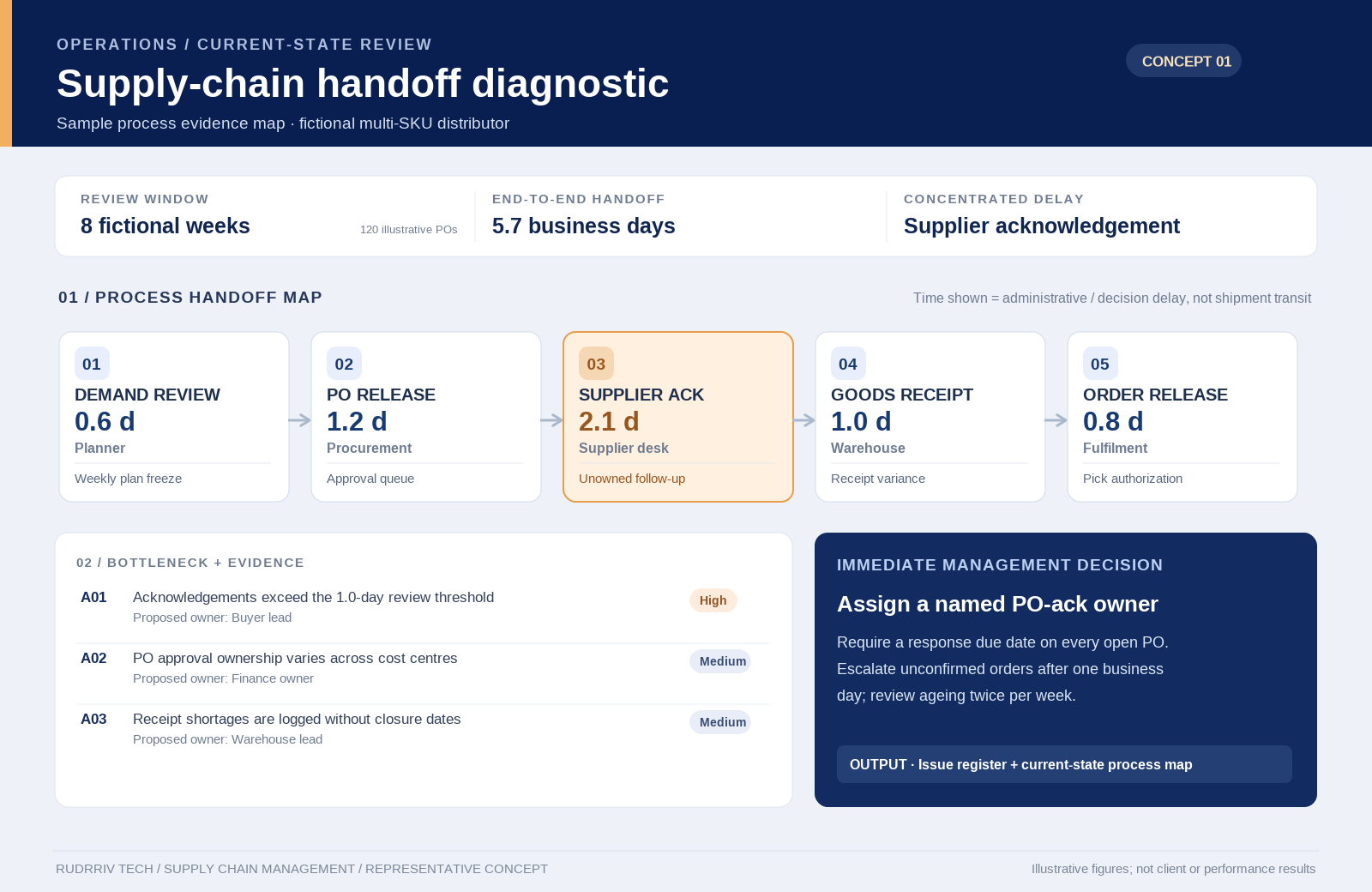
Supply-chain handoff diagnostic
Pinpoint delayed supplier confirmations, ownership gaps and the operational controls needed to clear exceptions.


This supplied feedback relates to the adjacent Customs & Tariff Advisory service and is shown with its original label and wording.
Supply chain management coordinates how demand is translated into sourcing, purchasing, inventory, movement, fulfilment and service decisions. Businesses purchase professional supply-chain support when lead times are unpredictable, stock is difficult to control, supplier performance is unclear, responsibilities are fragmented, or operational data exists without a consistent decision process.
Rudrriv delivers this as a professional service. You share the business objective, current workflow and available data; Rudrriv scopes the engagement, conducts the agreed analysis, handles communication, performs quality review, and delivers the agreed management outputs.
Provide the business objective, current pain points, product or service flow, supplier or partner context, known operating constraints, current KPIs, and any relevant process documents or exports. Useful inputs can include purchase records, supplier lists, inventory files, order history, lead-time data, ERP/WMS/TMS exports, warehouse or fulfilment reports, and existing SOPs. When data is incomplete, the engagement can proceed with assumptions and limitations explicitly documented.
Rudrriv confirms the decision objective, operating context, available inputs, boundaries and required outputs.
We review workflows, data, suppliers, inventory or logistics evidence relevant to the agreed scope.
Findings are organized by impact, evidence, dependency and implementation practicality, with open assumptions clearly flagged.
Rudrriv quality-checks the work, consolidates your feedback and finalizes the deliverables within the selected revision scope.
A useful supply-chain engagement should distinguish facts from assumptions, connect operational symptoms to likely root causes, identify decisions that need business ownership, and provide a realistic sequence for improvement. The goal is not to produce a large generic report; it is to leave your team with management-ready outputs that can guide the next operational actions.
This page covers analytical, planning, documentation and decision-support work. It does not automatically include freight forwarding, warehousing, customs brokerage, physical inspections, supplier contracting, legal or tax advice, ERP implementation, direct system integrations, or authority to commit funds on your behalf.
See the types of practical analysis, process documentation and management-ready improvement plans available within a scoped supply-chain engagement.
Pinpoint delayed supplier confirmations, ownership gaps and the operational controls needed to clear exceptions.
Compare stock positions with reorder thresholds using explicit demand, lead-time and safety-stock assumptions.
Prioritize vendor follow-up with weighted on-time, quantity-fill and response measures.
Define accountable purchase-order approvals, confirmations and receipt exceptions in a practical SOP workflow.
Sequence supplier, inventory and fulfilment improvements with named owners and decision gates.
All five items are representative concepts built with fictional scenarios or synthetic figures. They do not claim commissioned projects, verified outcomes or live system access.
Need an analysis tailored to your operation? Share the workflow, available data and decision you want to improve.
Discuss your supply chain brief →Choose the smallest scope that answers the operational decision you need to make. Multi-entity, ongoing, implementation-heavy or on-site requirements are quoted separately after scope review.
| Package criteria | ₹7,999 Essential
Focused Supply Chain DiagnosticA targeted diagnostic for one defined supply-chain problem or workflow, with evidence-based priorities and a practical action memo. | ₹19,999 Professional
Recommended
Supply Chain Performance PlanA cross-functional review for the most common business need: clearer supplier, inventory, procurement and logistics decisions with a 90-day plan. | ₹44,999 Advanced
End-to-End Improvement RoadmapA broader end-to-end review for growing or complex operations that need a coordinated improvement roadmap across planning, suppliers, inventory and fulfilment. |
|---|---|---|---|
| Best for | One defined supply-chain problem | Cross-functional performance plan | Broader end-to-end improvement roadmap |
| Workflow coverage | 1 workflow / problem | Up to 3 connected workflows | Core end-to-end functions |
| Input review | Up to 2 files / exports | Up to 5 files / exports | Up to 8 files / exports |
| Process mapping | Focused current-state map | Connected process maps | End-to-end dependency map |
| Supplier / inventory / logistics analysis | One relevant focus area | Included as relevant to scope | Multi-function analysis |
| KPI framework | Baseline or simple tracker | Management scorecard | Governance-ready KPI framework |
| Improvement roadmap | Priority action memo | 90-day roadmap | 180-day roadmap |
| Handoff support | Written handoff | 30-minute handoff call | 60-minute handoff + 14-day clarification |
| Revisions | 1 revision | 2 revisions | 3 revisions |
| Delivery | 5 working days | 8 working days | 12 working days |
| Select | ₹7,999 |
₹19,999 |
₹44,999 |
Rudrriv’s service can cover supply-chain diagnostics, process mapping, supplier-performance review, inventory and lead-time analysis, KPI design, risk identification, and a prioritized improvement roadmap. The exact mix depends on the selected package and the business problem being assessed.
It is designed for founders, ecommerce and retail teams, manufacturers, distributors, procurement teams, operations leaders, and growing businesses that need structured supply-chain analysis. It is especially useful when data and responsibilities are spread across spreadsheets, ERP exports, suppliers, warehouses, or logistics partners.
Share the business objective, the supply-chain problem you want solved, relevant suppliers or product groups, process notes, current KPIs, known bottlenecks, and any available spreadsheets or exports from ERP, WMS, TMS, purchasing, inventory, or fulfilment systems. Incomplete data can still be assessed when assumptions and limitations are clearly documented.
The Essential package is planned for 5 working days, Professional for 8 working days, and Advanced for 12 working days after the required inputs are available and the scope is confirmed. Larger datasets, multiple entities, on-site work, or implementation support require a custom timeline.
Choose Essential for one focused problem or workflow, Professional for a practical cross-functional performance plan, and Advanced when you need a broader end-to-end roadmap across planning, suppliers, inventory, logistics, and fulfilment. Rudrriv can confirm fit before work begins.
Yes. The service can review exported or customer-provided data from common planning and operations systems, along with spreadsheets and CSV files, when those inputs are relevant to the agreed scope. Direct system integration, software implementation, and automated data pipelines are not included unless separately scoped.
Not by default. Standard packages focus on analysis, process improvement, documentation, management tools, and decision support. Supplier negotiation, freight forwarding, warehousing, customs brokerage, physical inspections, or other operational execution must be separately assessed and confirmed.
No. Supply-chain analysis may identify dependencies involving customs, tax, contracts, trade compliance, or regulated requirements, but specialist legal, tax, customs-brokerage, or regulatory advice is outside the standard scope unless a separately qualified service is engaged.
Revisions apply to the agreed deliverables and are intended to correct details, incorporate consolidated feedback, or improve clarity. A revision does not create a new workstream, add a materially larger dataset, or replace the original objective; those changes may require a revised scope.
Depending on the package, final delivery can include a management summary, process maps, KPI or scorecard templates, risk and bottleneck registers, supplier or inventory analysis, and an implementation roadmap. Files are supplied in practical formats such as PDF, XLSX, CSV, or DOCX where appropriate.
Yes, ongoing monitoring, recurring reporting, implementation support, or operations support can be considered as a custom engagement after the initial scope is understood. Responsibilities, service levels, system access, approval authority, and reporting cadence are defined separately.
The following testimonials were supplied for Customs & Tariff Advisory. They are included exactly under that service label and are not presented as Supply Chain Management reviews.
Our experience with Customs & Tariff Advisory was structured, responsive, and much more tailored than a generic consulting engagement. The assignment centered on a customs and tariff advisory review, with strong attention to product classification, tariff exposure, origin considerations, import documentation, duty implications, and compliance checkpoints. The team quickly separated the issues that mattered from the items that could wait, which kept the work efficient and reduced unnecessary back-and-forth. Each review round made the deliverable more precise without losing sight of the original objective. The result was a clearer import-compliance approach that helped us understand likely duties and avoid preventable customs issues. We also appreciated the concise documentation and the practical way recommendations were explained.
The final outcome from our Customs & Tariff Advisory project closely matched what we needed. We asked for a customs and tariff advisory review, and the team approached it methodically, especially around product classification, tariff exposure, origin considerations, import documentation, duty implications, and compliance checkpoints. They challenged a few of our initial assumptions with useful evidence while still respecting the constraints of our business. Progress was easy to review, open questions were documented, and changes were handled without creating confusion. We finished with a clearer import-compliance approach that helped us understand likely duties and avoid preventable customs issues. The work gave us more confidence because the recommendations were specific enough to act on rather than remaining high level.
We hired the team for Customs & Tariff Advisory after struggling to bring enough structure to the problem internally. The brief required a customs and tariff advisory review, and their strongest contribution was the disciplined treatment of product classification, tariff exposure, origin considerations, import documentation, duty implications, and compliance checkpoints. Communication stayed direct throughout the engagement, with clear ownership of actions and sensible explanations when tradeoffs were required. They were also careful not to overcomplicate the solution simply to make the project look larger. The delivery ultimately gave us a clearer import-compliance approach that helped us understand likely duties and avoid preventable customs issues, along with a cleaner set of next steps for the people responsible for implementation.
Tell Rudrriv what operational decision you need to make, where the current process breaks down, what data is available and when you need the output. We will review the requirement and confirm the most suitable package or custom scope.