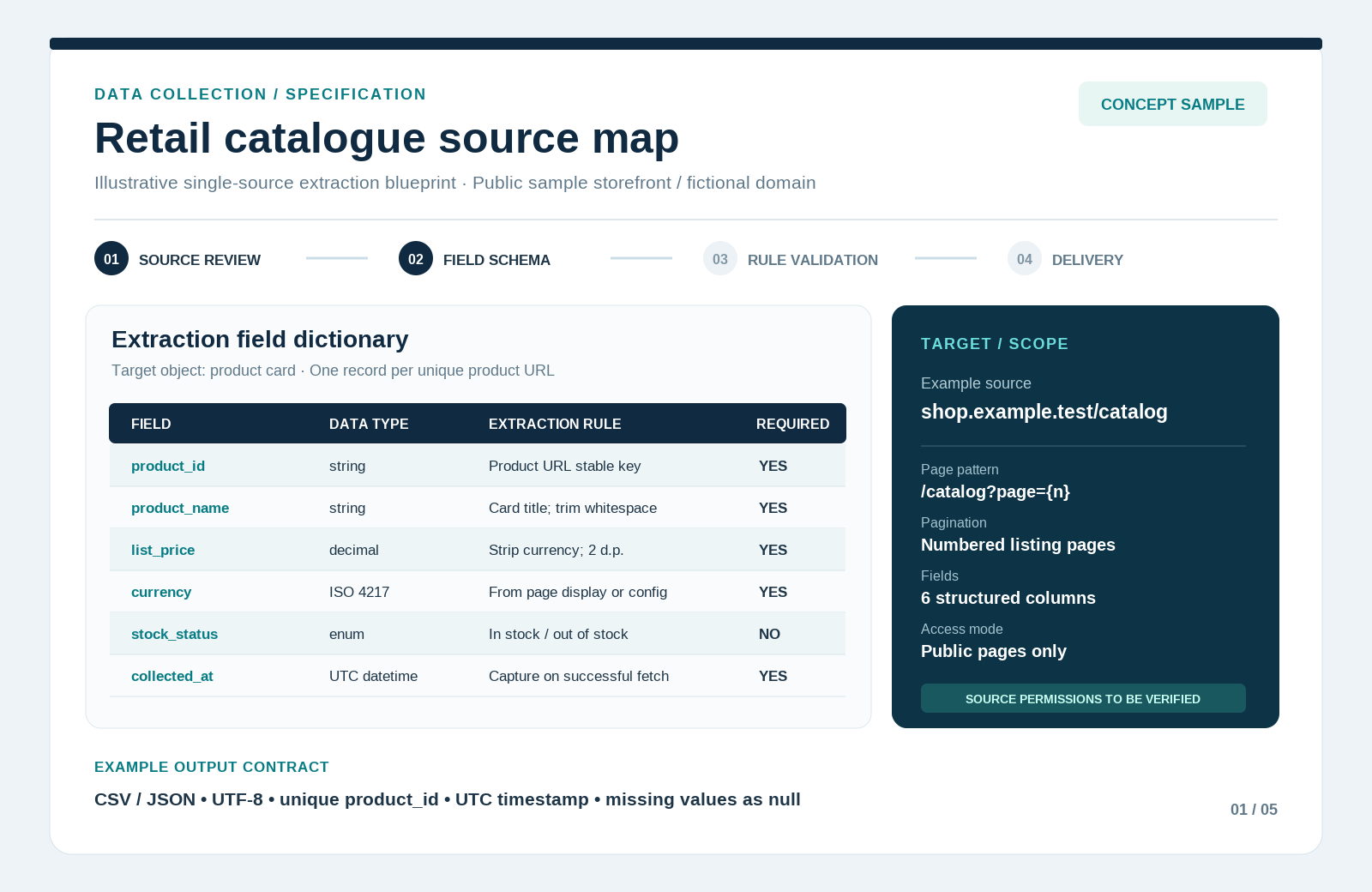
Retail catalogue source map
A source-to-schema specification defining record boundaries, six output fields, pagination and permissions review.
Schema designSource inventoryMapping rules

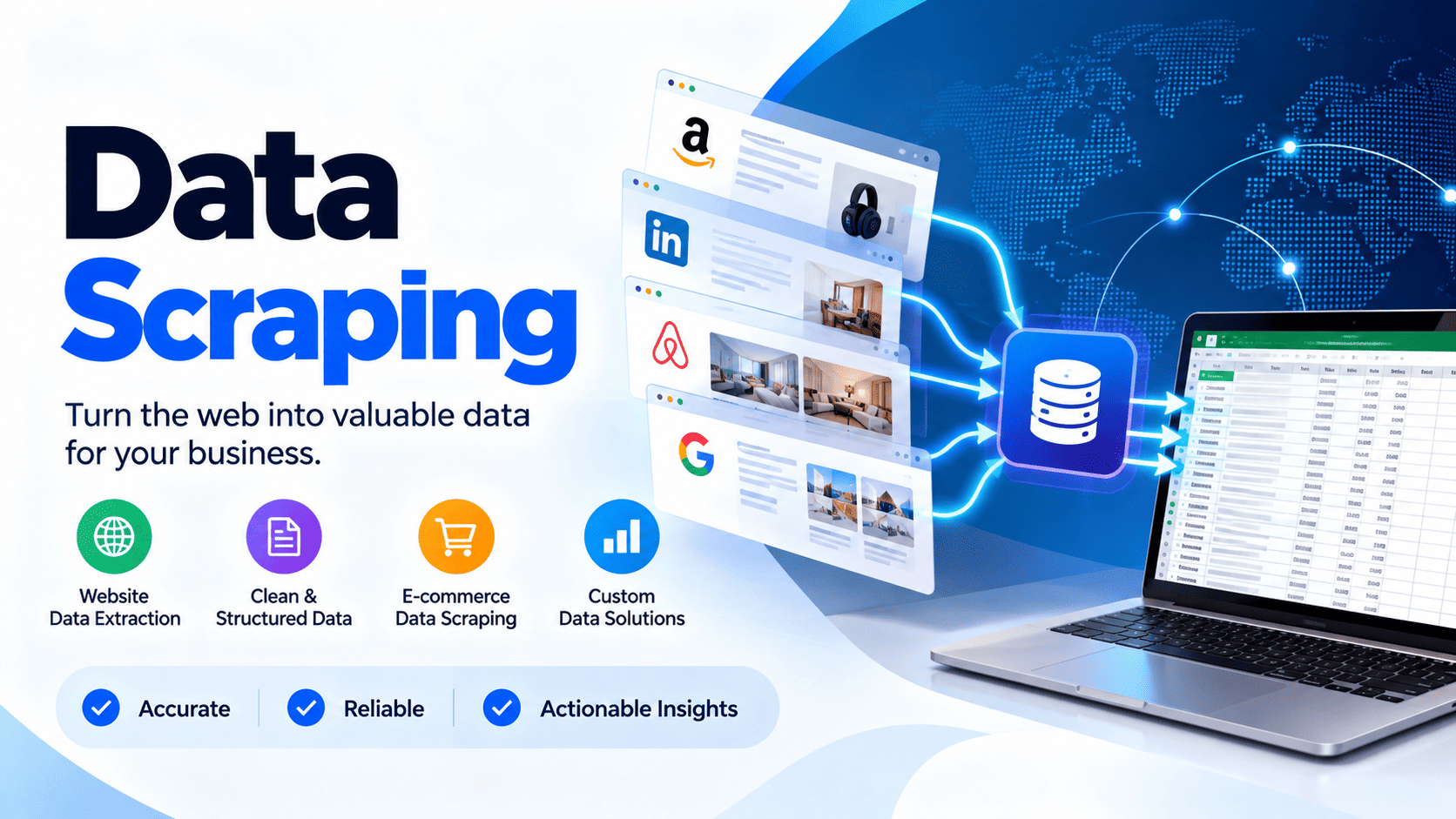
Data scraping turns repetitive information published across websites into structured records that can be searched, filtered, compared and used in business workflows. Rudrriv provides the complete service: requirements are translated into a field map, extraction is implemented, the output is checked, and the final dataset is handed over in the agreed format.
This service is suited to businesses that need product data, public listings, competitor information, directory records, market-research inputs, operational reference data or other clearly defined web-sourced datasets without building and managing an internal scraping workflow.
Share the target website or sample URLs, the fields you want, an example of the desired output, approximate record volume, preferred file format, deadline and whether the requirement is one-time or recurring. Also identify any login, API, geographic-access or compliance constraints you already know about.
Rudrriv reviews the source, required fields, expected coverage, output format and practical constraints.
We implement the collection logic and validate a sample against the field map.
Records are gathered, deduplicated and normalized, then checked for completeness and obvious extraction issues.
You receive the agreed dataset, documentation and reusable code or support where included in the package.
Not every source should be scraped. Rudrriv assesses technical access, source terms, privacy considerations, available APIs and the requested collection method before confirming execution. Sources that require prohibited circumvention, inappropriate collection of personal data or access that is not authorized are outside normal scope.
Choose based on source complexity, record volume and whether you need a delivered dataset only or a reusable scraping workflow.
| Included | ₹4,999 Essential Focused Data Extract For a clearly defined one-time extraction from one straightforward source. | ₹11,999 Professional Recommended Business Dataset Build For larger, dynamic or reusable extraction requirements. | ₹24,999 Advanced Advanced Scraping Pipeline For complex, multi-source or automation-oriented projects. |
|---|---|---|---|
| Source coverage | 1 website / source | Up to 2 sources | Up to 5 sources |
| Typical record coverage | Up to 2,000 | Up to 10,000 | Up to 30,000 |
| Field mapping | Up to 8 fields | Up to 15 fields | Up to 25 fields |
| Pagination support | ✓ | ✓ | ✓ |
| JavaScript-rendered pages | — | ✓ | ✓ |
| Deduplication & normalization | Basic | Standard | Advanced |
| Reusable code handoff | — | ✓ | ✓ |
| Documentation | Delivery notes | Setup + field notes | Technical handoff |
| Revision rounds | 1 | 2 | 3 |
| Standard delivery | 3 business days | 5 business days | 7–10 business days |
| Output formats | CSV / XLSX | CSV / XLSX / JSON | CSV / XLSX / JSON / agreed schema |
| Package price | ₹4,999 | ₹11,999 | ₹24,999 |
SELECTED WORK · 05 REPRESENTATIVE CONCEPTS
Explore illustrative collection specifications, structured extracts, scraper handoffs, quality checks and scheduled delivery workflows. All source names, records and figures shown are fictional examples—not claims of completed client projects.
A source-to-schema specification defining record boundaries, six output fields, pagination and permissions review.
A normalized, eight-row preview of a larger fictional catalogue extract with stable identifiers, timestamps and quality flags.
An implementation handoff illustrating rendering, pagination, selectors, checkpoint recovery and stop conditions.
A reconciled illustrative batch report with 11,984 accepted records, deduplication results and required-field validation.
An operational runbook for authorized scheduled refreshes, quality gates, versioned exports and monitored exceptions.
Our experience with Data Scraping was structured, responsive, and much more tailored than a generic consulting engagement. The assignment centered on a structured data-scraping project, with strong attention to target coverage, field mapping, pagination, deduplication, error handling, data normalization, rate limits, and output quality. The team quickly separated the issues that mattered from the items that could wait, which kept the work efficient and reduced unnecessary back-and-forth. Each review round made the deliverable more precise without losing sight of the original objective. The result was a clean and repeatable dataset that reduced hours of manual collection and was ready for downstream analysis. We also appreciated the concise documentation and the practical way recommendations were explained.
The final outcome from our Data Scraping project closely matched what we needed. We asked for a structured data-scraping project, and the team approached it methodically, especially around target coverage, field mapping, pagination, deduplication, error handling, data normalization, rate limits, and output quality. They challenged a few of our initial assumptions with useful evidence while still respecting the constraints of our business. Progress was easy to review, open questions were documented, and changes were handled without creating confusion. We finished with a clean and repeatable dataset that reduced hours of manual collection and was ready for downstream analysis. The work gave us more confidence because the recommendations were specific enough to act on rather than remaining high level.
We hired the team for Data Scraping after struggling to bring enough structure to the problem internally. The brief required a structured data-scraping project, and their strongest contribution was the disciplined treatment of target coverage, field mapping, pagination, deduplication, error handling, data normalization, rate limits, and output quality. Communication stayed direct throughout the engagement, with clear ownership of actions and sensible explanations when tradeoffs were required. They were also careful not to overcomplicate the solution simply to make the project look larger. The delivery ultimately gave us a clean and repeatable dataset that reduced hours of manual collection and was ready for downstream analysis, along with a cleaner set of next steps for the people responsible for implementation.
Tell us what source you need covered, which fields matter, how much data you expect and how you want it delivered. Rudrriv will review feasibility and recommend the right scope.