Ticket Operations
Ticket Triage & Routing Blueprint
A decision-led intake flow, issue taxonomy and queue ownership model for common ecommerce support requests.
Ticket taxonomyQueue routingPriority rules

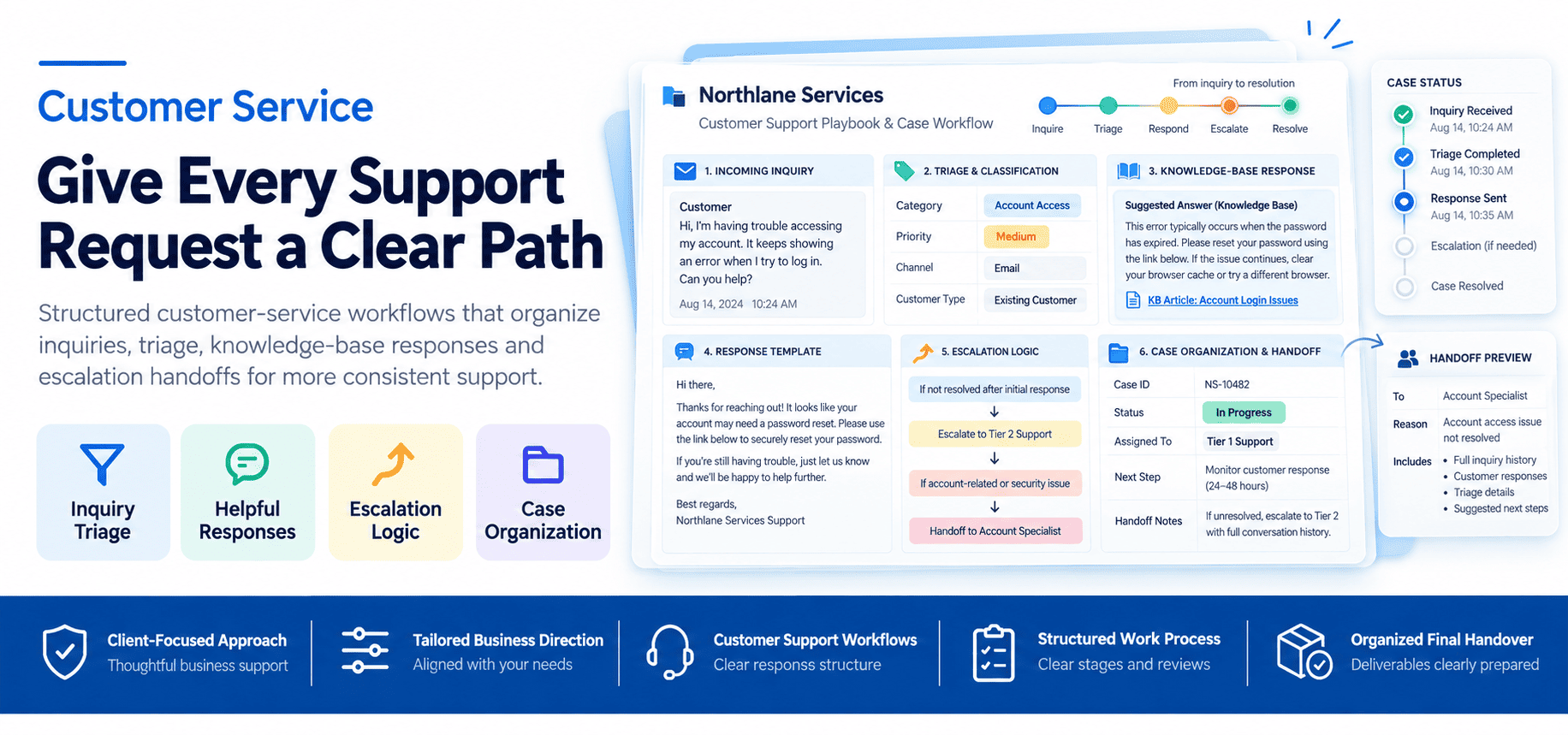
Customer service problems are often operating-system problems rather than effort problems. Tickets arrive through different channels, categories are unclear, the same questions receive different answers, escalation depends on who happens to be online, and useful knowledge stays inside individual team members. Rudrriv’s Customer Service service is designed to bring structure to those workflows.
The engagement focuses on how support requests move from intake to resolution: how issues are categorized, prioritized, assigned, answered, escalated, documented, checked for quality and measured. Rudrriv provides the service and converts the brief into a structured improvement project with defined outputs and review points.
This service is suited to startups, SaaS teams, ecommerce businesses, agencies, service companies and other organizations that already receive customer questions but need a clearer, more repeatable way to handle them. It can also support teams preparing to implement or clean up a helpdesk, standardize a growing support function, or hand better-defined processes to an internal or outsourced team.
Provide your current support channels, helpdesk or shared-inbox setup, representative ticket examples or exports, common issue types, existing macros or policies, escalation owners, knowledge resources, service targets, CSAT or reporting data if available, team structure and the operational problems you want the project to solve. Access should be limited to what is necessary for the agreed scope.
Rudrriv reviews your channels, ticket examples, policies, service targets, recurring issues and operating constraints.
The delivery team identifies routing friction, inconsistent answers, escalation gaps, knowledge issues and measurement blind spots.
Triage rules, response standards, macros, escalation logic, QA checks and tracking guidance are prepared for your scope.
Rudrriv quality-checks the deliverables, incorporates included feedback and provides a prioritized implementation handoff.
Final deliverables depend on the selected package, but the outcome is a documented support framework your team can put into use: prioritized workflow improvements, response guidance, reusable macros, escalation logic, knowledge recommendations, quality controls and measurement guidance. Where implementation is included, the handoff clarifies what should change first, who should own it and what should be monitored after rollout.
Explore five representative support-operations deliverables: designed to clarify ticket handling, response consistency, escalation and measurement. These are original concept examples, not verified client projects or live outcomes.
A decision-led intake flow, issue taxonomy and queue ownership model for common ecommerce support requests.
Illustrative working-hour response targets, update cadence and clear rules for acknowledgements and closure.
Organized response templates with real drafting anatomy, approved-variable checks and agent review notes.
A trigger-to-owner matrix and structured specialist handoff sequence for sensitive or blocked cases.
A weighted quality rubric and sample survey-count reporting design using clearly synthetic data.
Need a customer service operations framework? We can shape the right scope around your channels, support volume and priorities.
Discuss your support workflow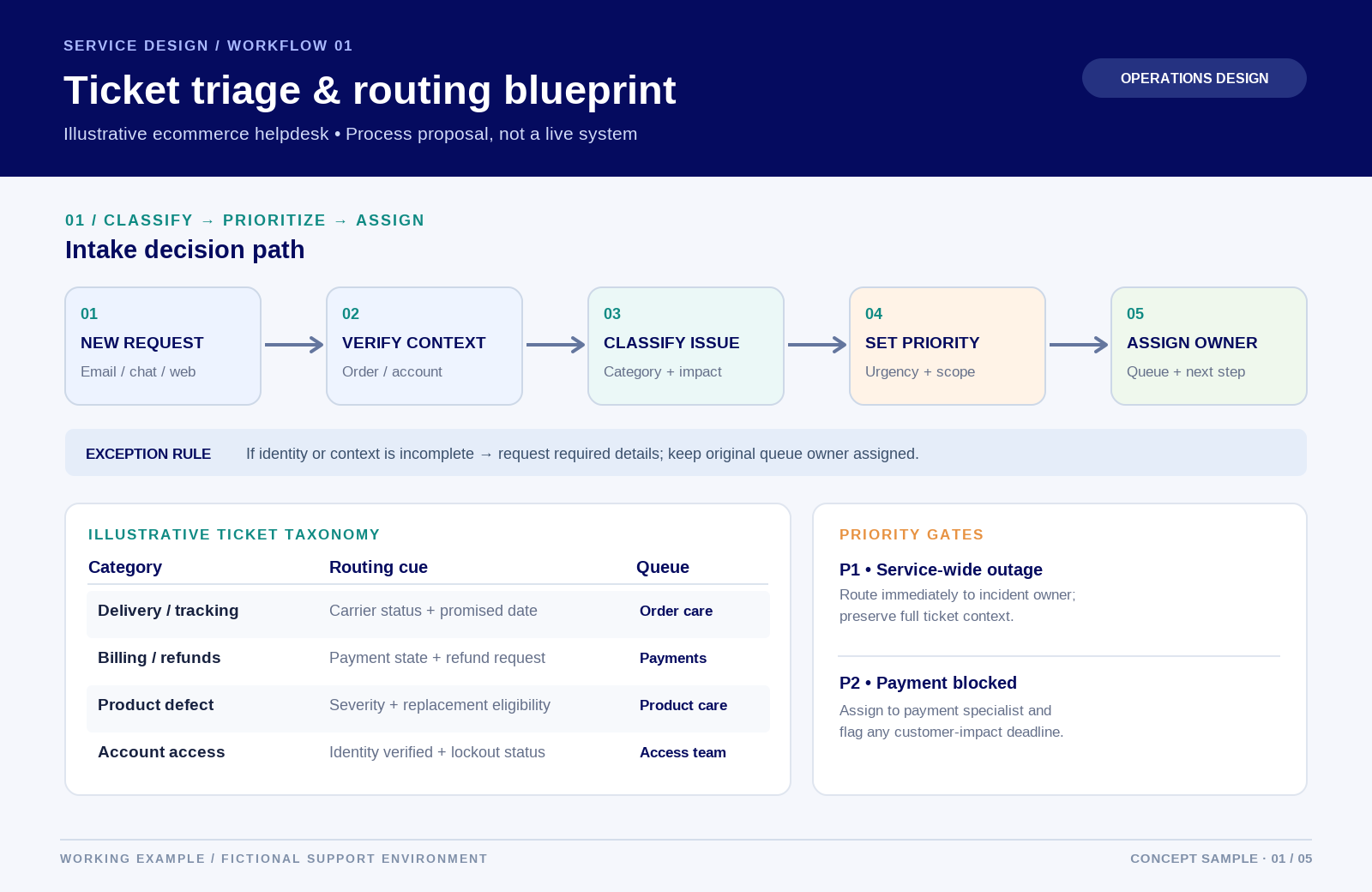
Choose a focused audit when one workflow needs structure, the Professional package for a practical operations upgrade, or Advanced for broader multi-workflow redesign and implementation guidance.
| Included | ₹8,999 Essential Support Workflow Audit A focused review of one customer-support workflow with practical fixes for triage, response consistency and escalation. |
₹19,999 Professional Recommended Customer Service Operations Upgrade A broader operating-model upgrade covering routing, standards, macros, escalations, knowledge gaps, QA and satisfaction tracking. |
₹39,999 Advanced Support Operations Transformation A deeper multi-workflow engagement for teams that need a coordinated support operating system, implementation guidance and measurement framework. |
|---|---|---|---|
| Support workflows in scope | 1 | Up to 2 | Up to 4 |
| Ticket/example review | Up to 50 | Up to 150 | Up to 300 |
| Ticket taxonomy & triage framework | ✓ | ✓ | ✓ |
| Reusable macros/templates | 5 | 12 | 20 |
| Escalation matrix | Basic | Detailed | Multi-level |
| Response-standard / SLA guidance | Response standards | ✓ | Advanced |
| Knowledge review | Priority gaps | 10 topic recommendations | 20-topic framework |
| QA scorecard | — | ✓ | ✓ + calibration guidance |
| CSAT / KPI tracking plan | Core measures | ✓ | Expanded reporting framework |
| Implementation guidance | 30-day plan | Implementation notes | Roadmap + 2 review sessions |
| Revision rounds | 1 | 2 | 3 |
| Standard delivery | 5 business days | 10 business days | 15 business days |
| Package price | ₹8,999 | ₹19,999 | ₹39,999 |
Our experience with Customer Service was structured, responsive, and much more tailored than a generic consulting engagement. The assignment centered on a customer-service operations improvement project, with strong attention to ticket triage, response standards, macros, escalation rules, knowledge resources, quality checks, and satisfaction tracking. The team quickly separated the issues that mattered from the items that could wait, which kept the work efficient and reduced unnecessary back-and-forth. Each review round made the deliverable more precise without losing sight of the original objective. The result was a more consistent support process that improved response handling and made recurring customer issues easier to resolve. We also appreciated the concise documentation and the practical way recommendations were explained.
The final outcome from our Customer Service project closely matched what we needed. We asked for a customer-service operations improvement project, and the team approached it methodically, especially around ticket triage, response standards, macros, escalation rules, knowledge resources, quality checks, and satisfaction tracking. They challenged a few of our initial assumptions with useful evidence while still respecting the constraints of our business. Progress was easy to review, open questions were documented, and changes were handled without creating confusion. We finished with a more consistent support process that improved response handling and made recurring customer issues easier to resolve. The work gave us more confidence because the recommendations were specific enough to act on rather than remaining high level.
We hired the team for Customer Service after struggling to bring enough structure to the problem internally. The brief required a customer-service operations improvement project, and their strongest contribution was the disciplined treatment of ticket triage, response standards, macros, escalation rules, knowledge resources, quality checks, and satisfaction tracking. Communication stayed direct throughout the engagement, with clear ownership of actions and sensible explanations when tradeoffs were required. They were also careful not to overcomplicate the solution simply to make the project look larger. The delivery ultimately gave us a more consistent support process that improved response handling and made recurring customer issues easier to resolve, along with a cleaner set of next steps for the people responsible for implementation.
Tell us how customer requests are handled today, what is breaking down and which tools or channels are involved. Rudrriv will review the requirement and recommend the most appropriate package or custom scope.