
What Is an Email Marketing Service?
What is email marketing service? It is a specialist or managed service that helps a business plan, create, send, automate, measure, and improve permission-based emails to prospects, customers, members, or other approved audiences. The service can range from producing one newsletter each month to operating a complete lifecycle programme covering welcome journeys, lead nurturing, ecommerce messages, retention campaigns, re-engagement, and reporting.
The practical decision is not simply whether email works. It is whether your organisation needs advice, production support, technical implementation, ongoing campaign management, or an accountable team that can coordinate all four. A provider should therefore be evaluated by the responsibilities it accepts, the quality controls it uses, the systems it can work with, and the way it protects consent, data, accounts, and sender reputation.
Start by defining the business outcome and the audience. A professional-service firm may need a monthly insight email and lead-nurture sequence. An ecommerce company may need product, cart, post-purchase, and win-back journeys. An enterprise may need governed templates, multiple approval layers, regional segmentation, and integration with customer systems. These are different services even when all are sold under the label “email marketing.”
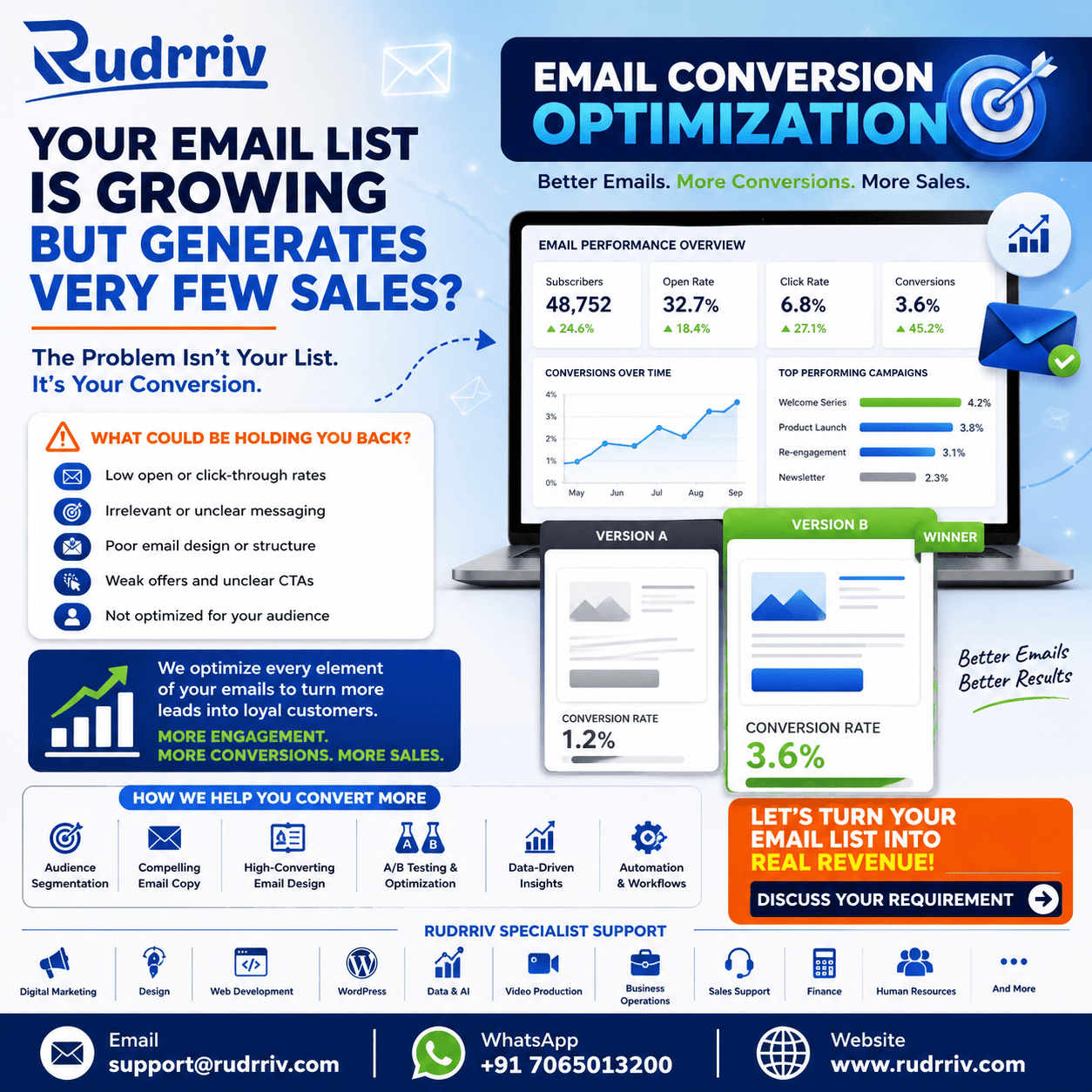
Quick Answer: What an Email Marketing Service Does
An email marketing service turns business goals and customer data into planned email communications. Depending on scope, it may provide strategy, campaign calendars, subscriber segmentation, copywriting, responsive design, template coding, automation, platform configuration, testing, deliverability support, reporting, and continuous improvement.
Choose limited specialist support when your internal team already owns strategy, data, approvals, and the sending platform. Choose ongoing managed support when campaigns are frequent, automations are commercially important, several stakeholders are involved, or the business lacks the time and skills to manage quality consistently.
Do not begin by importing every available contact and sending immediately. Validate the lawful basis for communication, list source, suppression rules, domain authentication, platform ownership, customer fields, campaign purpose, and approval process first.
Key Takeaways
- The service is broader than sending newsletters: it may combine strategy, production, automation, technical setup, measurement, and governance.
- Scope should follow customer behaviour: campaign frequency, buying cycle, repeat use, product type, and lifecycle events determine the right programme.
- List permission and ownership are foundational: the business should understand where contacts came from and retain control of its platform, data, domains, and creative assets.
- Deliverability is partly technical and partly behavioural: authentication, list hygiene, relevance, complaint rates, and sending consistency all matter.
- Automation requires maintained data: a sophisticated journey will fail when triggers, fields, integrations, or suppression rules are inaccurate.
- Reports should support decisions: useful reporting connects campaign delivery with clicks, conversions, customer progression, and business-relevant outcomes.
- The best delivery model depends on internal capacity: some businesses need a specialist project; others need a dedicated professional or managed programme.
Table of Contents
- What the service includes
- When external support is suitable
- Email service delivery models compared
- How a campaign becomes an operating programme
- Cost, resources, and technical requirements
- Measurement and ongoing maintenance
- Risks and common mistakes
- Summary and next decision
What an Email Marketing Service Should Include
A complete service should convert a communication objective into a controlled operating process. The exact components vary, but the provider should clearly state which of the following it owns and which your team must supply.
Strategy and campaign planning
This covers audience definition, business objectives, offers, message themes, lifecycle stages, frequency, timing, campaign calendar, and success criteria. Good planning prevents every department from treating the mailing list as an unlimited broadcast channel.
Content, design, and production
The provider may write subject lines, preview text, body copy, calls to action, and supporting landing-page recommendations. It may also design responsive templates, prepare images, build reusable modules, test links, check accessibility, and render emails across common clients. Production should include a documented review and approval stage rather than relying on last-minute corrections.
Segmentation and automated journeys
Segmentation uses relevant data—such as lifecycle stage, location, product interest, account type, purchase behaviour, or engagement—to avoid sending the same message to everyone. Automation applies agreed triggers and rules to sequences such as onboarding, lead nurture, cart recovery, post-purchase education, renewal, or re-engagement. The value comes from relevance and timing, not from the number of workflows built.
Technical delivery and compliance support
Professional delivery includes sender-domain review, platform configuration, data-field mapping, unsubscribe and suppression handling, test sends, link checks, tracking validation, and monitoring of bounces and complaints. Google’s email sender guidelines explain authentication and sending practices for messages delivered to Gmail users. The FTC’s CAN-SPAM compliance guide outlines obligations for commercial email in the United States, while the UK Information Commissioner’s electronic mail marketing guidance explains relevant PECR considerations. Legal requirements vary by audience and jurisdiction, so a service provider should support process control without presenting operational advice as universal legal advice.
When External Email Support Becomes Worthwhile
External support is most useful when the required workload or expertise is greater than the internal team can sustain. It is not automatically necessary because a company has a mailing list.
- Campaigns are delayed because copy, design, data, approvals, and platform work have no clear owner.
- Customer journeys require several triggers, segments, or system integrations.
- The business sends frequently across products, regions, brands, or languages.
- Deliverability, bounce patterns, complaints, or list quality need structured attention.
- Internal specialists need additional production capacity without hiring every role permanently.
- Leadership needs a consistent calendar, review cadence, reporting model, and accountable delivery process.
A simple decision rule: keep email marketing in-house when the programme is limited, ownership is clear, and the team can maintain quality. Add specialist or managed support when complexity, frequency, risk, or production demand is creating missed opportunities or operational inconsistency.
Email Marketing Delivery Models Compared
The right model depends on campaign volume, technical complexity, strategic ownership, and the level of continuity required.
| Model | What it usually covers | Main limitation | Best fit |
|---|---|---|---|
| Internal team | Strategy, data, approvals, production, and platform control remain inside the business | Capacity or specialist depth may be limited | Simple programmes with clear ownership and steady internal capability |
| Freelance specialist | Defined expertise such as copy, design, automation, deliverability, or platform setup | One person may not cover the complete operating model | Focused projects, audits, or additional production support |
| Agency service | Multi-skill campaign planning and execution across recurring deliverables | Assigned team quality and responsiveness can vary | Businesses needing regular campaigns and a broader production team |
| Dedicated or managed support | Ongoing capacity, defined roles, governance, reporting, and scalable specialist input | Requires clear priorities, stakeholder access, and management cadence | Complex, high-volume, multi-brand, ecommerce, or enterprise programmes |
A hybrid model is often practical. An internal marketing lead can own audience strategy and approvals while external specialists manage production, automation, testing, and reporting.
How Campaign Work Becomes a Reliable Programme
A sustainable programme develops in phases. Trying to build every campaign and automation at once creates more failure points than value.
- Define the customer and business decision. Identify who should receive the message, what useful action follows, and why email is the appropriate channel.
- Audit data and permission. Review contact sources, consent or other applicable basis, required fields, duplicates, inactive records, suppression lists, and retention rules.
- Secure the sending foundation. Confirm account ownership, domain authentication, sender identities, reply handling, unsubscribe processing, tracking, and access controls. The technical relationship among SPF, DKIM, and DMARC is described in the IETF’s DMARC specification.
- Build reusable campaign components. Create approved templates, content modules, naming standards, testing checklists, and brand rules.
- Launch priority communications first. Begin with the campaigns or lifecycle moments that have a clear audience and measurable purpose.
- Measure, learn, and maintain. Review segment response, delivery issues, conversions, customer feedback, and operational delays before adding complexity.
Practical example: professional services
A consulting firm assumes it needs weekly promotional emails. Its buying cycle is long, and most prospects need evidence of expertise rather than frequent offers. A better programme may be one useful monthly insight, a short event follow-up sequence, and a carefully timed lead-nurture journey. Specialist support can help establish the editorial calendar, templates, segmentation, and measurement without creating unnecessary volume.
Practical example: ecommerce
An ecommerce business focuses only on promotional broadcasts while cart abandonment and post-purchase communication are inconsistent. The stronger decision is to stabilise product and customer data, then prioritise welcome, cart, order-support, review, replenishment, and win-back journeys. The service must coordinate marketing objectives with platform events, inventory logic, exclusions, and customer-service messaging.
Practical example: early-stage startup
A startup wants an advanced automation system before it has validated its audience, offer, or sales process. A smaller sequence—welcome, education, product update, and feedback—may provide more useful learning. Once user behaviour is clearer, the business can add segmentation and triggered journeys based on verified events rather than assumptions.
Cost, Resources, and Technical Requirements
Email marketing service pricing cannot be compared fairly without workload assumptions. A monthly newsletter for one audience is fundamentally different from a multi-market programme with daily campaigns, dynamic content, lifecycle automation, custom integrations, and formal compliance reviews.
- Campaign volume: number of broadcasts, newsletters, sequences, and variants.
- Creative workload: research, copy, design, image production, localisation, and revisions.
- Data complexity: segments, fields, event tracking, consent records, and system integrations.
- Automation depth: triggers, branching rules, timing, exclusions, testing, and monitoring.
- Technical responsibility: platform setup, migration, authentication, coding, and troubleshooting.
- Governance: meetings, approvals, legal or brand review, stakeholder coordination, and documentation.
- Measurement: dashboard setup, attribution design, analysis, experimentation, and recommendations.
The business also needs internal resources. Someone must approve objectives and offers, provide accurate product or service information, resolve data questions, coordinate legal or policy review where needed, and make decisions when results suggest a change. Outsourcing production does not remove business ownership.
Measure Customer Action, Not Sending Activity Alone
A service should report both operational quality and customer response. Sending more messages is not an outcome. Useful reporting explains what was sent, to whom, why, what happened, what may have influenced the result, and what should change next.
| Measurement area | Examples | Decision supported |
|---|---|---|
| Delivery health | Delivered messages, hard and soft bounces, spam complaints, authentication issues | Whether the list and sending foundation are healthy |
| Audience response | Clicks, replies, unsubscribes, preference changes, segment differences | Whether the message and frequency are relevant |
| Business action | Qualified enquiries, registrations, purchases, renewals, product use, booked meetings | Whether email supports the intended customer journey |
| Operational quality | On-time delivery, approval delays, broken links, rendering issues, revision causes | Whether the service process is reliable |
| Programme learning | Test results, journey drop-offs, content themes, timing patterns, customer feedback | What should be improved or stopped |
Privacy protections in modern mail clients can affect the reliability of open-rate measurement. Treat opens as one signal and place greater weight on verified clicks, conversions, replies, and downstream actions where tracking is appropriate.
Maintenance should include list hygiene, suppression checks, template testing, authentication monitoring, broken-link checks, data-field validation, journey review, inactive automation removal, content refresh, access review, and documentation. Every automated message should have an owner and a review date.
Risks That Reduce Deliverability and Trust
The most damaging mistakes usually come from weak fundamentals rather than a lack of campaign ideas.
- Using purchased, scraped, unexplained, or outdated contact lists.
- Sending every message to the full database without relevant segmentation.
- Hiding unsubscribe options or failing to maintain suppression records.
- Launching from an unauthenticated or poorly governed sending domain.
- Measuring success only through opens, send volume, or isolated clicks.
- Building automations without testing triggers, exclusions, fallbacks, and customer-service consequences.
- Allowing a provider to own the account, domain settings, data, templates, or reporting access.
- Failing to document approvals, revisions, incidents, handover, and access removal.
A capable service provider should be willing to slow the launch when the list source, authentication, customer data, or approval process is not ready. That restraint is a sign of professional delivery, not lack of urgency.
Summary
An email marketing service is the coordinated capability behind effective business email: strategy, data, content, design, campaigns, automation, technical delivery, measurement, and maintenance. The correct scope depends on the customer journey and the capacity already available inside the organisation.
A limited specialist project is enough when the business needs a template, audit, migration, campaign series, or automation setup. Ongoing support is more suitable when communication is frequent, lifecycle journeys matter, multiple systems or stakeholders are involved, and quality must be maintained every month.
Before appointing a provider, confirm the audience, list source, goals, scope, budget, timeline, platform ownership, authentication, approvals, quality assurance, reporting, maintenance, security access, and handover. Validate the programme with a controlled first phase rather than building unnecessary complexity.
FAQs About Email Marketing Services
What is email marketing service in practical business terms?
An email marketing service is a managed or specialist capability that plans, builds, sends, measures, and improves permission-based email campaigns. It may cover strategy, list segmentation, copy, design, automation, technical setup, testing, reporting, and compliance support. Before buying it, confirm which responsibilities are included and which remain with your internal team.
What does an email marketing service usually include?
A useful scope commonly includes audience and offer planning, campaign calendars, email copy and design, template production, segmentation, automated journeys, platform setup, quality assurance, deliverability checks, reporting, and optimization. Some providers also manage data migration or integrations. The statement of work should name volumes, turnaround times, approval steps, exclusions, and ownership.
Does every business need a full-service email marketing provider?
No. A small business with a simple newsletter and a capable internal marketer may only need template setup or occasional specialist advice. Full-service support becomes more valuable when the business has multiple segments, frequent campaigns, ecommerce journeys, lead nurturing, complex integrations, strict approval processes, or insufficient internal capacity.
How is email marketing different from marketing automation?
Email marketing focuses on communicating with subscribers and customers through campaigns and sequences. Marketing automation is broader: it uses rules, data, triggers, scoring, and connected systems to coordinate actions across a customer journey. A service provider should explain whether it is delivering campaign execution, automation architecture, or both.
How much does an email marketing service cost?
Cost depends on list size, send frequency, number of campaigns, design and copy requirements, automation complexity, integrations, languages, reporting depth, and required senior oversight. Platform subscription and data-cleaning costs may be separate. Compare the included workload and responsibilities rather than evaluating price without scope.
What technical setup is needed before sending campaigns?
The business needs an approved sending platform, a controlled subscriber source, correct domain authentication, working unsubscribe handling, accurate tracking, and tested templates. SPF, DKIM, and DMARC should be reviewed with the relevant technical owner. Integrations and data fields should also be validated before automation is activated.
How long does it take to implement email marketing properly?
A basic campaign can be prepared quickly when the list, offer, template, approvals, and sending setup already exist. A structured programme takes longer because data must be cleaned, segments defined, templates tested, authentication checked, journeys mapped, integrations validated, and reporting agreed. Use a phased launch rather than activating every automation at once.
Which metrics should an email marketing service report?
Reporting should connect delivery quality with customer action. Useful measures include successful delivery, bounce patterns, spam complaints, unsubscribes, clicks, conversions or qualified actions, journey completion, segment performance, and revenue attribution where tracking is reliable. Open rates can be directionally useful but should not be treated as a complete measure of success.
What are the biggest risks when outsourcing email marketing?
The main risks are unclear consent, poor list quality, excessive sending, weak authentication, generic content, misleading reporting, uncontrolled account access, and loss of platform or data ownership. Reduce these risks through role-based access, written approvals, documented suppression rules, quality checks, ownership clauses, and a complete handover process.
Need a Clear Email Marketing Operating Plan?
Rudrriv can help define the scope, specialist roles, campaign workflow, production requirements, quality controls, and ongoing support model for a practical email marketing programme. Start with the customer journey and the work that genuinely needs external capability.
Discuss your requirement“At Rudrriv, we make it easier for businesses to access the right expertise, execute important work, and scale with confidence.”