
Marketing Service Comparison for Email Marketing Solutions
A useful marketing service comparison for email marketing solutions should begin with the work your business must accomplish, not with a provider label. Email consulting, campaign production, automation implementation, platform support, and fully managed operations solve different problems. The right choice depends on your customer journey, data readiness, sending volume, internal skills, compliance obligations, and the frequency with which campaigns and automated journeys must change.
The central caution is that many proposals use similar language while including very different levels of responsibility. One provider may only prepare newsletters. Another may design lifecycle journeys, configure integrations, manage deliverability, maintain templates, test segmentation logic, and report against business outcomes. Before comparing fees, define who owns strategy, data, creative, platform administration, approvals, quality assurance, and ongoing maintenance.
For most businesses, the practical starting point is to separate one-time setup needs from recurring operating needs. A defined project can establish the platform, templates, tracking, and initial automations. Ongoing support is justified when your team needs regular campaign production, experimentation, monitoring, and optimization. A managed service becomes appropriate when several capabilities must operate together and internal ownership is limited.
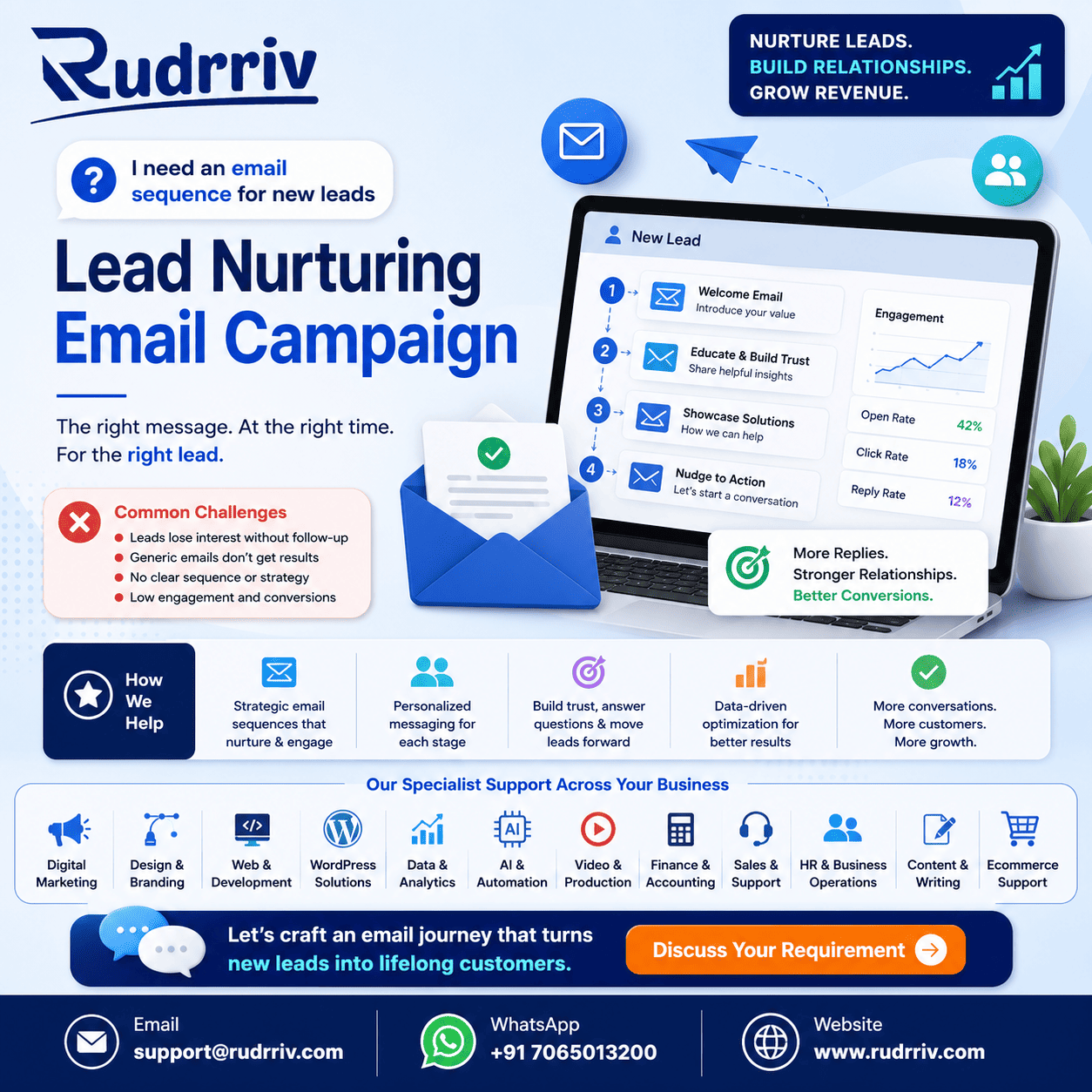
Quick Answer: Which Email Marketing Service Fits?
Choose strategic consulting when your team can execute but needs a better roadmap, lifecycle architecture, measurement plan, or deliverability diagnosis. Choose a defined implementation project when you need platform setup, migration, templates, integrations, tracking, consent workflows, or initial automations. Choose ongoing campaign support when the recurring workload is mainly planning, copy, design, scheduling, testing, and reporting.
Choose lifecycle automation support when customer events, segmentation, triggers, branching logic, and continuous journey improvement are central. Choose a managed email marketing service when strategy, production, technical operations, analytics, compliance coordination, and maintenance must be handled as one operating system.
Before committing, validate your data quality, consent records, sender authentication, content capacity, platform ownership, expected campaign volume, internal approval speed, and the business actions you want email to influence.
Key Takeaways
- Service labels are not enough: compare actual responsibilities, deliverables, dependencies, and ownership.
- Consulting and execution solve different needs: advice has limited value when no team is available to implement it.
- Automation is a technical operating capability: it requires reliable data, triggers, exclusions, testing, and maintenance.
- Managed support is justified by coordination: use it when several specialist roles must work together repeatedly.
- Platform fees are only one cost: include content, design, integration, testing, governance, and internal review time.
- Deliverability and consent are operating requirements: design them into the service rather than checking them after launch.
- Start with evidence: a discovery phase or pilot can reveal data, process, and provider-fit issues before a long commitment.
Table of Contents
- Start with the email problem to be solved
- Compare the five main service models
- Match the model to business stage
- Use customer behavior to define scope
- Check technical and compliance capability
- Compare scope, ownership, and resources
- Plan implementation and maintenance
- Evaluate realistic business examples
- Avoid common selection mistakes
- Summary and next decision
Start with the Email Problem to Be Solved
The best service model is the one that closes a clearly defined capability gap. Begin by describing the business problem in operational terms. “We need email marketing” is too broad. “We need to recover abandoned carts, onboard new customers, and publish two segmented campaigns each month” is specific enough to scope.
Separate the work into four layers: strategy, production, technology, and operations. Strategy covers audience priorities, lifecycle stages, offers, testing hypotheses, and measurement. Production covers copy, design, coding, approvals, scheduling, and localization. Technology covers platform configuration, integrations, event tracking, authentication, data flow, and troubleshooting. Operations covers calendars, quality assurance, suppression, reporting, maintenance, and stakeholder coordination.
Decision rule: when one layer is missing, buy targeted specialist support. When several layers are missing and must work together every week, compare integrated or managed services.
Compare the Five Main Email Service Models
Email marketing support generally falls into five practical models. Providers may combine them, but the distinction helps reveal what is actually included.
| Service model | Best fit | Typical responsibility | Main limitation |
|---|---|---|---|
| Strategic consulting | Capable internal team needing direction | Audit, roadmap, lifecycle design, measurement, deliverability diagnosis | Recommendations still require internal execution |
| Defined implementation project | New platform, migration, or automation launch | Configuration, templates, integrations, tracking, testing, documentation | May not include ongoing campaign operations |
| Campaign production service | Regular newsletters and promotions | Calendar, copy, design, build, approvals, scheduling, reporting | May lack deep data or automation capability |
| Lifecycle automation service | Behavior-based customer journeys | Triggers, segmentation, branching, experimentation, monitoring | Depends on reliable data and technical access |
| Managed email operations | Recurring multi-discipline workload | Strategy, production, automation, analytics, governance, maintenance | Needs clear decision rights and a larger budget |
A business can use more than one model over time. A common sequence is consulting, followed by an implementation project, followed by focused ongoing support. This phased approach reduces the risk of paying for a large retainer before the platform, data, and operating process are ready.
Match the Service Model to Business Stage
Early-stage businesses need a minimum viable system
A startup usually benefits from a small number of high-value journeys: lead follow-up, onboarding, trial education, purchase confirmation, or re-engagement. A defined project with light ongoing support is often more suitable than a broad managed programme. The priority is learning which messages and moments matter before building a large automation library.
Growing businesses need repeatable production
As campaign frequency increases, the constraint often shifts from strategy to execution. The provider must manage calendars, briefs, assets, approvals, segmentation, testing, and reporting without creating bottlenecks. Campaign production and lifecycle support may need to operate together.
Enterprise teams need governance and integration depth
Enterprise email programmes typically involve several brands, regions, data systems, approval groups, and compliance requirements. The service should define role-based access, change control, test environments, incident handling, documentation, localization, data retention, and handover. A managed team or specialist delivery pod can be more practical than a single generalist.
Use Customer Behavior to Define the Scope
User behavior determines whether the programme is mainly editorial, promotional, transactional, or lifecycle-driven. A monthly professional-services newsletter needs different capabilities from an ecommerce programme responding to browsing, cart, purchase, and replenishment events.
- Low-frequency considered purchases: prioritize education, lead nurturing, sales alignment, and long-cycle measurement.
- Frequent ecommerce purchases: prioritize product data, behavioral events, dynamic content, promotion controls, and revenue attribution.
- Subscription products: prioritize onboarding, adoption, renewal, churn signals, and account-status events.
- Marketplaces: prioritize preference management, recommendation logic, supply-demand messaging, and notification governance.
- Internal or partner communications: prioritize data accuracy, role segmentation, accessibility, and operational reliability.
Ask the provider to map each proposed campaign or automation to a customer action, business objective, data source, trigger, exclusion, owner, and success measure. This exposes generic proposals quickly.
Check Technical and Compliance Capability
Email performance depends on more than creative quality. The service must protect sender identity, customer preferences, and data integrity. Google’s email sender guidelines and Yahoo’s sender best practices make authentication, complaint control, and accessible unsubscribe processes important operating requirements for bulk senders.
Ask who is responsible for SPF, DKIM, and DMARC coordination; domain alignment; bounce and complaint monitoring; suppression lists; one-click unsubscribe support; and sender reputation review. The provider should also explain how it handles broken integrations, delayed events, duplicate contacts, conflicting consent states, and failed automation steps.
Legal requirements vary by jurisdiction and audience. The US Federal Trade Commission’s CAN-SPAM compliance guidance and the UK Information Commissioner’s direct marketing guidance illustrate why identification, opt-out, consent, and record-keeping must be addressed. A marketing provider can support process and platform controls, but your organization should obtain appropriate legal advice for its markets.
Ownership should remain with the business. Domains, customer data, consent records, platform accounts, templates, code, analytics, and documentation should not become inaccessible when the engagement ends.
Compare Scope, Ownership, and Resources
A useful proposal makes the operating model visible. It should show what the provider does, what the client must supply, who approves each stage, how revisions are handled, and what happens when inputs are late.
| Comparison question | What a clear proposal should state |
|---|---|
| What is produced? | Campaign volumes, automations, templates, reports, tests, meetings, and documentation |
| Who owns strategy? | Decision rights for audiences, offers, journeys, testing priorities, and calendar changes |
| Who supplies inputs? | Product data, offers, brand assets, legal text, customer events, and approval feedback |
| How is quality checked? | Rendering, links, personalization, segmentation, exclusions, tracking, and sign-off steps |
| What is excluded? | Platform fees, integrations, custom development, data cleanup, localization, and extra revisions |
| Who owns the assets? | Accounts, data, templates, code, dashboards, documentation, and exported files |
| How is performance reviewed? | Operational measures, customer actions, business outcomes, assumptions, and limitations |
Resource requirements should be realistic. Even a managed provider needs timely product information, offer decisions, brand approvals, access, and subject-matter input. A proposal that assumes no client involvement may be underestimating the work or hiding how generic the output will be.
Plan Implementation and Ongoing Maintenance
Implementation should be treated as a controlled release, not a single launch date. Begin with discovery, access review, data mapping, consent validation, authentication, template standards, tracking definitions, and a prioritized journey list. Build and test one or two important flows before expanding.
Each automation should have documented entry conditions, exclusions, wait periods, content versions, exit conditions, fallback behavior, owner, and review date. Test with representative records and edge cases. Confirm that events arrive in the expected order and that contacts cannot receive conflicting messages.
Maintenance is part of the service decision. Offers change, product catalogs evolve, URLs break, teams rename fields, and privacy preferences change. Define who monitors failures, reviews inactive journeys, updates content, handles platform releases, and removes obsolete logic. Without assigned maintenance, a sophisticated automation programme can become unreliable even when the original build was sound.
For complex requirements, a defined discovery or implementation engagement can be scoped before recurring operations. Rudrriv can help businesses access relevant specialists through dedicated talent support or discuss a structured requirement through the Rudrriv business-services platform.
Evaluate the Choice Through Practical Examples
Example 1: A professional-services firm
The firm sends occasional newsletters and wants more consistent lead nurturing. Its mistaken assumption is that it needs a full managed service immediately. A better decision is a defined strategy and implementation project covering audience stages, CRM fields, lead follow-up journeys, templates, and reporting, followed by light monthly production support. This fits a lower campaign frequency and a longer sales cycle.
Example 2: A growing ecommerce business
The business already sends promotions but has weak segmentation and several disconnected automations. A campaign-only provider would not address the core problem. Lifecycle automation support with ecommerce integration expertise is a better fit because browsing, cart, purchase, and replenishment behavior must drive the programme. Specialist help may be needed for event validation, deliverability, testing, and revenue measurement.
Example 3: A subscription software company
The company wants more emails, but the real need is better onboarding and adoption. The appropriate service combines product-event mapping, lifecycle strategy, copy, automation configuration, and experiment analysis. A managed arrangement may become justified if product, customer success, sales, and marketing stakeholders need continuous coordination.
Avoid Common Email Service Selection Mistakes
The most expensive mistakes usually come from unclear responsibility rather than creative quality.
- Choosing a provider before defining the customer journeys and business actions that matter.
- Assuming every agency can handle data integrations, automation logic, and deliverability.
- Comparing monthly fees without comparing campaign volumes, technical work, revision limits, and exclusions.
- Using purchased or poorly documented lists that create consent, complaint, and reputation risks.
- Giving unrestricted account access instead of role-based permissions.
- Launching complex automations without test cases, monitoring, and named maintenance owners.
- Allowing the provider to retain exclusive control over templates, data, domains, or reporting.
- Judging performance only by opens rather than delivery quality, customer actions, and business outcomes.
A pilot can reduce uncertainty, but it should test representative work. For campaign support, test briefing, production, revisions, quality assurance, and reporting. For automation, test data mapping, logic, documentation, and fault handling. The pilot should produce reusable assets rather than a disposable demonstration.
Summary: Choose the Service Around the Work
Email consulting is the right choice when your internal team can execute but needs clearer strategy, architecture, or diagnosis. A defined implementation project is appropriate when the platform, integrations, templates, tracking, or initial journeys must be built or repaired. Campaign production support fits businesses with regular editorial and promotional needs. Lifecycle automation support fits behavior-driven programmes. Managed operations fit recurring, multi-discipline work that requires coordinated ownership.
Before selecting a provider, validate scope, data readiness, consent, authentication, platform ownership, internal review capacity, budget, timeline, quality assurance, reporting, maintenance, and handover. The strongest proposal is not necessarily the largest; it is the one that assigns responsibility clearly and matches the maturity of your email programme.
FAQs on Email Marketing Service Comparison
What is the best marketing service comparison for email marketing solutions?
The best comparison evaluates strategic consulting, campaign production, lifecycle automation, platform implementation, and managed operations against your actual need. A small business may need campaign setup and list hygiene, while an ecommerce brand may need behavioral automation, product feeds, segmentation, and ongoing testing. Compare scope, data access, deliverables, ownership, compliance controls, reporting, and internal workload before comparing price.
Should a startup hire a freelancer, agency, or managed email team?
A freelancer can suit a defined setup, template, or copywriting assignment when the scope is narrow. An agency is stronger when strategy, creative, automation, analytics, and deliverability must work together. A managed team is appropriate when the startup needs recurring execution but cannot yet build every role internally. Validate expected campaign volume, decision speed, and who will own the platform.
When is email marketing consulting enough without ongoing management?
Consulting is usually enough when your team can execute campaigns but needs help with architecture, segmentation, deliverability, measurement, or a lifecycle roadmap. The consultant should leave documented recommendations, priorities, templates, and acceptance criteria. Ongoing management becomes more useful when internal capacity is limited or campaigns require continuous production, testing, and operational monitoring.
How should businesses compare email marketing service pricing?
Compare the work included, not only the monthly fee. Check whether pricing covers strategy, copy, design, coding, automation, list management, testing, reporting, meetings, platform administration, and deliverability support. Also identify software charges, data-enrichment costs, overage fees, revision limits, and implementation dependencies. A lower fee may exclude the work that creates most of the operational value.
Which technical requirements matter when choosing an email marketing provider?
The provider should understand data sources, consent records, CRM or ecommerce integrations, event tracking, template compatibility, sender authentication, suppression handling, preference management, and reporting. Ask who configures SPF, DKIM, and DMARC, how customer events enter the platform, and how failures are monitored. Technical access should be role-based, documented, and removable.
Can one email marketing service support both newsletters and automation?
Yes, but confirm that the provider has experience with both editorial campaigns and event-driven lifecycle programmes. Newsletters depend on content planning, production, segmentation, and scheduling. Automation depends more heavily on data quality, triggers, branching logic, exclusions, testing, and maintenance. A provider strong in one area may not automatically be strong in the other.
What mistakes should businesses avoid when outsourcing email marketing?
Avoid buying a package before defining the customer journey, importing unverified or purchased lists, sharing owner-level credentials, measuring only opens, and launching automations without test cases. Do not allow a provider to control the domain, platform, templates, or customer data without clear ownership terms. Start with a documented scope and a controlled pilot when the relationship is untested.
How often should email automations be reviewed and maintained?
Review critical automations after major product, pricing, website, CRM, or policy changes and on a regular operating schedule. Check triggers, exclusions, broken links, outdated offers, rendering, consent status, suppression logic, and conversion tracking. High-volume or revenue-critical journeys need more frequent monitoring than a simple welcome sequence. Assign a named owner for each automation.
How can a business measure whether an email marketing service is working?
Measure both delivery quality and business contribution. Operational measures include campaign completion, error rates, bounce and complaint trends, list growth quality, automation health, and test velocity. Business measures may include qualified clicks, conversions, repeat purchases, retained customers, booked calls, or assisted revenue where attribution is reliable. Establish baselines and definitions before the provider begins.
Need Help Defining the Right Email Support?
Share your current platform, customer journeys, campaign frequency, data sources, internal capacity, and priority outcomes. Rudrriv can help clarify whether you need a defined implementation, specialist support, or an ongoing managed arrangement.
Discuss your requirementAt Rudrriv, we make it easier for businesses to access the right expertise, execute important work, and scale with confidence.