
How to Choose a Web Designer Who Balances Visual Quality, Usability, Conversions, and Brand Consistency
Learning how to choose a web designer who can balance visual quality, usability, conversions, and brand consistency requires more than comparing portfolios. A polished homepage can still confuse visitors, weaken trust, hide important calls to action, perform poorly on mobile, or drift away from the brand once new pages are added.
The right designer connects four outcomes that are often treated separately. Visual quality creates credibility and emotional fit. Usability helps people understand and complete tasks. Conversion design guides appropriate next actions. Brand consistency makes the experience recognisable across pages, campaigns, devices, and future updates.
For founders, ecommerce teams, marketing leaders, professional-service firms, agencies, and enterprise departments, the decision should therefore be based on evidence, working method, collaboration, governance, and handover—not taste alone. This guide provides a practical scorecard, interview questions, proposal checks, engagement-model comparison, examples, and launch controls.
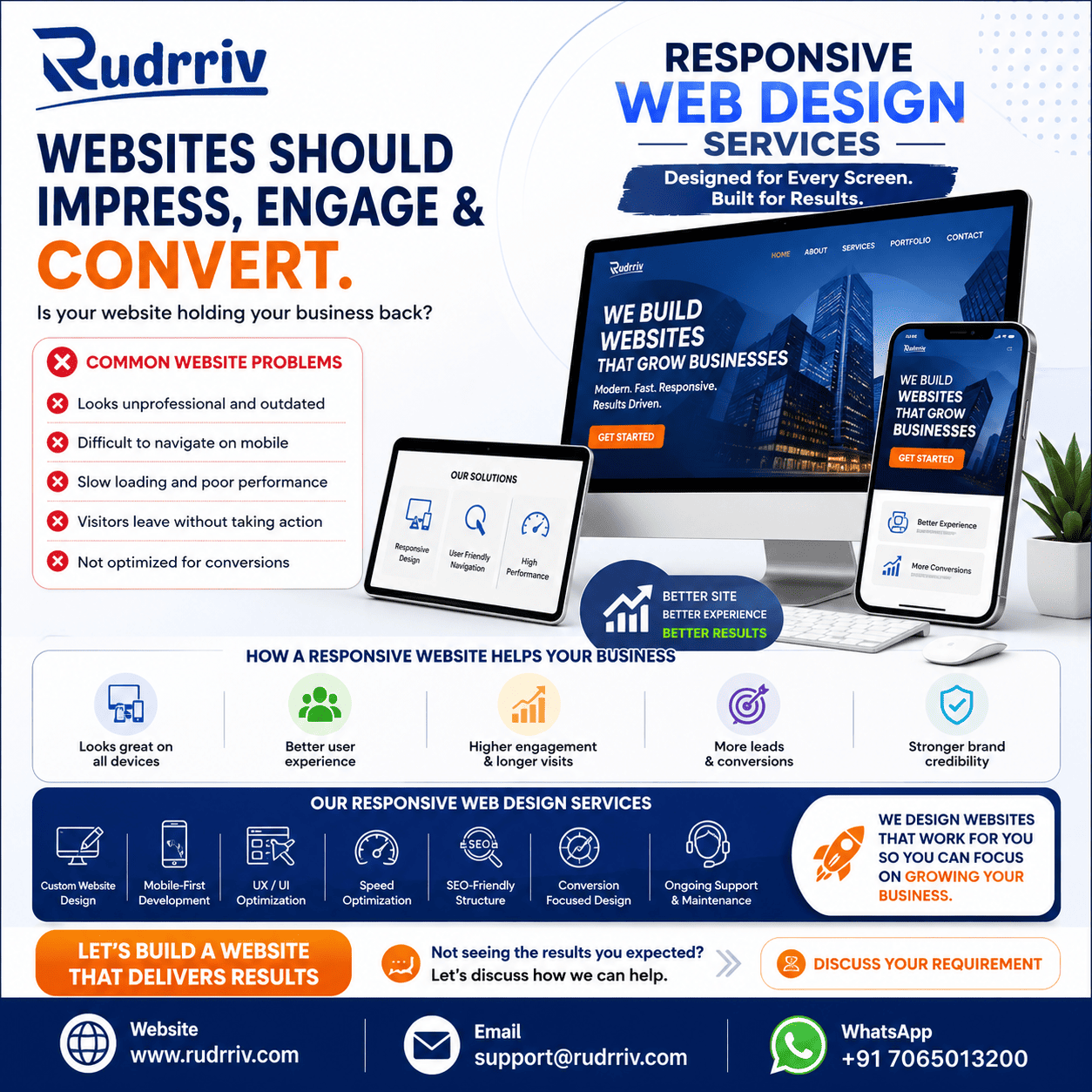
Where a project needs coordinated discovery, UI/UX design, responsive web design, development support, analytics planning, or ongoing creative capacity, Rudrriv design services can help structure a defined project, dedicated-professional arrangement, or managed team.
Quick Answer: How to Choose a Web Designer Who Balances Design and Business Performance
Choose a web designer who can show how each visual decision supports a user task, a business objective, and a documented brand principle. The designer should ask about audiences, priority actions, content, objections, devices, accessibility, analytics, internal approvals, and development constraints before proposing a visual direction.
Review live work rather than screenshots. Test representative pages on mobile and desktop, follow key journeys, inspect forms and calls to action, and ask the designer to explain trade-offs. A strong candidate can discuss hierarchy, readability, responsive states, trust signals, component reuse, performance constraints, and measurement without presenting personal taste as evidence.
Before signing, define deliverables, milestones, review stages, revision rules, source-file ownership, third-party licences, accessibility expectations, developer handoff, quality assurance, acceptance criteria, and post-launch support. Use a paid discovery or small pilot if the project is complex or the working relationship is untested.
Key Takeaways
- Evaluate systems, not isolated screens: the designer should create reusable patterns that remain coherent as the site grows.
- Open the live portfolio: attractive mock-ups do not prove usability, responsiveness, accessibility, or conversion clarity.
- Make conversion intent explicit: every important page needs a defined audience, decision, next action, and measurement plan.
- Protect brand consistency: require component rules, typography, colour, imagery, voice, and usage guidance rather than a few finished pages.
- Document governance: agree who decides, who consolidates feedback, what counts as a revision, and how scope changes are approved.
- Plan implementation early: designer–developer collaboration should begin before high-fidelity screens are final.
- Retain ownership and continuity: source files, accounts, approved assets, specifications, and handover records should remain accessible to the business.
What This Page Covers
- How to define visual, usability, conversion, and brand requirements before contacting designers.
- How to review portfolios and interview designers using evidence-based questions.
- How to compare a freelancer, agency, in-house hire, and managed team.
- How to write a practical statement of work with milestones and acceptance criteria.
- How to manage accessibility, responsive design, content, analytics, revisions, and handover.
- Which red flags commonly lead to expensive redesigns or inconsistent execution.
- How Rudrriv can support a defined web design project or ongoing design capability.
Table of Contents
- How this guide was prepared
- What “balance” means in web design
- Prepare the right brief
- Review portfolios properly
- Interview and score designers
- Compare engagement models
- Define scope, milestones, and ownership
- Practical examples
- Avoid common mistakes
- Final selection checklist
How this guide was prepared
This guide combines practical provider selection, UI/UX planning, brand governance, conversion design, accessibility, responsive implementation, quality assurance, and handover considerations. It uses public references including the W3C Web Content Accessibility Guidelines 2.2, web.dev guidance on Core Web Vitals, the W3C accessibility planning resources, and GOV.UK Design System documentation as examples of authoritative standards and reusable design practice.
Tools, browser capabilities, platform features, prices, licences, and provider capacity may change. Use this framework to structure a decision, then verify current technical, commercial, legal, accessibility, privacy, and industry-specific requirements with appropriate specialists before implementation.
What does balancing visual quality, usability, conversions, and brand consistency mean?
Balance means making deliberate trade-offs without allowing one goal to undermine the others. A visually distinctive site should still be readable, navigable, responsive, and fast enough for real users. A conversion-focused page should guide action without using manipulative patterns or stripping away the brand’s credibility. A consistent brand system should support familiar interaction patterns rather than forcing novelty into every component.
Visual quality is more than decoration
Visual quality includes hierarchy, spacing, typography, imagery, composition, interaction states, and the confidence created by careful details. It should fit the market and the brand rather than imitate a current trend. Ask how the designer will translate brand strategy into page-level decisions and how that direction will remain usable across long-form pages, forms, product listings, dashboards, and campaign landing pages.
Usability is task completion with low avoidable friction
Usability concerns whether a visitor can understand where they are, find relevant information, compare options, recover from errors, and complete a task. It requires clear navigation, readable content, predictable interactions, responsive layouts, accessible controls, and useful feedback. A designer should be comfortable discussing information architecture, user flows, prototypes, testing, and edge cases—not only colour and imagery.
Conversion design supports a relevant next step
A conversion may be a purchase, enquiry, booking, registration, download, demo request, donation, or internal workflow completion. Good conversion design clarifies value, reduces uncertainty, places proof near decisions, keeps forms proportionate, and avoids competing actions. It does not guarantee a commercial result because traffic quality, offer, pricing, operations, and market conditions also matter.
Brand consistency is a scalable decision system
Brand consistency does not mean making every page identical. It means using a controlled set of visual and verbal principles so different pages still feel related. The designer should define components, variants, states, spacing, typography, colour usage, image treatment, icons, and content patterns. This reduces rework and protects quality when developers, marketers, and external partners create new pages.
Prepare a decision-ready web design brief before comparing providers
A useful brief gives designers enough context to solve the right problem without prescribing every visual answer. It should explain the business situation, users, content, priority journeys, current evidence, constraints, and definition of success.
Include these business and user inputs
- Business model, offer, market, locations, audience segments, and buying cycle.
- Primary and secondary actions for each important audience.
- Current site problems supported by analytics, feedback, sales observations, or usability findings.
- Brand strategy, positioning, tone, existing guidelines, and non-negotiable assets.
- Required pages, content status, features, integrations, languages, and compliance needs.
- Technology or CMS constraints and the developer responsible for implementation.
- Target launch date, approval stakeholders, budget range, and post-launch ownership.
Translate broad goals into acceptance criteria
“Make it modern” is subjective. Replace it with criteria such as: priority information is visible in the first mobile viewport; the primary action remains clear at common breakpoints; body text meets an agreed readability standard; all interactive states are specified; approved components cover the required page types; and the developer can implement the design without unresolved behavior.
| Goal | Weak requirement | Decision-ready requirement | Evidence at review |
|---|---|---|---|
| Visual quality | Make it premium | Use the approved brand attributes, restrained motion, strong editorial hierarchy, and original image direction | Design rationale and page-set review |
| Usability | Easy to use | Users can find the priority service and submit an enquiry on mobile without avoidable steps | Task test and prototype review |
| Conversions | Increase leads | Define one primary and one secondary action, proof near decision points, and analytics events | Journey map and tracking plan |
| Brand consistency | Follow our brand | Provide reusable components, variants, typography, colour, imagery, and content rules | Design system and sample pages |
The table helps prevent proposals from being judged on presentation alone. It also gives reviewers a shared language when opinions differ.
How to review a web designer portfolio without being misled by screenshots
Review live outcomes, context, and decision quality—not only aesthetic similarity to your preferred style. A portfolio is evidence when you can understand the problem, the designer’s role, the constraints, the process, and the implemented result.
Use a five-part portfolio review
- Open the live site: check mobile and desktop navigation, content hierarchy, forms, page states, responsiveness, and basic performance.
- Trace a real journey: attempt a purchase, enquiry, booking, comparison, or account task rather than browsing passively.
- Compare page types: inspect the homepage, inner pages, long-form content, forms, error states, and campaign pages for consistency.
- Ask about ownership: confirm which research, information architecture, design, content, development, and optimization work the candidate performed.
- Request the rationale: ask why major decisions were made and what changed after testing or stakeholder feedback.
Look for evidence of restraint
Strong designers do not apply every trend to every project. They know when animation distracts, when dense layouts damage comprehension, when a shortened form removes necessary qualification, and when strict brand rules need an accessible alternative. Their case studies should demonstrate judgment under constraints.
Interview and score designers using the same evidence
Use a structured interview and weighted scorecard so confidence, charisma, or one attractive project does not dominate the decision. Ask every shortlisted provider the same core questions, record answers, and score the evidence after the meeting.
High-value interview questions
- How will you learn about our users and validate priority journeys?
- How do you connect brand attributes to typography, colour, imagery, layout, and interaction?
- How do you decide which conversion actions deserve prominence?
- How do you design responsive behavior and content hierarchy before final visuals?
- How do you address accessibility and document exceptions?
- What do you need from our copywriter, marketer, developer, and decision-makers?
- How are feedback, revisions, scope changes, delays, and approvals managed?
- What source files, component specifications, licences, and training will we receive?
- How do you review implementation and resolve differences between design and build?
- What post-launch evidence would cause you to recommend a change?
| Evaluation area | Suggested weight | Strong evidence | Warning sign |
|---|---|---|---|
| Relevant problem-solving | 20% | Explains decisions and constraints from comparable work | Relies on visual similarity alone |
| Usability and accessibility | 20% | Shows research, task flows, prototypes, and inclusive states | Treats accessibility as a plugin or final check |
| Conversion thinking | 15% | Connects user intent, proof, friction, CTA design, and measurement | Promises more conversions from appearance alone |
| Brand system | 15% | Creates reusable rules, components, and content guidance | Produces disconnected page mock-ups |
| Delivery and collaboration | 15% | Defines milestones, roles, feedback, QA, and developer handoff | Leaves responsibilities vague |
| Commercial and ownership terms | 15% | Clear fees, assumptions, licences, IP, files, and exit terms | Low headline price with major exclusions |
Adjust weights to the project. An ecommerce redesign may give more weight to journeys, product discovery, and analytics. A brand-led corporate site may give more weight to narrative, credibility, and component governance. Keep the scoring rules consistent across candidates.
Choose the right engagement model for the design workload
The best provider type depends on scope breadth, continuity, internal capability, governance, and implementation responsibility. No model is automatically superior.
| Model | Best suited to | Main advantage | Control to add |
|---|---|---|---|
| In-house designer | Continuous product or marketing work with deep organisational context | Fast collaboration and retained knowledge | Specialist support, peer review, and workload prioritisation |
| Freelance designer | Focused site, landing page, audit, or design-system assignment | Direct access and flexible capacity | Availability, backup, scope, developer coordination, and handover |
| Design agency | Brand, research, UX, visual design, and launch work requiring several disciplines | Broader skills and established process | Named team, senior involvement, change control, and account ownership |
| Managed team | Ongoing multi-page programmes, multiple brands, or coordinated design and development | Dedicated capacity with governance and continuity | Service levels, prioritisation, reporting, and performance review |
A paid discovery phase can precede any of these models. It is especially useful when the website must serve several audiences, migrate complex content, integrate with business systems, or reconcile differing stakeholder expectations.
Define scope, milestones, revisions, ownership, and handover before work starts
A good statement of work converts the brief into verifiable responsibilities and acceptance points. It should prevent assumptions about content, mobile layouts, prototypes, accessibility, development, and support.
Core scope elements
- Discovery activities, workshops, research inputs, and required stakeholder access.
- Information architecture, page inventory, user flows, wireframes, and prototype depth.
- Number and type of page templates, components, variants, and interaction states.
- Desktop, tablet, and mobile behavior, including agreed browser and device coverage.
- Content responsibilities: strategy, copy, migration, imagery, data, product information, and approvals.
- Accessibility target, review method, documented limitations, and remediation responsibilities.
- Developer handoff format, design reviews during build, and implementation QA.
- Milestones, dependencies, decision dates, revision rounds, change requests, and delay rules.
- Intellectual-property ownership, source files, licences, confidentiality, and portfolio permissions.
- Launch support, training, warranty period, maintenance, optimization, and exit handover.
Use milestone acceptance, not one final reveal
Review work in stages: discovery alignment, sitemap and journeys, low-fidelity wireframes, visual direction, component system, representative high-fidelity pages, responsive states, interactive prototype, build QA, and final handover. Each stage should have named reviewers and acceptance criteria. This catches structural problems before they become expensive visual or development changes.
Define feedback governance
The client should appoint a project owner who gathers stakeholder comments, resolves internal contradictions, and sends one prioritised response. The designer should explain how feedback affects user goals, brand principles, scope, and timeline. “Unlimited revisions” is not a substitute for clear decisions; it can create repeated subjective changes and weaken accountability.
Three practical examples of choosing the right web designer
Example 1: A professional-services firm needs credibility and qualified enquiries
The firm’s existing site looks dated, but its larger problem is that visitors cannot distinguish services or understand who the team is suitable for. A relevant designer should map audience questions, restructure service pages, place credentials and evidence near decision points, simplify the enquiry path, and build a restrained visual system. A portfolio of expressive campaign sites is less relevant than evidence of complex service communication.
Example 2: An ecommerce business needs stronger mobile product discovery
The business has good brand photography but high mobile drop-off. The shortlist should prioritise designers with navigation, search, filter, product-detail, cart, checkout, and merchandising experience. The evaluation should include mobile task testing and developer collaboration. A visually impressive homepage concept is not enough if filters, variant selection, shipping information, and form errors remain unclear.
Example 3: An enterprise team needs consistency across many departments
Several teams publish pages independently, causing inconsistent components and slow approvals. The right engagement may be a managed design team rather than a one-off redesign. Deliverables should include a governed design system, contribution rules, templates, accessibility guidance, training, release management, and ongoing component support. Success depends on adoption and governance as much as visual quality.
Common mistakes and warning signs
Most expensive failures begin with unclear responsibility, evidence, or acceptance criteria rather than a lack of visual talent. Watch for these warning signs.
- Style-first discovery: the provider asks for websites you like but not what users need to understand or do.
- Screenshot-only portfolio: live sites, responsive behavior, outcomes, and personal contribution are unclear.
- Conversion guarantees: the designer promises sales or leads without controlling traffic, offer, pricing, or operations.
- Accessibility postponed: inclusive requirements are treated as a final automated check or optional extra.
- No content plan: layouts are approved with placeholder text even though real content will change hierarchy and length.
- Developer handoff at the end: feasibility, components, breakpoints, performance, and CMS constraints surface too late.
- Unclear source-file ownership: licences, editable files, fonts, imagery, accounts, or components cannot be transferred cleanly.
- Fragmented brand execution: pages look attractive individually but lack reusable rules for future teams.
- Single decision-maker dependency: stakeholders appear only at final approval and reopen settled direction.
- Low bid with missing work: research, copy, mobile states, QA, accessibility, analytics, or support are excluded.
Final checklist for selecting a balanced web designer
- The designer understands our audiences, commercial context, priority journeys, and current evidence.
- Relevant live work demonstrates usable, responsive, accessible, and coherent implementation.
- The candidate can explain decisions, constraints, trade-offs, and changes after review or testing.
- The proposed process includes discovery, structure, prototype, visual system, responsive states, and QA.
- Conversion goals and analytics requirements are defined without guaranteed-outcome claims.
- Brand consistency is supported by reusable components, rules, variants, and content guidance.
- Scope identifies pages, components, content, integrations, browsers, responsibilities, and exclusions.
- Milestones, approvals, revision rules, delays, and change requests are documented.
- Accessibility expectations and testing responsibilities are explicit.
- Developer involvement begins before final design approval.
- Source files, licences, accounts, intellectual property, confidentiality, and portfolio rights are clear.
- The handover includes specifications, assets, training, unresolved issues, and post-launch support.
How Rudrriv can help
Rudrriv can help businesses move from an unclear redesign request to a controlled design engagement. Depending on the requirement, support may include a defined discovery and web design project, a dedicated designer, coordinated UI/UX and development support, ongoing creative assistance, or a managed cross-functional team.
The engagement can begin with requirement discovery covering audiences, brand direction, priority journeys, content readiness, technology, internal capacity, timeline, and decision governance. Work can then be scoped with named responsibilities, milestones, review cycles, quality checks, and handover requirements. Explore Rudrriv services, outsourcing support, or specialist talent options according to the capacity and continuity required.
Summary: How to choose a web designer who balances quality, usability, conversions, and brand consistency
Choose the designer whose process makes quality inspectable. The strongest candidate can connect brand expression with user tasks, explain conversion decisions without promising outcomes, create reusable components, collaborate with developers, and define how work will be tested, accepted, measured, and handed over.
Do not select on aesthetic preference or price alone. Compare relevant live work, decision rationale, accessibility, responsive behavior, content planning, conversion logic, delivery governance, ownership, and continuity. Use a paid discovery or pilot where uncertainty remains.
A balanced website is not created by compromising every goal equally. It is created by understanding which outcome matters at each decision point and using a coherent system that protects users, business objectives, brand character, and future maintainability.
FAQs on Choosing a Web Designer
How do I choose a web designer who can balance visual quality, usability, conversions, and brand consistency?
Choose a designer who can explain how brand strategy, user journeys, accessibility, responsive behavior, content hierarchy, and conversion goals shape the visual system. Review relevant live work, ask for decisions behind each example, test the proposal against real user tasks, and document measurable acceptance criteria, ownership, revisions, testing, and handover.
What should I look for in a web designer portfolio?
Look beyond attractive screenshots. Open the live sites, check mobile layouts, navigation, readability, page speed, forms, calls to action, accessibility basics, and brand consistency across multiple page types. Ask which parts the designer personally owned, what constraints existed, how success was measured, and whether the final result changed after launch.
How can I tell whether a designer understands conversions?
A conversion-aware designer asks what action each audience should take, what objections delay that action, which proof elements reduce risk, and how the page will measure results. They should discuss message hierarchy, CTA prominence, form friction, trust signals, landing-page variants, analytics events, and testing rather than promising that a visual redesign alone will increase revenue.
Should I hire a web designer, UI UX designer, developer, or agency?
Hire a web designer for visual systems and page composition, a UI/UX specialist for research and interaction design, and a developer for implementation. A multidisciplinary agency or managed team is more suitable when discovery, content, design, development, analytics, quality assurance, accessibility, and launch coordination must work together. The right model depends on scope and internal capability.
What questions should I ask a web designer before hiring?
Ask about their discovery process, target-user research, brand inputs, responsive design, accessibility, conversion planning, content responsibilities, design-system deliverables, revision limits, developer collaboration, testing, ownership, source files, post-launch support, timeline assumptions, and how they handle disagreements or scope changes.
How much should a professional web design project cost?
Cost depends on page count, research depth, content readiness, custom components, ecommerce or application complexity, accessibility expectations, prototyping, design-system depth, development involvement, integrations, testing, and support. Compare scope and responsibilities rather than headline price. A lower fee may exclude research, copy, mobile states, QA, or developer handoff.
How many design revisions should be included?
There is no universal number, but the contract should define review stages, who consolidates feedback, what counts as a revision, and what triggers a change request. Two focused review rounds per milestone can work when discovery and approvals are strong. Unlimited revisions often hide weak governance and can extend timelines without improving quality.
Who should own the website design files and brand assets?
The client should retain ownership or clearly documented usage rights for approved designs, source files, exported assets, copy, custom illustrations, component specifications, domains, analytics, and accounts after payment and subject to third-party licence terms. The agreement should identify pre-existing tools, fonts, stock assets, plugins, and code that carry separate licences.
How should usability and accessibility be checked before launch?
Test key tasks with representative users where possible, review keyboard navigation, headings, labels, focus states, contrast, zoom, form errors, mobile touch targets, and screen-reader basics, and validate responsive behavior across agreed browsers and devices. Use WCAG 2.2 as a reference while recognizing that automated tools cannot replace expert and human review.
What should a web design handover include?
A complete handover should include approved source files, design-system rules, components and states, responsive specifications, content and asset inventory, licences, accessibility notes, analytics requirements, outstanding issues, credentials transferred securely, training, acceptance records, and a support or maintenance plan. Developers should be able to implement without guessing essential interactions.
Need help defining the right web design engagement?
Share your current website, audience, brand requirements, priority user journeys, content readiness, technology constraints, and desired business outcomes. Rudrriv can help structure a defined project, dedicated-professional arrangement, ongoing design support plan, or managed design and development team with clear responsibilities and delivery controls.
Discuss your requirementAt Rudrriv, we make it easier for businesses to access the right expertise, execute important work, and scale with confidence.