
How to Choose the Right Freelancer for Your Project
Choose the right freelancer by matching proof of capability to the exact work you need, rather than relying on a profile headline, low quote, or high rating alone. Learning how to choose the right freelancer based on skills, experience, reviews, availability, and communication means testing five connected questions: can the person do the work, have they handled a comparable situation, do past clients describe dependable delivery, can they commit enough capacity, and do they communicate in a way that reduces uncertainty?
The most common mistake is treating those signals as interchangeable. A freelancer may have strong technical skills but limited experience in your industry. Another may have years of experience but an outdated portfolio. A highly rated candidate may be overbooked, while a newer professional may be an excellent fit for a tightly defined task. The decision should therefore be based on the evidence needed for your particular project, its risk level, and the amount of independent judgment required.
For a small design task, a recent portfolio sample and reliable turnaround may be enough. For software development, financial data handling, campaign management, or a customer-facing product, you may need deeper technical verification, role-based access, documentation, quality assurance, and continuity after launch. The correct evaluation process becomes more rigorous as the cost of failure increases.
Quick Answer: Choosing the Right Freelancer
The right freelancer is the candidate whose verified evidence best matches the work, risk, timeline, and collaboration style of your project. Start with a written outcome, deliverables, tools, quality standard, deadline, and decision owner. Then score candidates against the same criteria instead of changing the standard for each profile.
Review skills through work samples or a short paid task; evaluate experience by relevance, not years alone; read reviews for repeated behavioral patterns; confirm real weekly capacity and time-zone overlap; and test communication with a structured project discussion. A candidate should be able to restate the goal, identify missing information, explain trade-offs, and commit to a realistic next step.
For high-value or sensitive work, validate access controls, confidentiality, ownership, documentation, and handover before kickoff. The main caution is simple: do not award a large project based only on a portfolio, rating, interview, or price. Use several independent signals and reduce uncertainty with a defined paid trial where practical.
Key Takeaways
- Define the result first: candidates cannot be compared fairly until the deliverables, quality standard, timeline, and dependencies are clear.
- Verify current skills: use relevant samples, technical discussion, or a paid trial rather than accepting a list of tools at face value.
- Prefer relevant experience: similar constraints, users, systems, or business models matter more than total years worked.
- Read review patterns: repeated comments about communication, deadlines, revisions, and ownership are more useful than the average score alone.
- Confirm capacity explicitly: ask about start date, weekly hours, competing commitments, time-zone overlap, and planned leave.
- Test communication before hiring: a strong freelancer clarifies assumptions, reports risk early, and explains decisions in language your team can use.
- Protect delivery and handover: document acceptance criteria, access, ownership, security, files, documentation, and support after completion.
Table of Contents
- Quick Answer
- Define the work before comparing profiles
- Match skills to actual deliverables
- Judge experience by relevant context
- Read reviews as evidence, not proof
- Confirm availability and working rhythm
- Test communication before hiring
- Compare cost, capacity, and continuity
- Use a scorecard and paid trial
- Apply the framework in real situations
- Summary
Define the Work Before Comparing Profiles
A reliable selection starts with a project definition that is specific enough to expose real differences between candidates. “Need a website,” “need social media help,” or “need a data analyst” is too broad. State the business outcome, the deliverables, the users affected, the systems involved, the deadline, and the conditions that determine whether the work is accepted.
Separate mandatory requirements from preferences. A mandatory requirement may be proficiency in a specific framework, experience with multilingual ecommerce, availability during a launch week, or the ability to work inside your existing design system. A preference may be industry familiarity, a particular time zone, or experience with one project-management tool. This prevents attractive but nonessential profile details from overpowering the criteria that actually control delivery.
Write a brief that candidates can challenge
A useful brief gives enough detail for a freelancer to identify missing information. Include the current situation, desired result, known constraints, required outputs, reference material, stakeholders, approval process, target dates, budget range where appropriate, and what your team will provide. Do not hide every constraint as an interview test; strong candidates need a realistic picture to propose a realistic approach.
Decision rule: if two people interpret the assignment in materially different ways, clarify the scope before comparing their price or timeline.
Match Skills to the Actual Deliverables
Skills should be assessed at the level the project needs. A tool name on a profile only shows claimed familiarity. It does not prove depth, judgment, troubleshooting ability, or the capacity to produce work that meets your quality standard. Ask for evidence that resembles the actual deliverable and working environment.
For design, review editable files, responsive states, accessibility decisions, and how feedback changed the work. For development, discuss architecture, testing, version control, deployment, security, and maintenance. For marketing, examine research, audience logic, measurement, creative decisions, and what the freelancer changed when results were weak. For writing, check source use, tone control, factual accuracy, revision quality, and the ability to follow a content specification.
Use proof that reveals the freelancer’s contribution
- Ask which parts of a sample the freelancer completed personally.
- Request the problem, constraints, decisions, and trade-offs behind the work.
- Check whether the sample is recent enough to reflect current tools and practices.
- Use a live walkthrough, code discussion, redacted file, or reference where confidentiality permits.
- For critical work, use a paid task that exercises the same skill rather than an unrelated test.
Judge Experience by Relevant Context
Experience is valuable when it helps the freelancer recognize patterns, anticipate risks, and make better decisions under your project’s conditions. Total years are a poor shortcut. A candidate with three years in a closely related environment may be safer than someone with twelve years of broad but unrelated work.
Compare context across five dimensions: the type of customer or user, project complexity, required systems, regulatory or security constraints, and the level of stakeholder coordination. Ask what went wrong in a comparable project, how the freelancer responded, and what they would do differently now. Mature answers include limitations and lessons rather than presenting every project as a success.
Adjust the experience standard to project risk
Routine production work can be suitable for an emerging freelancer when the brief is clear and review is available. Ambiguous strategy, core product architecture, sensitive data, major migrations, or work tied to an immovable launch date usually requires stronger evidence of comparable responsibility. The higher the recovery cost, the more directly relevant the experience should be.
Read Reviews as Evidence, Not Proof
Reviews are most useful when they reveal repeated delivery behavior. Do not treat a five-star average as a complete quality assessment. Read the words, dates, project types, and reviewer context. Look for recurring evidence about responsiveness, deadline management, accuracy, revision handling, initiative, professionalism, and whether the final result matched the agreed scope.
Prioritize reviews that are recent, specific, and related to your required work. A freelancer may be highly rated for logo design but unproven for a complex design system. One negative review is not automatically disqualifying; examine the response, the pattern across other projects, and whether the issue relates to the work you are buying.
The FTC guidance on consumer reviews and testimonials is a useful reminder that fake or deceptive reviews can distort marketplace decisions. Treat reviews as one signal within a broader verification process.
Confirm Availability and Working Rhythm
Availability is not the same as a profile showing “open to work.” Confirm the earliest start date, weekly capacity, working days, time-zone overlap, planned leave, and the other commitments that could affect your milestones. Ask whether the freelancer will perform the work personally, use subcontractors, or depend on another team member.
Translate capacity into milestone commitments
Ask the freelancer to connect capacity to actual deliverables: what can be completed in the first week, which inputs are required from your team, what could delay the work, and how schedule changes will be reported. Record the answer in the project plan. Reconfirm it immediately before kickoff because a freelancer’s pipeline can change between proposal and award.
Test Communication Before Hiring
Communication quality is visible before the contract begins. A strong freelancer does not merely reply quickly; they improve the clarity of the decision. They restate the objective, ask relevant questions, distinguish assumptions from facts, explain trade-offs, and tell you what they need next. Their messages should make it easier for stakeholders to act.
Use a short structured discussion. Send the brief, ask the candidate to summarize the assignment in their own words, identify the three most important unknowns, propose an initial approach, and flag the main risk. This tests listening, judgment, written clarity, and whether the person can handle ambiguity without pretending to know more than they do.
Compare Cost, Capacity, and Continuity
Price should be compared against the complete scope and the probability of reaching an acceptable result. Hourly rates, fixed fees, retainers, and milestone payments can all work, but each quote should state what is included, what is excluded, the number of revisions, third-party costs, payment triggers, and how changes are approved.
Use the table below to score every shortlisted candidate against the same evidence. A five-point score can be used for each criterion, multiplied by the suggested weight. Change the weights when your project has unusual risk—for example, increase security and continuity for a system with sensitive access.
| Criterion | Suggested weight | Strong evidence | Warning signs |
|---|---|---|---|
| Skills and work quality | 25% | Relevant recent samples, clear contribution, sound technical or creative reasoning | Tool lists without proof, copied samples, inability to explain decisions |
| Relevant experience | 20% | Comparable users, systems, constraints, scale, or responsibility | Years emphasized without comparable examples or lessons |
| Reviews and references | 15% | Specific, recent patterns about quality, reliability, revisions, and ownership | Vague or repetitive reviews, unrelated project history, unverifiable claims |
| Availability and capacity | 15% | Confirmed start date, weekly hours, overlap, leave, and milestone capacity | Immediate availability without details, hidden subcontracting, overcommitment |
| Communication and judgment | 15% | Clarifies goals, surfaces risk, summarizes decisions, explains trade-offs | Generic replies, missed questions, unsupported certainty, slow risk reporting |
| Commercial and delivery fit | 10% | Clear scope, fees, revisions, ownership, security, support, and handover | Unclear inclusions, missing acceptance criteria, no exit or handover plan |
The score is a decision aid, not an automatic answer. Review any low score in a critical category before considering the total. A candidate should not win solely because strengths in presentation or price compensate for a serious gap in capability, security, or availability.
Use a Scorecard and a Paid Trial
A paid trial is the most practical way to test fit when the evidence remains incomplete. It should be small enough to limit risk but similar enough to the main assignment to reveal actual working behavior. A trial for a developer might be a contained bug fix with tests and documentation; for a designer, one key flow with editable files; for a writer, a sourced section using the real brief and revision process.
Define the trial as carefully as the main project: scope, deadline, access, fee, acceptance criteria, ownership, and what happens next. Pay fairly for usable work. Do not ask several candidates to produce substantial speculative output without compensation.
Evaluate the trial on process as well as output
- Did the freelancer clarify the assignment before starting?
- Was the approach appropriate for the stated constraints?
- Were risks or blockers reported early?
- Did the deliverable meet the agreed quality standard?
- How well were feedback and revisions handled?
- Were files, notes, and next steps handed over cleanly?
For freelancers who require access to business systems, apply the principle of least privilege: provide only the permissions needed for the task and remove them when no longer required. The NIST definition of least privilege and CISA guidance on multifactor authentication provide useful security foundations for external access.
Complete a controlled onboarding and handover
Before full kickoff, confirm the project owner, communication rhythm, milestone plan, source-of-truth documents, access method, invoicing, and escalation path. At completion, collect editable source files, code or repository access, documentation, asset licenses, credentials through a secure channel, open-issue notes, and the removal of unnecessary permissions. Continuity should be designed before the freelancer leaves, not after a problem occurs.
Apply the Framework in Real Situations
Example 1: An ecommerce team needs product-page design
An ecommerce business initially favors the designer with the most visually impressive portfolio. The mistaken assumption is that visual polish alone predicts conversion-ready work. A better decision is to choose the candidate who can show responsive product flows, variant handling, accessibility, collaboration with developers, and a realistic weekly capacity. Because shoppers move between mobile discovery, comparison, and checkout, the freelancer’s understanding of user behavior and implementation constraints matters more than an unrelated award-winning concept.
Example 2: A startup needs an integration developer
A startup considers the lowest fixed quote for connecting a subscription product to billing and customer-support systems. The confusion is treating the work as a simple connection rather than a data, error-handling, and maintenance problem. The better candidate explains authentication, webhooks, retries, test environments, logging, ownership, and what happens when an external API changes. A paid technical discovery task can validate judgment before the startup grants broader access or approves the full build.
Example 3: An agency needs ongoing content support
An agency assumes the freelancer with the most five-star reviews will be the safest choice. Review details reveal that most projects were one-off blog posts, while the agency needs weekly briefs, source verification, client-specific tone, and rapid revisions across several accounts. The better choice is a writer with fewer but more relevant reviews, confirmed recurring capacity, and a communication process that separates factual questions, client approvals, and revision requests. Specialist matching may help when the agency needs reliable coverage across multiple subjects.
Avoid these final hiring mistakes
- Comparing candidates before the brief and acceptance criteria are stable.
- Using one signal—price, rating, years, or portfolio—as the whole decision.
- Ignoring who will actually perform the work or whether subcontracting is involved.
- Granting broad system access before security and ownership terms are agreed.
- Starting the full project without testing communication or milestone discipline.
- Leaving editable files, documentation, credentials, and exit obligations undefined.
Summary
Choose a freelancer by connecting evidence to the real risks of the assignment. Skills should match the deliverables, experience should match the context, reviews should reveal repeated behavior, availability should translate into milestone capacity, and communication should make decisions clearer. No single profile signal can replace that combined assessment.
For low-risk, well-defined work, a portfolio review, structured conversation, and clear agreement may be sufficient. For strategic, technical, sensitive, or time-critical work, add stronger verification, a paid trial, controlled access, quality assurance, documentation, ownership terms, and a planned handover. Compare total value and continuity rather than hourly rate alone.
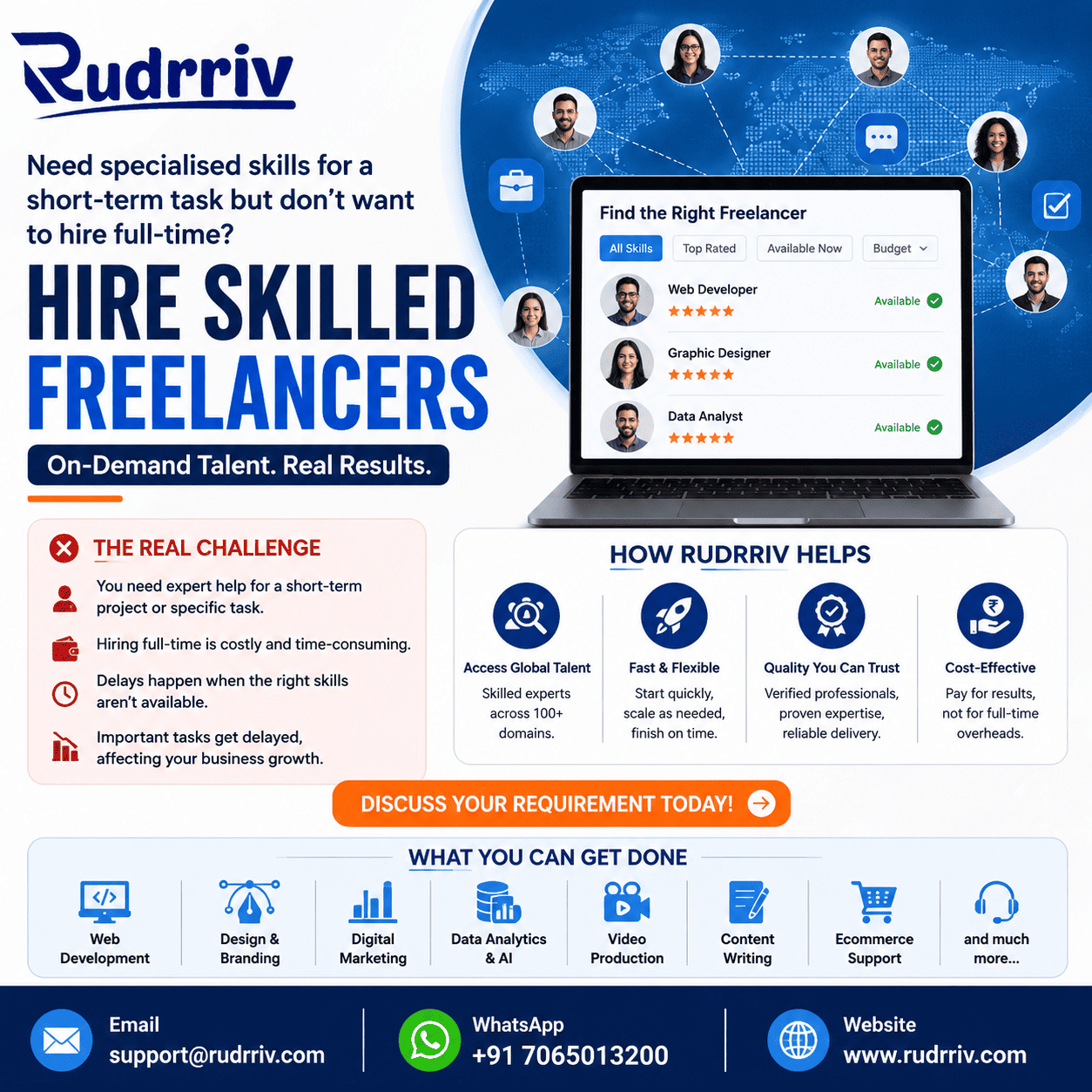
When the brief is unclear or the project needs several capabilities, businesses can use Rudrriv's freelancer support options to clarify requirements and identify relevant specialist capacity. The hiring decision should still remain evidence-based and proportionate to the work.
FAQs on Choosing the Right Freelancer
How do I choose the right freelancer based on skills, experience, reviews, availability, and communication?
Start by defining the deliverables and the level of judgment the work requires. Then compare each freelancer's demonstrated skills, relevant experience, review patterns, confirmed capacity, and communication during a real project discussion. Use a weighted scorecard and, for important work, a small paid trial before committing to the full scope.
Should skills or experience matter more when hiring a freelancer?
Skills show whether a freelancer can perform the required tasks; experience shows whether they can apply those skills in a similar business context. For routine, well-specified work, current skill evidence may matter more. For ambiguous, high-risk, or strategic work, relevant experience and decision quality should carry more weight.
How can I tell whether a freelancer's portfolio is genuine and relevant?
Ask the freelancer to explain their exact contribution, the original problem, constraints, decisions, and outcome for two or three samples. Where confidentiality permits, request a live link, redacted work file, repository contribution, or client reference. A polished image without a clear explanation is not enough evidence.
What should I look for in freelancer reviews?
Look beyond the average rating. Read recent reviews for repeated evidence about communication, quality, deadlines, revision handling, and reliability on projects similar to yours. Treat vague praise, clusters of identical wording, and reviews unrelated to the required work as weak evidence rather than automatic proof of fit.
How do I verify a freelancer's availability before hiring?
Ask for the earliest start date, weekly capacity, working days, time-zone overlap, known leave, and other commitments that may affect delivery. Confirm whether the freelancer personally performs the work and record milestones in the agreement. Recheck availability immediately before kickoff because profiles can become outdated.
What communication test should I use before awarding the project?
Send a short brief with one deliberate ambiguity and ask the freelancer to summarize the goal, identify missing information, propose an approach, and explain the next step. Strong candidates clarify assumptions and communicate trade-offs. Avoid unpaid speculative work; use a paid discovery task when deeper analysis is required.
Is the lowest-priced freelancer usually the best value?
No. The lowest quote may exclude discovery, revisions, testing, documentation, project management, or post-delivery support. Compare the complete cost of getting an acceptable result, including your team's supervision time and the cost of rework. A higher rate can be better value when scope understanding and execution risk are stronger.
When should I use a paid trial project?
Use a paid trial when the assignment is important, the relationship is new, or the portfolio cannot demonstrate the exact working conditions. Choose a small task that tests the same skills, tools, communication, and quality standard as the main project. Define the deliverable, deadline, payment, and ownership before the trial begins.
What should be included in a freelancer agreement and handover?
Document the scope, milestones, fees, payment triggers, revision limits, confidentiality, intellectual-property terms, security requirements, access rules, acceptance criteria, cancellation terms, and handover items. At completion, collect editable source files, credentials through a secure method, documentation, status notes, and confirmation that unnecessary access has been removed.
Need Help Finding the Right Specialist?
Share the outcome, required skills, timeline, working model, and delivery risks. Rudrriv can help structure a defined project, identify suitable specialist support, or arrange ongoing capacity with clearer responsibilities, communication, and handover expectations.
Discuss your requirementAt Rudrriv, we make it easier for businesses to access the right expertise, execute important work, and scale with confidence.