
AI Chatbot Platforms with Advanced Language Understanding
AI chatbot platforms with advanced natural language understanding should be selected by matching their language capability, integration model, governance controls, and operating cost to a specific customer or employee task. The strongest platform is not automatically the one with the largest model or longest feature list. It is the one that can understand the language your users actually employ, access the right approved information, complete or route the task reliably, and operate within your security, budget, and maintenance constraints.
For most organizations, the practical decision is between a packaged chatbot platform, a low-code conversational system, and an API-first architecture built around one or more large language models. Packaged products are faster for common service workflows. Low-code platforms offer more control without requiring a fully custom stack. API-first systems are appropriate when the chatbot is part of a differentiated digital product or must coordinate complex tools, data, and business rules.
The main caution is that natural-sounding conversation can hide weak operational performance. Before committing, test the platform against real questions, incomplete requests, ambiguous language, policy-sensitive situations, integration failures, and human handoff scenarios. A polished demonstration is not enough evidence for production use.
Quick Answer: Which AI Chatbot Platform Fits?
Choose a packaged or low-code platform when the primary need is customer support, lead qualification, internal help, or another repeatable workflow that benefits from predefined channels, analytics, integrations, and agent escalation. Choose an API-first platform when the chatbot is a product capability, must call custom tools, needs specialized retrieval or evaluation, or requires deeper control over models, prompts, memory, and interface behavior.
Do not decide on natural language quality alone. Confirm whether the platform can ground answers in approved sources, respect permissions, preserve context appropriately, integrate with systems of record, expose useful logs, and support testing before changes reach users. The correct choice may also be a phased approach: start with a narrow workflow, validate demand and reliability, then add more channels, languages, data sources, and transactional capabilities.
A practical starting rule is simple: use the least complex platform that can meet the required accuracy, integration, security, and scale. Complexity should be earned by a validated business need.
Key Takeaways
- Start with the user task: define what the chatbot must understand, answer, complete, or escalate.
- Separate fluency from reliability: natural conversation is useful only when responses are grounded and actions are controlled.
- Match architecture to differentiation: packaged platforms suit standard workflows; API-first systems suit custom product experiences.
- Test real language: include ambiguity, spelling variation, multilingual requests, incomplete information, and domain terminology.
- Include governance in the platform decision: data retention, access, auditability, tool permissions, and human review affect suitability.
- Model total operating cost: licensing, usage, integrations, evaluation, monitoring, content maintenance, and support all matter.
- Launch in phases: prove one valuable workflow before expanding the chatbot’s authority and scope.
Table of Contents
- Start with the conversation the business must support
- Compare the three main platform approaches
- Evaluate natural language understanding in practice
- Match platform capabilities to business use cases
- Check integrations, knowledge, and action controls
- Compare platform options across key criteria
- Estimate cost, resources, and implementation effort
- Plan testing, monitoring, and maintenance
- Avoid common platform-selection mistakes
- Summary: choose the least complex viable platform
Start with the Conversation the Business Must Support
The platform decision begins with a conversation inventory, not a vendor shortlist. Identify the users, channels, languages, tasks, data, and consequences involved. A chatbot that answers store-policy questions has a different risk profile from one that changes an order, recommends a financial product, resets an employee account, or updates a patient record.
Define the target outcome
Write the outcome in operational terms. Examples include resolving a delivery-status question, helping a buyer compare products, guiding an employee to an approved policy, collecting structured lead information, or routing a complex case to the right team. Avoid broad goals such as “improve engagement” until they are translated into observable user actions.
Map language and context requirements
List the terminology, languages, tone, and context the platform must handle. Ecommerce users may refer to product variants informally. Field teams may use abbreviations. Global customers may switch languages within one message. Internal users may expect the chatbot to understand role, location, and policy eligibility. These requirements influence model choice, retrieval design, training examples, and evaluation data.
Decision rule: when the intended task cannot be described clearly, the platform comparison is premature. First define the conversation, data, action, and escalation boundaries.
Compare the Three Main Platform Approaches
Most business choices fall into three categories. Each can provide advanced natural language capability, but they differ in speed, control, engineering responsibility, and long-term flexibility.
Packaged conversational platforms
These products combine a chatbot builder, channels, analytics, knowledge ingestion, integrations, and human-agent handoff. They are often the fastest route for common customer-service or employee-support scenarios. Their limitation is that deep customization may depend on vendor-specific workflows, connectors, and pricing tiers.
Low-code enterprise platforms
Low-code platforms let business and technology teams define topics, data connections, actions, policies, and deployment channels with less custom code. They suit organizations that need governance and integration but want faster iteration than a fully custom application. Evaluate how much flexibility remains when the conversation moves beyond predefined patterns.
API-first and custom architectures
An API-first solution combines language models with application code, retrieval, databases, tools, identity, evaluation, and observability. It offers the most control and can support differentiated products, but the organization owns more design and operational responsibility. This route requires strong engineering, security, quality assurance, and maintenance capability.
Evaluate Natural Language Understanding in Practice
Advanced natural language understanding is not a single feature. It is a set of behaviors that should be tested against the organization’s actual conversations.
- Intent recognition: does the platform identify what the user is trying to achieve, including indirect or multi-intent requests?
- Entity extraction: can it identify products, dates, locations, order numbers, account types, and other structured details?
- Context retention: can it use prior turns without carrying irrelevant or sensitive information too far?
- Ambiguity handling: does it ask a precise follow-up question when multiple interpretations are possible?
- Domain language: can it understand industry vocabulary, abbreviations, misspellings, and local phrasing?
- Grounded generation: can it answer from approved knowledge and distinguish retrieved facts from general model knowledge?
- Action selection: can it choose and call the correct tool while respecting eligibility, permissions, and confirmation rules?
Create a test set from real support logs, search queries, sales conversations, employee questions, and product research behavior. Synthetic examples are useful, but they should not replace genuine language from the intended audience.
Match Platform Capabilities to Business Use Cases
The same platform may be strong for one use case and unsuitable for another. The following examples show how the decision changes with user behavior and operational risk.
Example 1: Ecommerce product guidance
An ecommerce team assumes it needs a fully custom shopping assistant because customers ask open-ended questions. After reviewing the task, the team finds that most conversations involve product comparison, size guidance, availability, delivery, and returns. A low-code platform connected to the product catalogue, policy content, and live-agent system may be the better first step. Specialist support may be useful for retrieval quality, interface design, product-data structure, and conversion-safe testing.
Example 2: Internal enterprise policy assistant
An enterprise wants one chatbot for HR, IT, procurement, and travel questions. The mistaken assumption is that loading all documents into one knowledge base will be sufficient. The better decision is a governed platform with identity-aware access, separate knowledge domains, source citations, audit logs, and role-based escalation. The language model is important, but permission-aware retrieval is the decisive requirement.
Example 3: Logistics field operation
A logistics business needs drivers to report incidents, check route instructions, and upload evidence from mobile devices. A generic website chat widget would not fit the workflow. An API-first or extensible low-code system may be justified because the experience requires location, camera access, intermittent connectivity, structured actions, and integration with operational systems.
Example 4: Startup validating a new service
A startup plans a sophisticated AI adviser before confirming demand. A narrower chatbot that answers a defined set of questions and collects structured user needs is a better first release. It provides evidence about conversation volume, unresolved questions, willingness to continue, and the value of deeper automation before the startup commits to a complex custom stack.
Check Integrations, Knowledge, and Action Controls
A chatbot becomes operationally useful when it can retrieve trusted information and complete approved actions. This is also where implementation risk increases.
Knowledge and retrieval
Check which sources can be indexed, how frequently they refresh, whether metadata and permissions are preserved, how conflicts are handled, and whether answers can reference their source. Product catalogues, policies, manuals, CRM records, ticket histories, and structured databases may require different retrieval methods.
System integrations
Identify the systems the chatbot must read from or write to. Common integrations include CRM, ecommerce, help desk, identity, analytics, order management, content management, HR systems, and custom APIs. Verify authentication, rate limits, error handling, idempotency, logging, and fallback behavior.
Action and approval boundaries
Not every understood request should trigger an action. Define which tasks are informational, which require user confirmation, which require additional verification, and which must be handed to a person. High-impact actions should use deterministic checks around the language model rather than relying on conversational confidence alone.
Compare Platform Options Across Key Criteria
This comparison helps narrow the architecture before evaluating individual vendors. Actual capabilities vary by product and plan, so use it as a decision framework rather than a substitute for testing.
| Decision criterion | Packaged platform | Low-code platform | API-first system |
|---|---|---|---|
| Best fit | Standard support, lead, and internal-help workflows | Governed workflows with moderate customization | Differentiated products and complex orchestration |
| Time to initial launch | Usually fastest | Moderate | Usually longest |
| Business-team control | High for configured features | High with guardrails | Depends on custom admin tooling |
| Engineering requirement | Low to moderate | Moderate | High |
| Integration flexibility | Connector and vendor dependent | Strong for supported systems | Highest, with custom development |
| Model and prompt control | Limited to moderate | Moderate | Highest |
| Governance tooling | Often built in | Often strong in enterprise tiers | Must be designed and assembled |
| Testing and observability | Built-in dashboards may be sufficient | Usually configurable | Can be comprehensive but requires implementation |
| Vendor lock-in | Potentially high | Moderate to high | Can be reduced through modular architecture |
| Maintenance responsibility | Shared with vendor | Shared with vendor and internal team | Primarily internal or delivery partner |
Choose the simplest category that satisfies non-negotiable requirements. A custom system is justified when its additional control creates meaningful product or operational value, not merely because customization is possible.
Estimate Cost, Resources, and Implementation Effort
Platform cost should be calculated as a total operating model. Subscription or model usage is only one component.
- Platform licenses, model tokens, messages, sessions, or resolved-conversation fees.
- Channel costs for messaging, voice, or third-party communication services.
- Knowledge preparation, content cleanup, taxonomy, metadata, and permissions.
- Integration development, testing environments, identity, and security review.
- Conversation design, UX writing, multilingual adaptation, and accessibility.
- Evaluation data, automated tests, human review, monitoring, and incident handling.
- Ongoing optimization, model changes, content updates, and vendor management.
Estimate cost at expected traffic, not only pilot traffic. Long conversations, repeated retrieval, multiple tool calls, and high-context prompts can materially change usage. Also estimate the internal time required from subject-matter experts, security, legal, operations, and customer-service teams.
Need a Clear Chatbot Architecture and Scope?
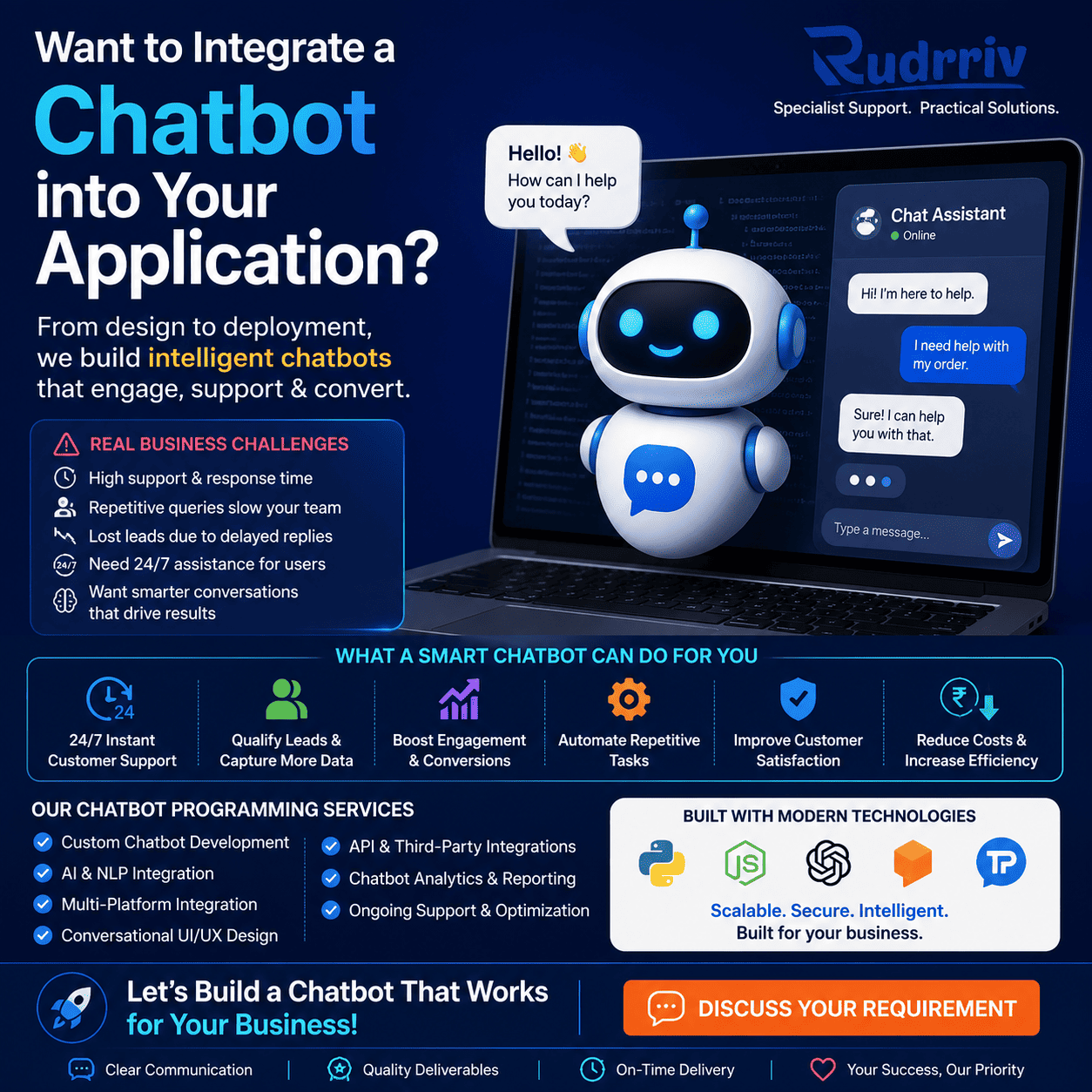
Rudrriv can support chatbot discovery, product planning, UX, web or software development, integration, quality assurance, and ongoing maintenance when those capabilities directly match the intended use case. A defined discovery phase can clarify users, workflows, data, governance, platform options, budget assumptions, and phased delivery before implementation begins.
Discuss your requirementPlan Testing, Monitoring, and Maintenance
Production quality depends on continuous evaluation. A chatbot can perform well in a demonstration and fail when users provide incomplete details, combine several requests, use uncommon terminology, or ask for an action outside policy.
Create a representative evaluation set
Include normal, difficult, ambiguous, adversarial, multilingual, and out-of-scope conversations. Label the expected answer, source, action, escalation path, and unacceptable behavior. Re-run the set when models, prompts, knowledge, integrations, or policies change.
Measure more than answer fluency
Track grounded correctness, task completion, escalation precision, containment where appropriate, user effort, latency, tool success, safety, cost, and unresolved-topic patterns. For commerce or service workflows, connect chatbot metrics to downstream outcomes without assuming the chatbot caused every change.
Assign operational ownership
Someone must own knowledge updates, platform configuration, quality review, security controls, incident response, vendor changes, and improvement priorities. Without clear ownership, even a technically capable platform will degrade as products, policies, teams, and customer language evolve.
Avoid Common Platform-Selection Mistakes
- Buying from a demonstration alone: vendor examples rarely represent your data, channels, policies, or failure cases.
- Equating a larger model with a better solution: architecture, grounding, permissions, and evaluation often matter more.
- Loading unprepared content: duplicate, outdated, contradictory, or inaccessible sources reduce answer quality.
- Automating before defining escalation: users need a clear route when the chatbot is uncertain or unauthorized.
- Ignoring multilingual reality: translation support is not the same as domain-quality understanding in every language.
- Underestimating maintenance: models, prompts, knowledge, integrations, and policies all change after launch.
- Giving the chatbot excessive authority: sensitive actions need permissions, confirmation, validation, and auditability.
- Choosing custom development too early: validate the workflow and value before assuming a complex architecture is necessary.
Summary: Choose the Least Complex Viable Platform
The right AI chatbot platform is the least complex option that can understand the target users, ground answers in approved information, complete permitted tasks, integrate with required systems, and operate within the organization’s security and governance standards.
A packaged platform is usually sufficient for common customer-service, lead, or employee-support workflows. A low-code platform is useful when the organization needs stronger integration, workflow control, and enterprise governance without building every component. An API-first system is justified when the chatbot is a differentiated product capability, must coordinate specialized tools and data, or requires control that packaged products cannot provide.
Before development, validate the use case with real conversations and a representative evaluation set. Confirm scope, budget, timeline, maintenance ownership, data access, quality assurance, escalation, and handover. Expand only after the first workflow demonstrates reliable user and business value.
FAQs on Advanced AI Chatbot Platforms
What makes an AI chatbot platform advanced at natural language understanding?
An advanced platform can identify user intent, extract relevant entities, preserve context across turns, handle natural phrasing and ambiguity, retrieve grounded information, and route uncertain requests safely. The strongest systems combine language-model capability with business rules, approved knowledge, integrations, analytics, and human escalation.
Which AI chatbot platform is best for a business?
The best platform depends on the use case. Customer-service teams may prioritize omnichannel deployment, CRM integration, analytics, and agent handoff. Product teams may prioritize API flexibility and model control. Regulated organizations may place greater weight on data residency, auditability, access controls, and private knowledge retrieval.
Should a business choose a no-code chatbot builder or an API platform?
Choose a no-code or low-code builder when business teams need to launch standard workflows quickly with limited engineering effort. Choose an API-first platform when the chatbot is part of a differentiated product, requires custom orchestration, complex integrations, specialized evaluation, or deeper control over user experience and data flows.
Can advanced chatbots understand context across a conversation?
Yes, but context quality depends on architecture. A platform may use recent conversation history, structured session data, customer records, tool outputs, and retrieved knowledge. Businesses should define what the chatbot is allowed to remember, how long that context persists, and when it must ask the user to confirm important details.
How much does an AI chatbot platform cost?
Cost usually includes model or message usage, platform licensing, channels, integrations, vector or search services, observability, testing, human-agent seats, and ongoing optimization. A low initial license can still become expensive when conversations are long, traffic is high, or custom engineering and governance are substantial.
How long does it take to implement an AI chatbot?
A narrow proof of concept can be built quickly, but production readiness takes longer. Time is usually driven by knowledge preparation, integration complexity, security review, conversation design, evaluation, escalation rules, analytics, user testing, and operational ownership. A phased launch is usually safer than opening every use case at once.
How can a business reduce chatbot hallucinations?
Use approved knowledge sources, retrieval with citations where appropriate, clear system instructions, restricted tool permissions, confidence or eligibility rules, deterministic workflows for high-risk actions, automated evaluations, human review, and fallback responses. The chatbot should be designed to admit uncertainty rather than invent an answer.
Do AI chatbot platforms support multiple languages?
Many do, but support quality varies by language, dialect, domain vocabulary, and channel. Test real customer phrasing in each priority language, including code-switching, spelling variation, local terminology, and escalation behavior. Do not assume strong English performance automatically transfers to every market.
What data and security controls should be checked before selection?
Check data retention, training-use policies, encryption, role-based access, audit logs, regional hosting, identity integration, prompt and tool permissions, personally identifiable information handling, vendor subprocessors, incident processes, and deletion workflows. Requirements should be reviewed against the sensitivity of the intended use case.
How should an AI chatbot platform be evaluated before launch?
Build a representative test set from real questions and tasks. Measure answer correctness, groundedness, task completion, escalation accuracy, latency, safety, language quality, integration reliability, and cost per resolved interaction. Include adversarial, ambiguous, incomplete, and out-of-scope requests before approving production use.
At Rudrriv, we make it easier for businesses to access the right expertise, execute important work, and scale with confidence.