
Services Offering End-to-End Website Development
Services offering end-to-end website development should help a business make the right product decision before writing code, then carry that decision through discovery, user experience, architecture, development, testing, launch, and maintenance. The practical starting point is not “Which technology is most impressive?” but “What must users accomplish, how often will they return, how will they discover the product, and which device capabilities are truly necessary?”
For many organizations, a responsive website is the best first platform because it is easy to reach through a link, supports search discoverability, and removes installation friction. A progressive web app becomes useful when repeat browser use, installability, caching, and selected offline functions matter. A native or cross-platform mobile app is justified when deep device access, intensive offline use, background behavior, push-driven engagement, or app-store distribution is central to the product.
An end-to-end provider should make these trade-offs visible, define what is included, identify dependencies, and plan the product as a lifecycle rather than a one-time launch. This guide explains how to choose the platform, scope the service, compare proposals, control cost, and avoid building the wrong solution too early.
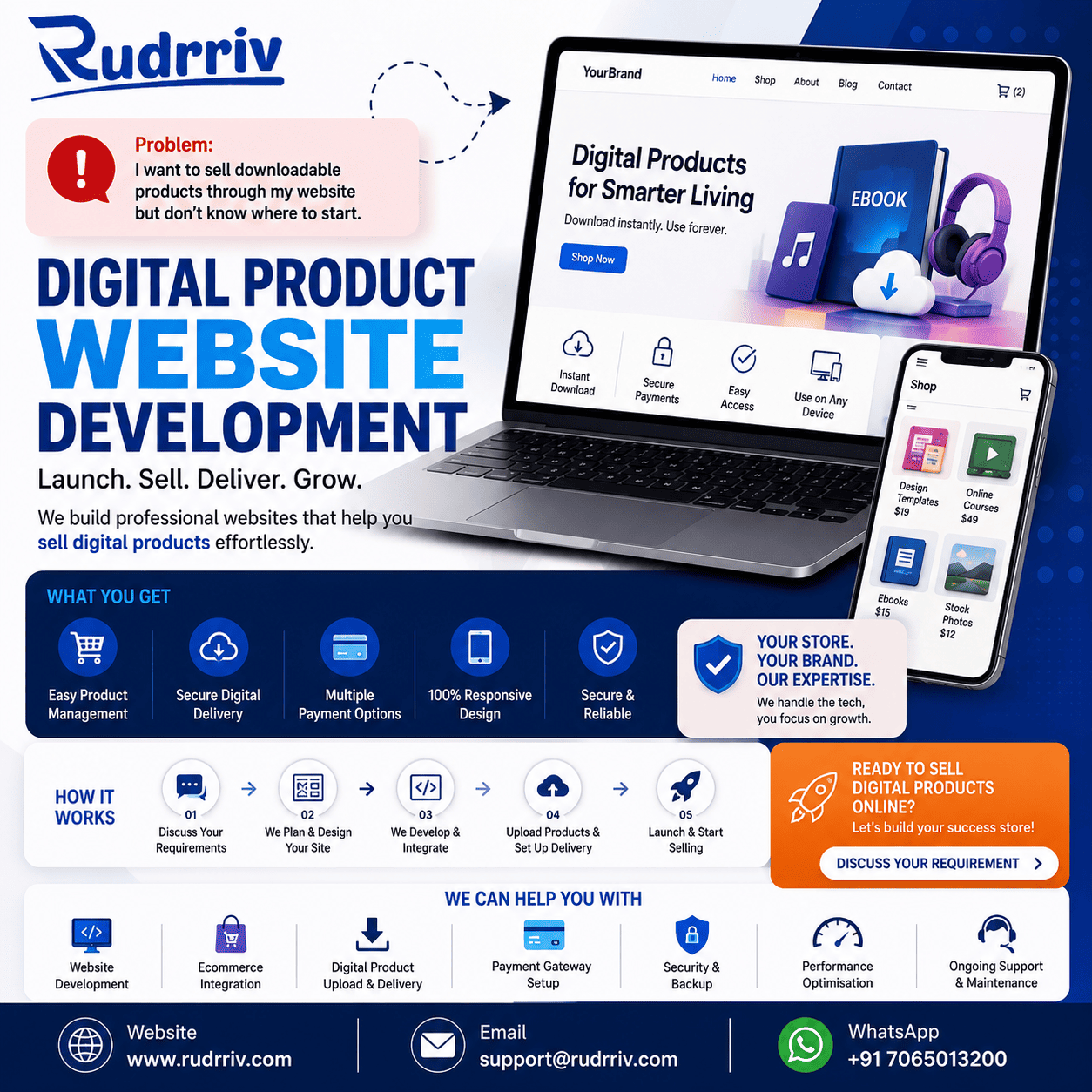
Quick Answer: Choosing the Right Development Scope
Choose an end-to-end development service that begins with customer tasks and business constraints, not a predetermined platform. A responsive website is the default when broad reach, search visibility, simple sharing, and low first-use friction matter most. Add PWA capabilities when users need an installable, app-like web experience with caching or selective offline functionality.
Choose a mobile app when the product depends on frequent use, deep device APIs, reliable background activity, intensive offline workflows, or app-store distribution. Before approving that investment, validate demand with user research, prototypes, analytics, and a clear operating model for releases, security, quality assurance, and maintenance.
The provider should own the delivery process, but your business should retain control of the domain, repositories, cloud accounts, analytics, source code, design files, documentation, and deployment credentials.
Key Takeaways
- Start with the customer task: platform choice should follow user behavior, not competitor imitation.
- Use a responsive website as the default: it offers broad reach, URL sharing, and search discoverability.
- Add PWA features selectively: installability and offline behavior should solve a proven interaction problem.
- Build a mobile app for justified capabilities: deep device access, high-frequency use, or app-store distribution must matter.
- Define end-to-end precisely: discovery, design, development, integrations, testing, deployment, documentation, and support should be explicit.
- Compare lifecycle cost: include updates, compatibility testing, security, infrastructure, content, and release management.
- Plan ownership and handover early: business-controlled accounts and usable documentation reduce long-term dependency.
Table of Contents
- Begin with the customer task
- Website, PWA, or mobile app
- What end-to-end delivery includes
- Choose scope by business stage
- Technical requirements to validate
- Compare cost and maintenance
- Plan implementation and ownership
- Practical platform decisions
- Risks that lead to the wrong build
- Summary
Begin with the customer task, not the technology
The correct platform follows the user journey. Identify how people first hear about the product, what information they need before acting, the task they must complete, how often they repeat it, and what happens when connectivity is poor. A first-time buyer searching for a service behaves differently from a field worker completing the same operational task many times each day.
Search-led acquisition usually favors a responsive website. High-frequency workflows may justify an installed experience. Offline requirements must be described precisely: reading previously loaded information is simpler than creating transactions offline, resolving conflicts, synchronizing securely, and recovering from partial failures.
Decision rule: do not approve a mobile app merely because it appears more advanced. Approve it when the user task cannot be delivered reliably or competitively through a responsive website or progressively enhanced web experience.
Choose between a website, PWA, and mobile app
The three options overlap, but they create different obligations. A PWA uses web technologies while adding capabilities such as installation and offline behavior; MDN explains how progressive web applications combine web reach with app-like features, while MDN's PWA overview also notes that capability depends on modern web APIs and platform support.
| Decision factor | Responsive website | Progressive web app | Mobile app |
|---|---|---|---|
| Best default | Broad public reach and browser-based tasks | Repeat web interactions needing app-like behavior | High-frequency or device-dependent workflows |
| Discoverability | Strongest fit for search and shareable URLs | Web pages remain linkable and potentially discoverable | Relies more on app stores, campaigns, and existing demand |
| Installation | Not required | May be installable from supporting browsers | Installed through app stores or managed distribution |
| Offline capability | Usually limited unless specifically engineered | Selective caching and offline flows are possible | Can support extensive offline architecture |
| Device access | Browser APIs and permissions | Enhanced web APIs, with compatibility limits | Broadest platform-specific access |
| Updates | Deploy centrally to the web | Deploy centrally, with cache-management responsibilities | Requires build, testing, store review, and staged release processes |
| Development effort | Usually the lowest starting effort | Higher when offline and installable behavior is substantial | Usually highest, especially across iOS and Android |
| Maintenance | Browsers, hosting, dependencies, security, and content | Website maintenance plus service worker and compatibility testing | Platform releases, stores, devices, SDKs, security, and backend services |
Installability is not identical across browsers and operating systems. Review MDN guidance on making PWAs installable and test the actual devices used by your audience before treating a PWA as a universal replacement for a mobile app.
Define what end-to-end development really includes
“End-to-end” should describe accountable coverage across the product lifecycle. It does not mean every activity must be performed by the same person, but one delivery model should connect the decisions and prevent gaps between design, engineering, content, infrastructure, and launch.
- Discovery: goals, users, journeys, risks, constraints, success measures, and stakeholder decisions.
- Product planning: requirements, priorities, information architecture, platform choice, roadmap, and acceptance criteria.
- UX and UI: flows, prototypes, responsive states, accessibility, design system use, and content requirements.
- Technical design: architecture, hosting, database, APIs, integrations, security, analytics, and migration approach.
- Development: front end, back end, content management, integrations, automation, and environment configuration.
- Quality assurance: functional, responsive, accessibility, performance, security, integration, and regression testing.
- Launch: content freeze, migration, redirects, monitoring, rollback, training, and release communication.
- Post-launch support: warranty, incident response, updates, optimization, documentation, and roadmap delivery.
Ask the provider to mark each activity as included, excluded, client-owned, or dependent on a third party. This exposes hidden work before it becomes a schedule or budget problem.
Match the platform scope to the business stage
A startup validating demand
Build the smallest credible responsive experience that can test the value proposition, acquisition route, and core transaction. Avoid investing in two mobile platforms before the team knows which users return, which features matter, and whether the operating model can support releases and customer service.
An established ecommerce business
Prioritize responsive web performance, search discoverability, product content, checkout reliability, integrations, analytics, and migration controls. Add an app only when repeat purchasing, loyalty, personalized engagement, stored preferences, or device-specific features can support a clear customer use case.
An enterprise workflow
Internal users may justify an app-like or mobile experience because they repeat tasks frequently, use managed devices, need offline operation, or require camera, location, scanning, and background synchronization. Distribution, identity, device management, auditability, and support become as important as interface design.
Validate technical requirements before architecture
Technical requirements should be expressed as testable outcomes. “Must work offline” is incomplete; specify which screens open, which records can be created, how conflicts are resolved, how much data is stored, how encryption works, and what users see during synchronization.
- Priority devices, operating systems, browsers, screen sizes, and network conditions.
- Authentication, roles, permissions, single sign-on, and session behavior.
- Payments, CRM, ERP, marketplace, logistics, analytics, and communication integrations.
- Content-management roles, approval workflows, localization, and structured content.
- Privacy, consent, data residency, retention, deletion, audit, and accessibility obligations.
- Performance budgets, uptime targets, backup, recovery, monitoring, and incident response.
- Offline reads and writes, synchronization rules, conflict handling, and data freshness.
- Push notifications, camera, location, files, biometrics, background tasks, and other device APIs.
For offline-first mobile products, the architecture must define local data as part of the product rather than an afterthought. Android's offline-first architecture guidance illustrates why local sources, synchronization, and conflict behavior require deliberate design.
Compare development cost across the full lifecycle
Initial build price is only one cost. The lower-cost proposal may exclude discovery, copy, migration, integrations, accessibility, test automation, cloud configuration, store submission, post-launch fixes, or documentation. Compare the same service boundary and a realistic operating period.
| Cost area | Questions to ask | Risk when omitted |
|---|---|---|
| Discovery and design | Are research, prototypes, responsive states, content, and acceptance criteria included? | Rework after development begins |
| Engineering | Which platforms, integrations, environments, and non-functional requirements are covered? | Change requests for expected functionality |
| Quality assurance | Which devices, browsers, workflows, accessibility checks, and security tests are included? | Launch defects and inconsistent experiences |
| Infrastructure | Who pays for hosting, services, certificates, monitoring, email, storage, and third-party APIs? | Unexpected recurring costs |
| Distribution | Who manages app accounts, signing, store assets, reviews, and staged releases? | Delayed or blocked releases |
| Maintenance | What response times, update cycles, compatibility checks, and support hours apply? | Security and reliability decline after launch |
| Handover | Are repositories, credentials, designs, documentation, training, and deployment instructions included? | Long-term dependency on one provider |
App-store distribution adds governance beyond coding. Apple documents preparation and release responsibilities in its application distribution guidance. Similar responsibilities apply to Android releases, signing, testing tracks, policy compliance, and ongoing compatibility.
Plan implementation, ownership, and handover
A strong implementation plan separates discovery, design validation, build increments, integration testing, content preparation, migration, user acceptance, launch, and stabilization. Each stage should have an owner, inputs, outputs, acceptance criteria, and decision date.
- Approve the problem and platform: agree who the product serves and why the chosen platform fits.
- Freeze the first release scope: distinguish mandatory flows from later enhancements.
- Prototype risky interactions: test usability, technical feasibility, and critical integrations early.
- Build in reviewable increments: demonstrate working software against acceptance criteria.
- Test the operating reality: include real content, devices, permissions, networks, and failure conditions.
- Prepare launch and rollback: define monitoring, support, communication, data migration, and recovery.
- Complete handover: transfer business-controlled access, repositories, documentation, designs, and training.
Your organization should own or control the domain, code repository, cloud tenancy, app-store accounts, analytics, tag management, payment accounts, certificates, design source files, and production credentials. Providers can administer these assets through role-based access without becoming the sole owner.
Practical platform decisions for real businesses
Local professional-service firm
A firm assumes it needs an app to appear modern. Its customers actually discover services through search, compare expertise, read proof, and request a consultation once or occasionally. A fast responsive website with clear service architecture and accessible forms is the better decision. Specialist guidance may help with user journeys, content structure, and technical implementation, but an app would add friction without solving a frequent task.
Ecommerce business with repeat customers
The retailer expects an app to increase loyalty, but most first purchases still begin in search, social, or shared product links. The better route is a strong responsive storefront first, followed by measured PWA features or an app when repeat purchase data supports saved preferences, loyalty, personalized notifications, or faster reordering. Product analytics should decide the second phase.
Field-service operation
Technicians work in areas with inconsistent connectivity and must capture photos, location, signatures, and job updates throughout the day. A mobile app may be justified because offline writes, background synchronization, camera access, and managed-device controls are central. A browser-only workflow could be tested, but the operating conditions—not branding—should drive the choice.
Subscription startup
The startup plans native iOS and Android apps before validating retention. A responsive product with a modular backend allows the team to test onboarding, payment, activation, and repeat use first. When analytics show frequent mobile sessions and a feature that benefits from native capability, the company can add a cross-platform or native app with a clearer business case.
Avoid the risks that lead to the wrong build
- Starting with a fixed technology: the team selects a framework or app before defining the customer task.
- Calling a build end-to-end without discovery: requirements remain assumptions until development exposes them.
- Treating offline as a checkbox: data freshness, conflicts, storage, security, and recovery remain undefined.
- Ignoring acquisition: an installed app may be difficult to discover when search and shared URLs drive demand.
- Comparing headline prices: proposals cover different design, testing, migration, infrastructure, and support responsibilities.
- Leaving content until the end: real copy, media, products, and data reveal layout and workflow issues late.
- Accepting provider-owned accounts: the business becomes dependent on access that it does not control.
- Launching without maintenance ownership: security, dependencies, compatibility, and incidents lack accountable owners.
Summary
A responsive website is enough when users need broad access, search discoverability, simple sharing, and browser-based transactions. It is usually the strongest first release for a new business, public-facing service, content-led product, or ecommerce experience that has not yet validated a distinct installed-app use case.
A PWA is useful when the web product benefits from installability, an app-like interface, caching, repeat use, and selected offline functions, provided the required capabilities work on the audience's browsers and devices. A native or cross-platform mobile app is justified when deep device access, intensive offline workflows, high-frequency behavior, background processes, or app-store distribution is central.
Before development, validate users, tasks, scope, budget, timeline, maintenance, ownership, quality assurance, and handover. Businesses that need help connecting product planning, UX, architecture, development, testing, and ongoing support can review Rudrriv's development capabilities and design support in the context of a defined project or continuing product roadmap.
FAQs on End-to-End Website Development
What do services offering end-to-end website development include?
They normally cover discovery, requirements, UX and interface design, technical architecture, front-end and back-end development, integrations, content or data migration, testing, deployment, documentation, and post-launch maintenance. Confirm the exact inclusions in writing because some providers describe design-only or build-only work as end-to-end.
When is a responsive website enough for a business?
A responsive website is usually enough when users mainly discover the business through search, links, campaigns, or referrals and can complete the key task in a browser. Validate mobile usability, speed, accessibility, forms, payments, and account flows before adding app complexity.
When should a business consider a progressive web app?
Consider a progressive web application when the browser experience needs installability, caching, repeat engagement, selected offline behavior, or an app-like interface without making app-store distribution the primary route. Check browser support for every capability that matters to the product.
When is a native or cross-platform mobile app justified?
A mobile app is justified when frequent use, deep device APIs, intensive offline workflows, background activity, push-led engagement, or app-store presence is central to the customer experience. A competitor having an app is not sufficient evidence; validate real user behavior and operational value first.
Can a business launch a website first and build an app later?
Yes. A responsive website first is often the lowest-risk route because it supports discovery, sharing, product validation, and early analytics. Use a modular architecture and documented APIs where practical so validated PWA features or a mobile app can be added later without unnecessary rebuilding.
Is a PWA cheaper to maintain than a mobile app?
It can be, because one web codebase may serve more devices and updates can be deployed through the web. However, cost depends on offline logic, browser compatibility, integrations, testing depth, security, and product complexity. Compare total lifecycle effort rather than only the initial build price.
What should be validated before end-to-end development begins?
Validate the primary users, core tasks, priority devices, acquisition channels, content and data needs, integrations, compliance requirements, offline expectations, analytics, ownership, budget, timeline, and internal decision makers. Convert these findings into acceptance criteria and a phased scope.
How should businesses compare end-to-end development proposals?
Compare whether each proposal covers the same discovery, design, development, integration, testing, deployment, documentation, training, warranty, maintenance, ownership, and handover responsibilities. Ask who performs each activity, what assumptions affect price, and how scope changes are approved.
What maintenance is needed after a website or app launches?
Ongoing work typically includes security updates, dependency management, backups, uptime monitoring, performance checks, bug fixes, accessibility review, browser and operating-system compatibility, analytics validation, content support, and controlled releases. Define response times, exclusions, and ownership before launch.
How can a business reduce the risk of building the wrong platform?
Start with evidence: interview users, map high-value tasks, review analytics, prototype critical flows, test technical assumptions, and phase the investment. Approve a mobile app only when user frequency, device access, offline needs, or distribution requirements justify its additional release and maintenance obligations.
Need help choosing the right platform?
Share the customer task, priority devices, current systems, expected integrations, offline needs, launch constraints, and internal capacity. Rudrriv can help clarify the platform decision and structure a defined website, PWA, mobile product, or ongoing development engagement with transparent responsibilities.
Discuss your requirementAt Rudrriv, we make it easier for businesses to access the right expertise, execute important work, and scale with confidence.