
In Software Development, What Is MVP?
In software development, an MVP is a minimum viable product: the smallest usable version of a product that can test a specific assumption with real users and produce evidence for the next investment decision. It is not a rough collection of features, a low-quality release, or a promise to finish the product later. A useful MVP completes one meaningful customer task, works reliably enough for the selected test, and captures the behavior or feedback needed to decide whether to continue, change direction, or stop.
The central decision is not “How little can we build?” It is “What is the least we must deliver to learn whether this product should exist in its proposed form?” That distinction protects teams from two common failures: overbuilding before demand is understood and releasing something so incomplete that poor results reveal nothing about the idea.
For founders, product leaders, enterprise innovation teams, and business owners, the practical starting point is a written hypothesis. Identify the target user, the problem, the core outcome, the riskiest assumption, and the observable evidence that would justify further work. Scope the MVP around that evidence, not around a long feature wish list.
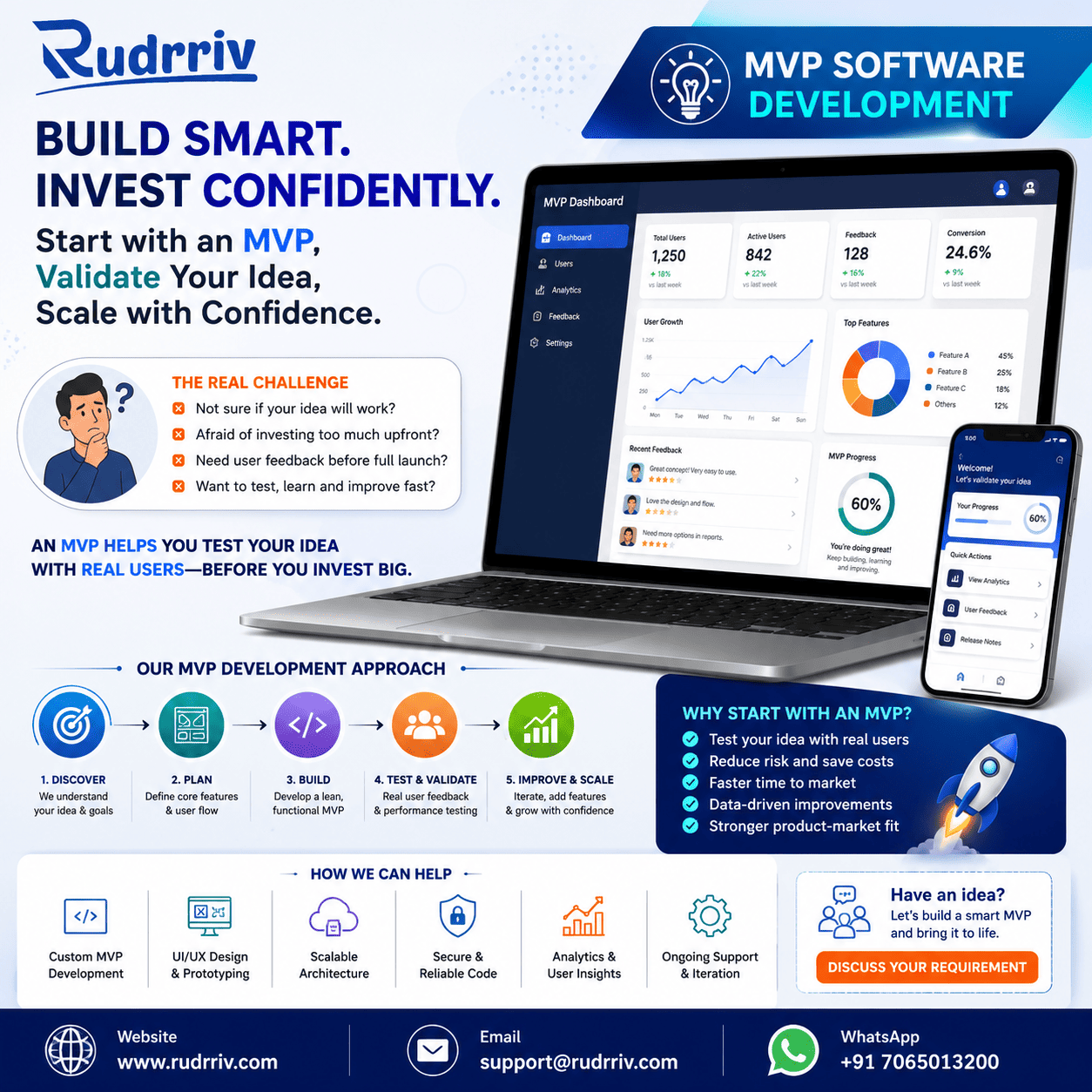
Quick Answer: What Is an MVP in Software Development?
An MVP is a learning instrument delivered as a usable product. It includes the minimum coherent experience required for a defined group of users to achieve one important outcome and for the team to observe whether the underlying product assumption is credible.
A good MVP has four parts: a clear hypothesis, a narrow target audience, a complete core journey, and a measurement plan. It may be a responsive web application, mobile app, internal workflow, concierge-supported service, or another delivery format. The format should match what must be tested; it should not be selected because it appears more impressive.
Do not remove quality attributes that could invalidate the test or harm users. Security, privacy, data accuracy, accessibility, essential performance, error handling, and support responsibilities remain part of viability when the product context requires them.
Key Takeaways
- An MVP tests a decision: it should validate a named assumption, not merely demonstrate that software can be built.
- Minimum means minimum scope: it does not mean careless engineering or an unusable customer experience.
- Viable means end-to-end value: the selected user must be able to complete the core task.
- Success measures must be defined first: collect behavior that can change a product decision, not only opinions or registrations.
- Technical choices follow the experiment: use the simplest architecture and platform that can test the hypothesis safely.
- Learning continues after launch: review evidence, improve the tested journey, pivot the assumption, or stop further investment.
Table of Contents
- MVP meaning: minimum, viable, and product
- MVP vs prototype, proof of concept, and beta
- Define the hypothesis before defining features
- Choose the right MVP form
- Build a complete core journey
- Compare MVP scope decisions
- Estimate cost, time, and team needs
- Measure evidence after release
- Avoid MVP mistakes that invalidate learning
- Summary: decide what happens after the MVP
MVP means minimum, viable, and product
Every word in “minimum viable product” sets a boundary. Minimum restricts the work to what is necessary for the current learning objective. Viable requires enough usefulness, reliability, and operational support for the target user to complete the intended task. Product means the release exists in a form that users can actually experience, rather than only as a slide deck or internal demonstration.
Minimum: remove work that does not change the test
Start by identifying the riskiest assumption. If the main uncertainty is whether restaurant managers will pay for automated stock alerts, a large supplier marketplace, advanced forecasting, multilingual reporting, and complex role administration may not affect the first decision. They can remain outside the MVP unless one is essential to the customer’s core workflow.
Viable: preserve trust and task completion
Viability is contextual. A private pilot for five trained employees can use controlled onboarding and manual support. A customer-facing payment product needs stronger reliability, transaction accuracy, privacy, security, recovery, and support from the first release. The scope may be small, but the critical path must work.
Product: expose the assumption to reality
The product must reach the intended users in conditions close enough to reveal meaningful behavior. Lean thinking treats ideas as hypotheses and uses rapid releases and feedback to improve decisions. The Lean Enterprise Institute’s Lean Startup overview describes this learning cycle as beginning with an MVP used by early customers.
Decision rule: if removing a capability prevents the target user from completing the tested task or prevents the team from interpreting the result, that capability is not optional for this MVP.
MVP vs prototype, proof of concept, and beta
An MVP is often confused with other early product artefacts, but each answers a different question. A prototype explores how an idea might look or behave. A proof of concept investigates whether a technical approach is feasible. A beta exposes a more developed product to users before general release. An MVP tests whether a narrowly defined product proposition creates enough value to justify the next step.
| Artefact | Primary question | Typical users | Expected completeness | Main output |
|---|---|---|---|---|
| Prototype | Can people understand and navigate the concept? | Test participants or stakeholders | May be non-functional | Usability and design learning |
| Proof of concept | Can the technology, integration, or algorithm work? | Technical team | Narrow technical demonstration | Feasibility evidence |
| MVP | Will target users adopt or value the core solution? | Real early users | Usable core journey | Product and business evidence |
| Beta | Is a broader product ready for general release? | Larger controlled audience | Most planned capabilities present | Defects, compatibility, and readiness findings |
A team may use all four in sequence, but it should not label a clickable prototype as an MVP if users cannot receive the promised outcome. Equally, it should not build a broad beta when a small experiment could answer the important business question earlier.
Define the hypothesis before defining features
The MVP scope should be derived from a falsifiable hypothesis. Write the statement so that the team can recognize evidence against it. “People want an easier finance app” is too vague. “Independent consultants who currently track invoices in spreadsheets will connect an account, create an invoice, and return weekly to review overdue payments” is more useful.
Define five elements before writing user stories:
- Audience: the exact user group and operating context.
- Problem: the costly, frequent, or important task being improved.
- Outcome: the result the user should achieve.
- Assumption: what must be true for the product to work as a business or operational solution.
- Evidence: observable behavior that supports, weakens, or rejects the assumption.
Example: a startup validating demand
A startup assumes small clinics need an appointment-reminder platform. Its first plan includes scheduling, payments, video consultations, patient records, analytics, and marketing automation. The riskiest assumption, however, is whether clinics will consistently use automated reminders and whether fewer missed appointments matter enough to pay. A better MVP focuses on importing appointments, obtaining consent, sending reminders, recording delivery, and measuring attendance. Specialist help may be useful for privacy, messaging integration, and reliable event tracking.
Example: an enterprise internal workflow
An enterprise team proposes a native mobile app for maintenance approvals. Interviews reveal that supervisors already work at desktop stations and only technicians need mobile access in the field. The MVP becomes a responsive approval dashboard plus a narrow technician interface. This tests task completion and adoption before the company funds broad mobile features and app-store distribution.
Choose the MVP form that tests the risk
The right MVP is not always a fully coded application. Select the lowest-complexity form that can expose the assumption to realistic user behavior without misleading users or creating unacceptable operational risk.
| MVP form | Best when | Main limitation |
|---|---|---|
| Landing page or demand test | You need evidence of interest, audience, or message fit before product use | Intent does not prove sustained usage or willingness to pay |
| Concierge MVP | Humans can deliver the result manually while the workflow is learned | Manual effort can hide automation cost and scalability constraints |
| Wizard-of-Oz MVP | The interface is real but some processing can remain manual behind it | Users must not be deceived about material limitations or data handling |
| Single-feature web MVP | The main task works in a browser and reach or rapid iteration matters | Browser and device capabilities may limit some experiences |
| Mobile app MVP | Device APIs, intensive offline use, push-led behavior, or app distribution is central to the hypothesis | Release, testing, and maintenance responsibilities increase |
For web products, performance and accessibility influence whether users can complete the experiment. MDN’s guidance on web performance and web accessibility provides useful implementation context. These are not “later” concerns when slow or inaccessible software would distort adoption data.
Build one complete core journey
An MVP should be thin across the full customer journey, not deep in one isolated layer. The target user needs to discover or access the product, understand the value, complete the main task, recover from common errors, and receive the promised outcome. The team also needs instrumentation, support, and operational procedures around that journey.
Translate the journey into acceptance criteria. Include normal completion, important error states, permissions, data validation, basic support, analytics events, deployment, and rollback. For a web application, testing should cover usability, compatibility, performance, security, and accessibility as appropriate; MDN’s web application testing overview summarizes these testing dimensions.
Compare MVP scope decisions
Use scope decisions that protect learning rather than arbitrary feature limits. The table below shows how to judge common requests.
| Scope question | Include now when | Defer when |
|---|---|---|
| User registration | Identity, permissions, saved data, or retention is part of the test | A controlled one-session test can use invited access |
| Payments | Willingness to pay is the critical assumption and transactions can be handled safely | Price interest can first be tested through quotes, deposits, or a controlled sales process |
| Multiple platforms | Cross-platform behavior is central or target users cannot be reached otherwise | One platform can represent the initial audience without invalidating results |
| Automation | Speed, scale, consistency, or algorithmic output is the proposition | Manual delivery can test demand and workflow first |
| Advanced administration | Multiple roles and governance are necessary for real use | A small pilot can operate with controlled onboarding and simple permissions |
| Integrations | The product cannot deliver value or collect valid evidence without them | Imports, exports, or manual bridging can support the first test safely |
Example: an ecommerce returns tool
An ecommerce business believes customers will prefer self-service returns. The original scope includes loyalty rewards, exchange recommendations, multilingual support, courier comparison, and advanced fraud scoring. The first MVP instead verifies order eligibility, captures the return reason, creates a return request, sends status updates, and records completion. It keeps fraud review manual because automated scoring is not the current hypothesis.
Example: a field-service product
A field-service team needs technicians to record inspections where connectivity is unreliable. A standard browser form would not test the real operating condition. The MVP therefore includes local storage, synchronization states, conflict handling, and recovery. Android’s offline-first architecture guidance explains why critical tasks need a data source that does not depend on network access.
Estimate MVP cost, time, and team needs
MVP estimates should be based on the tested journey and delivery risks, not on a generic package. Cost and timeline change with user roles, workflow depth, integrations, data migration, compliance, platform coverage, design maturity, analytics, deployment, and post-release support.
A practical estimate should separate discovery, experience design, engineering, quality assurance, infrastructure, release work, and observation after launch. It should also state assumptions and exclusions. Unknown integrations or novel technical work may need a short proof of concept before the MVP estimate is reliable.
- Product owner: owns the hypothesis, priorities, and decision.
- Design capability: turns the core journey into a usable experience and tests comprehension early.
- Engineering capability: selects a proportionate architecture and implements the product.
- Quality assurance: verifies critical behavior, compatibility, security, and regression risk.
- Analytics or research capability: ensures the team can interpret what users actually did.
- Operational owner: handles onboarding, support, exceptions, and feedback during the test.
Small teams may combine roles, but responsibilities should remain explicit. A credible proposal connects every work item to the learning objective and identifies what must happen after the first release.
Measure evidence after the MVP release
MVP success is not the number of features shipped or the amount of positive feedback. Measure behavior that relates directly to the hypothesis. Depending on the product, this may include task completion, activation, repeated use, retention, paid conversion, time saved, error reduction, or adoption by a defined team.
Use a small set of primary measures and diagnostic measures. A primary measure answers the product question; diagnostics explain why the result occurred. For example, low repeat use could reflect weak value, poor onboarding, technical defects, wrong audience selection, or an infrequent customer need. Interviews and support conversations help interpret analytics, but stated enthusiasm should not replace observed behavior.
Before launch, write the decision thresholds: what evidence supports continued investment, what result triggers another experiment, what finding requires a pivot, and what outcome should stop the initiative. Thresholds may be qualitative in a small pilot, but they must still be explicit.
Avoid MVP mistakes that invalidate learning
The most damaging MVP mistakes make the evidence ambiguous. A technically working release can still fail as an experiment.
- No explicit hypothesis: the team collects feedback but cannot connect it to a decision.
- Too many audiences: results from different user groups hide whether any one segment has a strong need.
- Feature-bundle thinking: the scope mirrors a future roadmap rather than one learning objective.
- Low quality in the critical path: defects, poor performance, or confusing design cause rejection unrelated to the proposition.
- Missing instrumentation: the team cannot distinguish sign-up, attempted use, successful completion, and return behavior.
- Manual work is ignored: a concierge MVP appears efficient because hidden operational effort is not measured.
- Technical debt has no boundary: shortcuts become permanent without ownership or a remediation trigger.
- Feedback becomes a feature queue: requests are accepted without testing whether they represent a broader need.
Research on software-startup MVP definitions has found that both technical and customer-market factors matter, which reinforces the need to treat an MVP as more than a reduced feature list. The IEEE systematic mapping study on MVP definitions provides further context.
How Rudrriv can support an MVP decision
Rudrriv can support businesses that need to turn an uncertain product idea into a defined experiment. Relevant support may include technical discovery, product planning, UI/UX work, web or software development, mobile development, quality assurance, and post-release maintenance. The objective should remain proportionate: clarify the hypothesis, choose an appropriate product form, define acceptance criteria, deliver the core journey, and create a usable evidence plan.
Businesses can explore Rudrriv development capabilities, design support, or specialist talent options when internal capacity or technical clarity is limited.
Summary: decide what happens after the MVP
An MVP in software development is a focused product experiment. It should give a defined user a complete core outcome while testing the riskiest product or business assumption. Its scope is minimum only in relation to the learning objective; its quality must still be sufficient for safe, credible use.
Choose a prototype when the main uncertainty is interaction or comprehension, a proof of concept when technical feasibility is unknown, and an MVP when real user behavior must inform an investment decision. Select a web, mobile, manual-assisted, or hybrid form according to the risk being tested.
After release, compare observed evidence with the thresholds established before development. Improve the product when the core assumption is supported but the journey needs refinement. Pivot when the problem, audience, channel, or solution assumption is wrong. Stop when the evidence does not justify more investment. Scope, budget, timeline, maintenance, ownership, quality assurance, and handover should be planned according to the next decision rather than an imagined final product.
FAQs About MVPs in Software Development
In software development, what is MVP?
In software development, an MVP is the smallest usable version of a product that lets a team test a specific business or user assumption with real users. It should complete one valuable end-to-end task, collect meaningful evidence, and meet essential quality, security, and reliability requirements. It is not simply an unfinished product released early.
What is the main purpose of an MVP?
The main purpose is validated learning. An MVP helps a team discover whether a defined audience has the problem, values the proposed solution, can use the product, and behaves in a way that supports further investment. The team should decide the learning question and success signal before development starts.
How is an MVP different from a prototype?
A prototype explores an idea, interaction, or technical possibility and may never be released. An MVP is usable by real target users in a real or controlled operating context and is designed to produce decision-quality evidence. A prototype can precede an MVP, but the two are not interchangeable.
How many features should an MVP include?
There is no universal feature count. Include only the capabilities required to complete the core user journey, operate safely, observe outcomes, and support the selected test. Remove features that do not change the result of the current hypothesis, but do not remove essentials such as authentication, error handling, privacy controls, or payment accuracy when they are relevant.
How long does MVP development take?
The timeline depends on scope, integrations, compliance, data migration, design maturity, platform choice, and team capacity. A narrow web MVP may be delivered in a relatively short cycle, while a regulated or integration-heavy product can take much longer. Estimate after discovery and break uncertain work into prototypes or technical spikes.
How much does an MVP cost?
MVP cost is driven by the number of user roles, workflow complexity, platform coverage, integrations, data requirements, security, design depth, testing, deployment, and support. Compare proposals against the same acceptance criteria and exclusions. A cheaper build that cannot test the intended hypothesis may create more waste than a smaller, correctly designed experiment.
Should an MVP be built with temporary code?
Temporary code can be acceptable for a disposable experiment, but production-facing MVPs need an intentional engineering standard. Teams should distinguish between reversible shortcuts and risks that affect security, data integrity, accessibility, maintainability, or user trust. Record technical debt and define when it must be addressed.
When should a business move beyond the MVP?
Move beyond the MVP when evidence supports further investment and the team understands what must improve. Useful signals may include repeated task completion, retention, willingness to pay, operational feasibility, or adoption within the target group. Expansion should follow observed needs rather than an old feature wish list.
Can an enterprise use an MVP approach?
Yes. Enterprises can use an MVP to test a new workflow, internal tool, customer portal, automation, or data product with a controlled user group. Governance still matters: access controls, procurement, privacy, architecture compatibility, support ownership, and change management may need to be included from the first release.
What are the most common MVP mistakes?
Common mistakes include building a feature bundle without a hypothesis, confusing low quality with minimal scope, testing with the wrong audience, measuring registrations instead of meaningful behavior, omitting analytics, ignoring operational work, and continuing to add features without reviewing evidence. A written experiment brief helps prevent these failures.
Need help defining the right MVP?
Share the target user, problem, riskiest assumption, current research, platform constraints, and intended learning outcome. Rudrriv can help structure a focused discovery or development engagement with clear scope, responsibilities, acceptance criteria, testing, and handover.
Discuss your requirementAt Rudrriv, we make it easier for businesses to access the right expertise, execute important work, and scale with confidence.