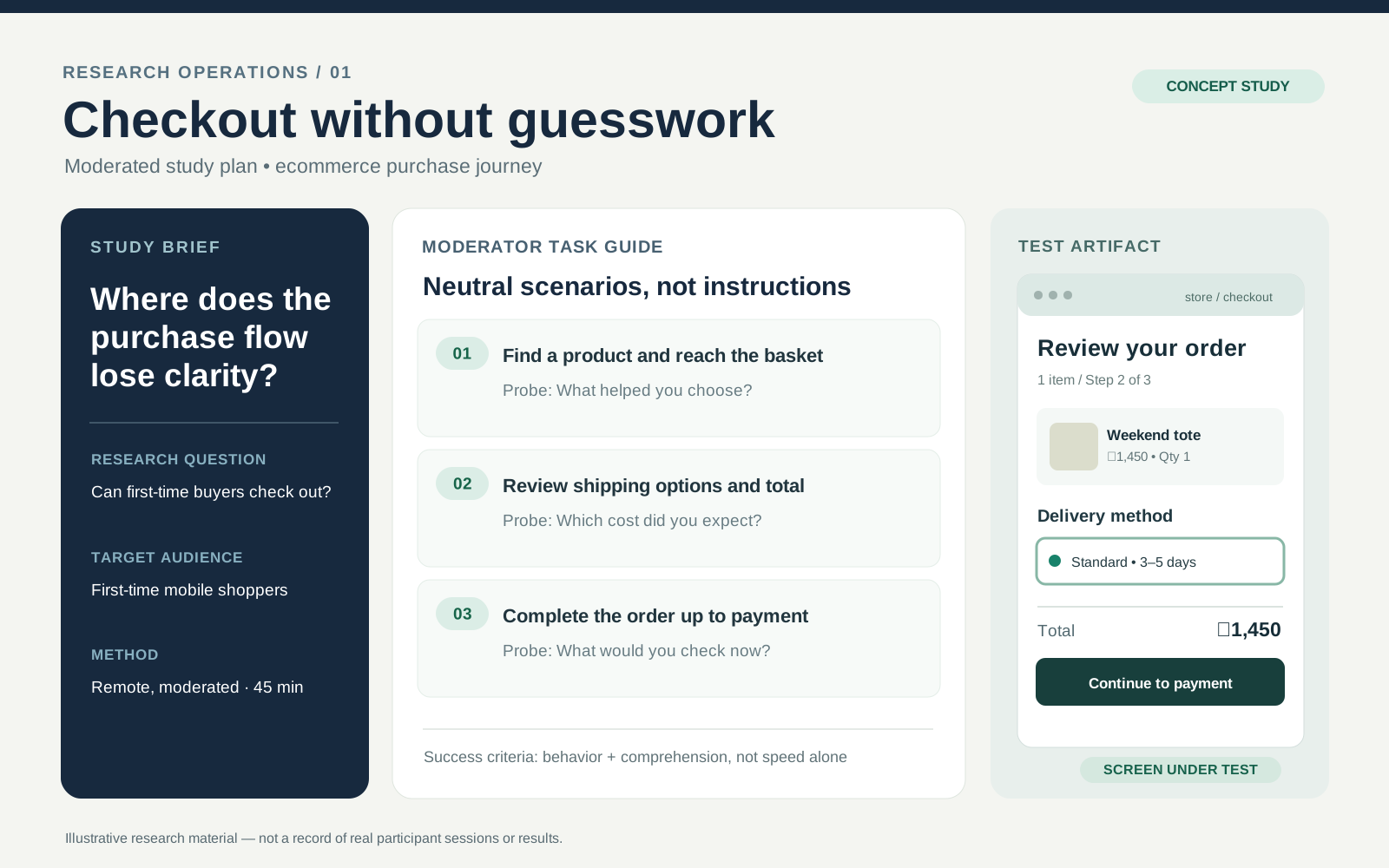
Checkout Clarity Study
A moderated checkout protocol with a neutral task guide, audience criteria and a realistic test artifact.
Study scopingTask scenariosModerator prompts

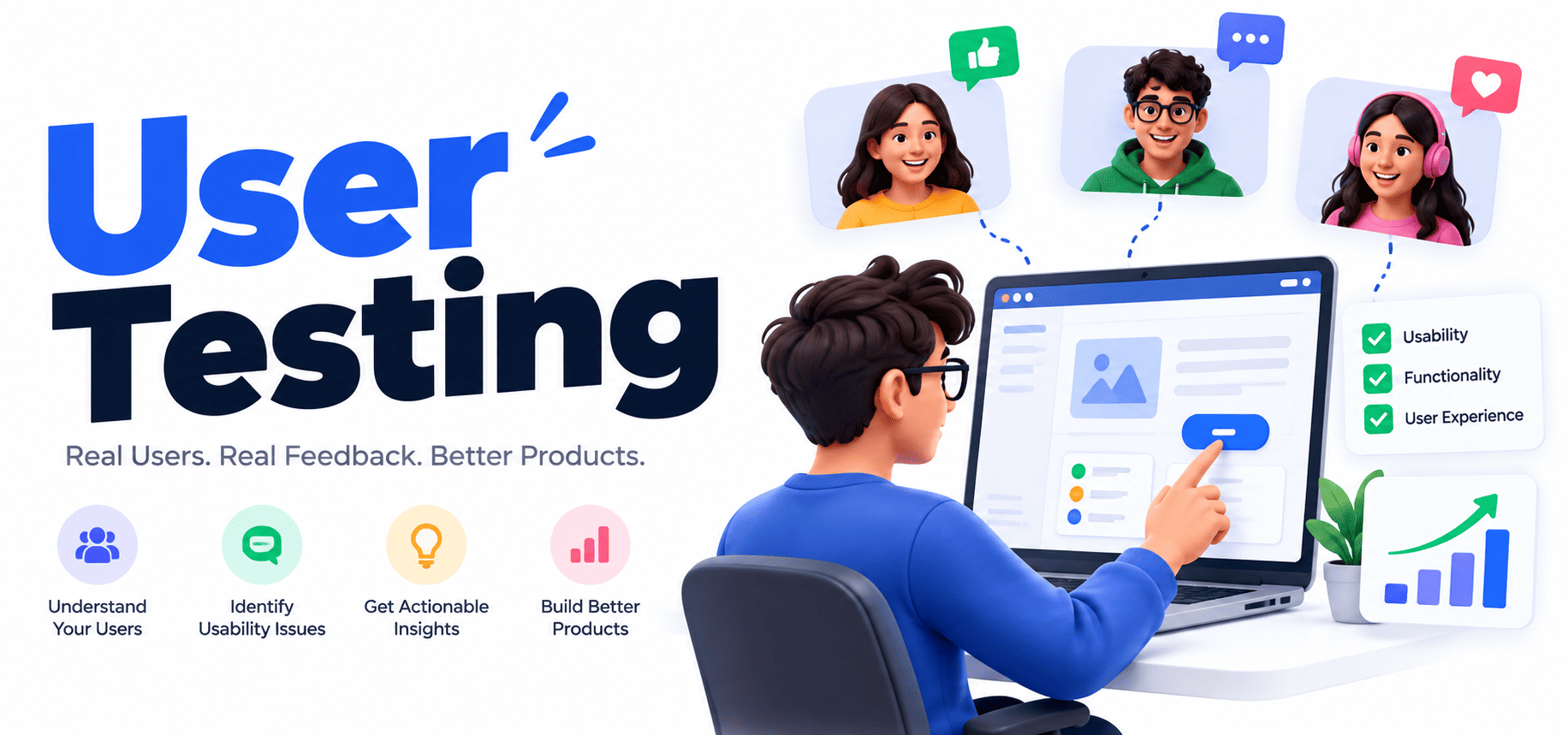
User testing shows how real people understand and use a digital experience when they are trying to complete realistic goals. Instead of relying only on internal assumptions, product teams can observe where users hesitate, choose the wrong path, miss important information, misunderstand labels, abandon a task or need extra effort to complete a journey.
Rudrriv turns that research activity into a service. You share the product, audience, objectives and priority journeys; Rudrriv provides the appropriate expertise, study design, moderation, evidence capture, synthesis, quality review and final delivery. The result is a structured view of what is creating friction and what your product, design or engineering team should consider changing next.
This service is suitable for product teams validating a new feature, SaaS businesses improving onboarding, ecommerce teams examining browse-to-checkout friction, mobile-app teams testing navigation, startups validating prototypes before development, and established organizations that need evidence before redesigning an important digital journey.
Share the product or prototype, your main research question, target users, the flows you want to evaluate, any known problem areas, access instructions, confidentiality constraints and your preferred deadline. If you already have analytics, support tickets, journey maps, earlier research or a participant list, those inputs can help sharpen the study.
Rudrriv reviews your objective, audience, product access and priority journeys, then confirms the package scope.
The research team prepares participant criteria, realistic task scenarios, prompts and session logistics.
Participants attempt the agreed flows while the moderator observes behaviour and probes relevant moments in real time.
Findings are grouped, prioritized and quality-checked before the final recommendations are delivered.
The study should help your team understand where users struggle, which problems repeat, why important tasks break down, what appears to be a usability issue rather than a one-off preference, and which changes deserve attention first. The objective is evidence that supports product decisions—not a long list of unprioritized comments.
Choose based on the number of participants, journeys and synthesis depth you need. The listed prices assume customer-provided or already recruited participants; paid recruitment and incentives are separate when required.
| Included | ₹14,999 Essential Focused Usability CheckFor one important flow that needs fast qualitative evidence. |
₹29,999 Professional Recommended Core User Testing StudyFor the most common product-validation or usability-improvement need. |
₹54,999 Advanced Multi-Flow Research SprintFor broader journeys, multiple segments or higher-stakes product decisions. |
|---|---|---|---|
| Moderated participants | 3 | 5 | 8 |
| User segments | 1 | 1 | Up to 2 |
| Journey coverage | 1 critical flow | Primary + related flow | Up to 2 major flows |
| Session duration | Up to 30 min | Up to 45 min | Up to 60 min |
| Research plan & task guide | ✓ | ✓ | ✓ |
| Participant screener design | Basic | Detailed | Advanced / multi-segment |
| Session notes | ✓ | ✓ | ✓ |
| Cross-session synthesis | Concise | Detailed | Expanded |
| Severity-ranked findings | ✓ | ✓ | ✓ |
| Findings walkthrough | — | 30 min | 60 min |
| Report revision rounds | 1 | 2 | 2 |
| Standard delivery | 5 business days | 7 business days | 10 business days |
| Participant sourcing | Customer-providedExternal recruitment quoted separately | Customer-provided or scoped add-onIncentives not included | Customer-provided or scoped add-onSpecialist recruitment may require extra time |
| Package price | ₹14,999 | ₹29,999 | ₹54,999 |
Participant costs: package prices cover the research work shown above. Paid participant panels, hard-to-recruit audiences, incentives, translation, in-person facilities or special research platforms are quoted separately when the brief requires them.
SELECTED WORK · FIVE CONCEPT SAMPLES
Explore five representative research artifacts—from study planning and observed behavior through prioritized usability recommendations. These are original illustrative examples, not completed client engagements or verified participant results.
A moderated checkout protocol with a neutral task guide, audience criteria and a realistic test artifact.
A structured observation record pairing a savings-goal interface with timestamped behaviors and neutral probes.
A coded journey matrix organizes hypothetical participant observations into patterns that warrant follow-up.
Severity-ranked example findings pair issue narratives and proposed fixes with an annotated scheduling interface.
A decision-ready synthesis links example usability concerns to recommendations and an impact–effort framework.
The User Testing engagement was our first time outsourcing this part of the stack, so a clear process mattered to us. We asked for a moderated user-testing study, and the implementation was broken down in a way that made each stage easy to validate. The quality showed most clearly in the way they handled task design, participant behavior, usability friction, observations, prioritization, and actionable findings. They kept momentum without rushing decisions that could have affected stability later. We finished the project with a much clearer view of where users struggled and which product changes would matter most. We would use the same team again for related work because the delivery was dependable without being over-engineered.
We hired the team for User Testing after realizing our internal approach was taking too much time to stabilize. The core of the engagement was a moderated user-testing study, and the team avoided distracting us with features that were outside the goal. We were particularly happy with the attention to task design, participant behavior, usability friction, observations, prioritization, and actionable findings. Testing was more thorough than our previous internal attempts, especially around edge cases and real usage. The final result was a much clearer view of where users struggled and which product changes would matter most. We also appreciated that the team left clear recommendations for the next improvements instead of trying to expand the scope during delivery.
The goal of our User Testing project was straightforward, but the underlying technical details were not, and the team handled that well. They delivered a moderated user-testing study and kept the work aligned with the original business need. The team made strong decisions around task design, participant behavior, usability friction, observations, prioritization, and actionable findings and explained the reasoning when we asked. Feedback was incorporated carefully, and completed work did not keep regressing after each revision. What we received in the end was a much clearer view of where users struggled and which product changes would matter most. The final files and notes were organized, and we were able to move directly into the next phase.
Tell us what you want to learn, who the target users are, what experience should be tested and when you need the findings. Rudrriv will review the brief and recommend the right study scope.