
How to Measure Outsourcing Success Across Five Metrics
The practical answer to how to measure outsourcing success using cost, quality, turnaround time, customer experience, and business impact is to use one balanced scorecard rather than five disconnected reports. Establish a comparable pre-outsourcing baseline, select a small number of measures under each dimension, define how every metric is calculated, and agree how trade-offs will be handled. A provider is not successful merely because invoices are lower or service levels are green.
The central decision is whether the arrangement is creating better value without transferring hidden cost or risk elsewhere. Faster turnaround can increase defects. Lower labour cost can create more rework for the retained team. Strong operational output can still frustrate customers. A well-designed scorecard makes these relationships visible and connects daily performance to the business reason for outsourcing.
Start with the outcome the business expected: more capacity, specialist capability, faster delivery, dependable service, lower cost-to-serve, improved customer experience, stronger resilience, or reduced operational risk. Then use cost, quality, turnaround time, customer experience, and business impact as complementary lenses. The main caution is to lock definitions, data sources, ownership, and baselines before judging results; otherwise, both parties may report accurate numbers that describe different realities.
Quick Answer: Measuring Outsourcing Success
Measure outsourcing success by comparing actual performance with an agreed baseline and target across five dimensions: total cost, accepted quality, end-to-end turnaround time, customer experience, and business impact. Give each dimension a defined owner, formula, source system, review cadence, and weight. Use both averages and exception measures so serious failures are not hidden inside an acceptable monthly result.
The practical decision rule is simple: the arrangement is working when it creates the intended business value while meeting minimum guardrails for quality, service speed, customer experience, compliance, and continuity. A cost reduction that increases defects or customer complaints is not a complete success. Likewise, excellent service levels that require unsustainable client oversight may not represent genuine value.
Before changing a provider, expanding scope, or renewing a contract, review trends over a suitable period, account for volume and scope changes, and investigate the causes of both gains and failures. Use the scorecard to guide decisions, not merely to label performance red, amber, or green.
Key Takeaways
- Start with a baseline: record comparable cost, quality, cycle time, customer outcomes, workload, scope, and internal effort before transition.
- Measure total cost: include supplier fees, retained-team effort, tools, transition, governance, rework, and continuity costs.
- Protect quality: track first-pass acceptance, defects, rework, accuracy, compliance, and issues found after handover.
- Separate speed from reliability: use median cycle time, late-case percentiles, backlog age, and on-time completion.
- Connect operations to customers: measure the customer journey points that the outsourced service can genuinely influence.
- Prove business impact: test whether outsourcing released capacity, accelerated delivery, improved resilience, reduced risk, or supported growth.
- Review trade-offs: no single KPI should allow cost or speed gains to conceal declining quality or customer experience.
Table of Contents
- Set a baseline before outsourcing
- Build a balanced scorecard
- Measure cost without false savings
- Track quality and rework
- Use turnaround time correctly
- Connect customer experience
- Prove business impact
- Set targets and review cadence
- Avoid misleading metrics
- Summary decision test
Set Baselines Before Outsourcing Begins
A useful outsourcing scorecard begins before the provider takes over the work. The baseline should describe the current service using the same scope, volume, quality rules, and cost categories that will be used later. Without that discipline, a business may compare an internal process that included difficult exceptions with a supplier report that counts only completed standard cases.
Record at least three views of the starting position: operational performance, the customer or user experience, and the business result. Include demand volume, case mix, seasonality, backlog, staffing, internal dependencies, tools, defects, escalations, and management effort. Note known data weaknesses rather than creating false precision.
Good governance is part of successful measurement. ISO 37500 guidance on outsourcing covers outsourcing phases, governance, flexibility, risk, and collaborative relationships. The UK Sourcing Playbook similarly emphasises getting sourcing decisions, KPIs, risk allocation, pricing, and resolution planning right from the start. These sources are broader than any single contract, but they reinforce a practical principle: performance measures work best when governance and responsibilities are defined early.
Baseline rule: if a metric cannot be calculated consistently for the pre-outsourcing period and the live service, treat it as an indicator for investigation rather than conclusive proof of improvement.
Build a Balanced Outsourcing Scorecard
A balanced scorecard prevents one attractive number from dominating the decision. The five dimensions should not be treated as equal by default. Their weights should reflect the service objective and its failure risks. A customer-support operation may place greater weight on customer experience and resolution quality, while a high-volume back-office process may emphasise accuracy, unit cost, and cycle time.
The primary table below shows a practical minimum. Each measure needs an agreed numerator, denominator, inclusion rule, data source, and owner. Targets should distinguish a desired level from a minimum threshold that triggers corrective action.
| Dimension | Core measures | Example calculation | Best evidence | Main caution |
|---|---|---|---|---|
| Cost | Total cost-to-serve, cost per accepted unit, budget variance, realised savings | Total attributable cost ÷ accepted output | Invoices, internal time, tooling, transition, rework, finance records | Lower invoices may hide retained-team effort or reduced scope |
| Quality | First-pass acceptance, defect rate, rework ratio, accuracy, compliance | Accepted without rework ÷ total delivered | Quality samples, audit logs, defect systems, acceptance records | Sampling and defect severity must be consistent |
| Turnaround time | Median cycle time, on-time completion, 90th percentile, backlog age | Completed within target ÷ total completed | Workflow timestamps, queue data, release records | Averages can hide seriously delayed cases |
| Customer experience | CSAT, first-contact resolution, complaints, repeat contacts, effort | Satisfied responses ÷ valid responses | Surveys, CRM, contact logs, complaints, journey analytics | Attribute only the journey points the provider can influence |
| Business impact | Capacity released, revenue supported, risk reduced, resilience, speed to market | Actual outcome change versus agreed baseline | Business systems, portfolio data, risk records, executive reporting | Operational correlation is not always proof of causation |
Use the table as a design aid, not a fixed universal template. A focused scorecard with a small number of decision-relevant measures is more useful than a dashboard containing every available metric. Current UK guidance on key performance indicators defines a KPI as a factor or measure against which supplier performance can be assessed during a contract’s life cycle and stresses setting desired performance targets.
Measure Cost Without Rewarding False Savings
Cost should show the economic value of the complete operating model, not just the provider’s invoice. Build a total cost-to-serve view that includes supplier fees, the retained client team, systems, licences, transition work, governance, quality checks, rework, travel where applicable, and continuity or exit preparation. Compare costs on the same volume and scope basis.
Use an accepted-output denominator
Unit cost is most meaningful when the denominator is accepted output, not merely activity completed. For example, divide attributable cost by orders processed accurately, cases resolved without avoidable repeat contact, releases accepted, or assets approved. This prevents a high-volume provider from appearing efficient when a significant share of work returns for correction.
Separate savings from cost avoidance
Realised savings reduce actual spend against a comparable baseline. Cost avoidance prevents an expected future increase. Both may be valuable, but they should not be combined without explanation. Document exchange rates, inflation assumptions, volume changes, one-time transition costs, and investments that are expected to pay back over several periods.
Decision rule: cost performance is positive only when the service remains within agreed quality, customer, risk, and continuity thresholds.
Track Quality Through Errors, Rework, and Compliance
Quality measures whether the delivered work is usable, accurate, compliant, and fit for its intended purpose. Start with first-pass acceptance: the percentage of work accepted without material correction. Add defect rate and rework effort, then include service-specific controls such as transaction accuracy, content accuracy, test coverage, escaped defects, policy compliance, or audit findings.
Define defect severity. A cosmetic issue should not carry the same weight as a security, compliance, financial, or customer-harm error. Also define who samples work, how often, and whether the provider and client can reproduce each other’s results. Independent client checks are especially important during transition and after major process changes.
Quality trends should be segmented by team, work type, complexity, channel, product, market, or release. An overall accuracy rate may appear strong while one high-risk category repeatedly fails. Use root-cause analysis to distinguish capability gaps, unclear requirements, weak source data, insufficient training, rushed approvals, and system limitations.
Use Turnaround Time Without Sacrificing Quality
Turnaround time should measure the full elapsed journey from an agreed start event to an accepted outcome. Avoid measuring only the provider-controlled portion when customers or internal teams experience the complete delay. Where client approvals or missing inputs pause the clock, record both gross cycle time and supplier-controlled time.
Use the median to describe a typical case, the 90th or 95th percentile to reveal late cases, on-time completion against priority-specific targets, and backlog age to show whether old work is accumulating. For customer-facing operations, include wait time and time to resolution. For development or project work, include lead time from approved requirement to production acceptance.
Speed and quality need a joint guardrail. A provider should not improve turnaround by closing cases prematurely, splitting work into smaller tickets, selecting easier items first, or bypassing review. Compare cycle-time improvements with rework, reopened cases, defect severity, and customer complaints.
Connect Customer Experience to Outsourced Work
Customer experience measures should focus on the journey points the provider can influence. Depending on the service, relevant indicators may include customer satisfaction, first-contact resolution, repeat contact, complaint rate, escalation, abandonment, delivery accuracy, customer effort, or the clarity and usefulness of communications.
The COPC Customer Experience Standard describes a performance-management approach for operations supporting customer experience and highlights service journeys, digital channels, and streamlined metrics. The practical lesson is to connect operational measures with the customer journey rather than treating satisfaction as an isolated survey score.
Segment customer data by channel, reason for contact, product, region, priority, and customer type. Combine survey responses with behavioural evidence such as repeat contacts, cancellations, escalations, refunds, or unresolved cases. Avoid attributing the entire customer relationship to the provider when product design, pricing, policies, fulfilment, or internal decisions also shape the outcome.
Prove Business Impact Beyond Service-Level Targets
Business impact asks whether outsourcing achieved the strategic reason for the decision. Relevant outcomes may include capacity released for core work, faster product or campaign delivery, access to specialist expertise, improved resilience, lower operational risk, better compliance, extended service coverage, shorter time to market, revenue supported, or improved ability to scale.
Choose one or two outcome measures that senior leaders would use to decide whether to continue, expand, redesign, or exit the arrangement. A support operation might measure retention risk or service continuity. A software team might measure release frequency, time from approved requirement to production, or reduction in critical defects. An ecommerce operations team might measure catalogue readiness, order accuracy, or the speed of peak-season scaling.
Performance measures track progress; deeper evaluation explains why results changed. The U.S. Government Accountability Office overview of performance measurement and evaluation distinguishes regular performance tracking from more in-depth assessment of impact. In commercial outsourcing, the same distinction is useful: dashboards can show what happened, while periodic value reviews investigate causation, trade-offs, and improvement opportunities.
Set Targets, Weights, and Review Cadence
Targets should reflect the baseline, business need, service risk, market reality, and maturity stage. During transition, measure knowledge transfer, access readiness, staffing, training completion, process stability, backlog control, and data quality. In steady state, shift weight toward quality, efficiency, customer experience, resilience, and business outcomes.
Use three performance levels
- Threshold: the minimum acceptable level; breaching it triggers investigation or corrective action.
- Target: the expected performance level under normal operating conditions.
- Stretch: a higher level that may justify shared benefits only when quality and risk guardrails remain healthy.
Match cadence to actionability
Review volatile operational data weekly, approve the formal scorecard monthly, and assess business impact quarterly or at a milestone suited to the service. Assign a client owner and provider owner for each metric. Keep a metric dictionary that records formulas, exclusions, source systems, cut-off times, data-quality checks, and change history.
Test the scorecard in real scenarios
Subscription support operation: the provider lowers cost per contact, but repeat contacts and cancellations rise. The mistaken assumption is that cheaper contact handling equals success. A better decision is to weight first-contact resolution and customer effort alongside cost, then investigate knowledge gaps and policies that generate avoidable contacts.
Ecommerce catalogue operation: turnaround improves during a seasonal launch, but product errors create customer complaints and returns. The better scorecard pairs catalogue cycle time with first-pass accuracy, defect severity, correction time, and launch-readiness impact. Specialist process or quality support may help clarify acceptance rules and sampling.
Software quality-assurance team: test execution volume and release speed increase, yet production defects also increase. The better decision is to measure escaped defects, risk-based coverage, defect severity, rework, and release outcomes rather than rewarding test counts alone. Technical discovery may be needed when requirements, environments, or release controls are unclear.
Avoid Metrics That Hide Outsourcing Problems
The most damaging measurement mistakes create a reassuring dashboard while the service weakens. Review the design of the scorecard whenever reported success conflicts with customer feedback, internal workload, or business results.
- Using too many KPIs: teams discuss reporting detail instead of the few measures that drive decisions.
- Rewarding speed alone: cases close faster while rework, reopen rates, or customer effort rise.
- Ignoring case mix: performance appears better because difficult work moved back to the client.
- Counting activities as outcomes: hours, tickets, or deliverables increase without improving accepted output or business value.
- Relying only on averages: seriously delayed or high-impact failures disappear inside an acceptable mean.
- Changing definitions mid-period: apparent improvement results from a new denominator, exclusion, or clock rule.
- Letting the provider own all evidence: important measures cannot be reconciled with client systems or independent samples.
- Ignoring internal effort: the retained team spends more time managing, correcting, or escalating work than expected.
- Keeping transition KPIs forever: readiness measures remain green while steady-state value is never tested.
- Linking fees to one metric: incentives encourage gaming or local optimisation at the expense of the wider service.
When Specialist Measurement Support Adds Value
External support can be useful when an outsourcing arrangement spans several functions, the contract lacks measurable acceptance criteria, client and provider data disagree, or leaders cannot connect operational reporting to business outcomes. The work should begin with a neutral baseline, a small balanced scorecard, clear governance, and a plan for reconciling data.
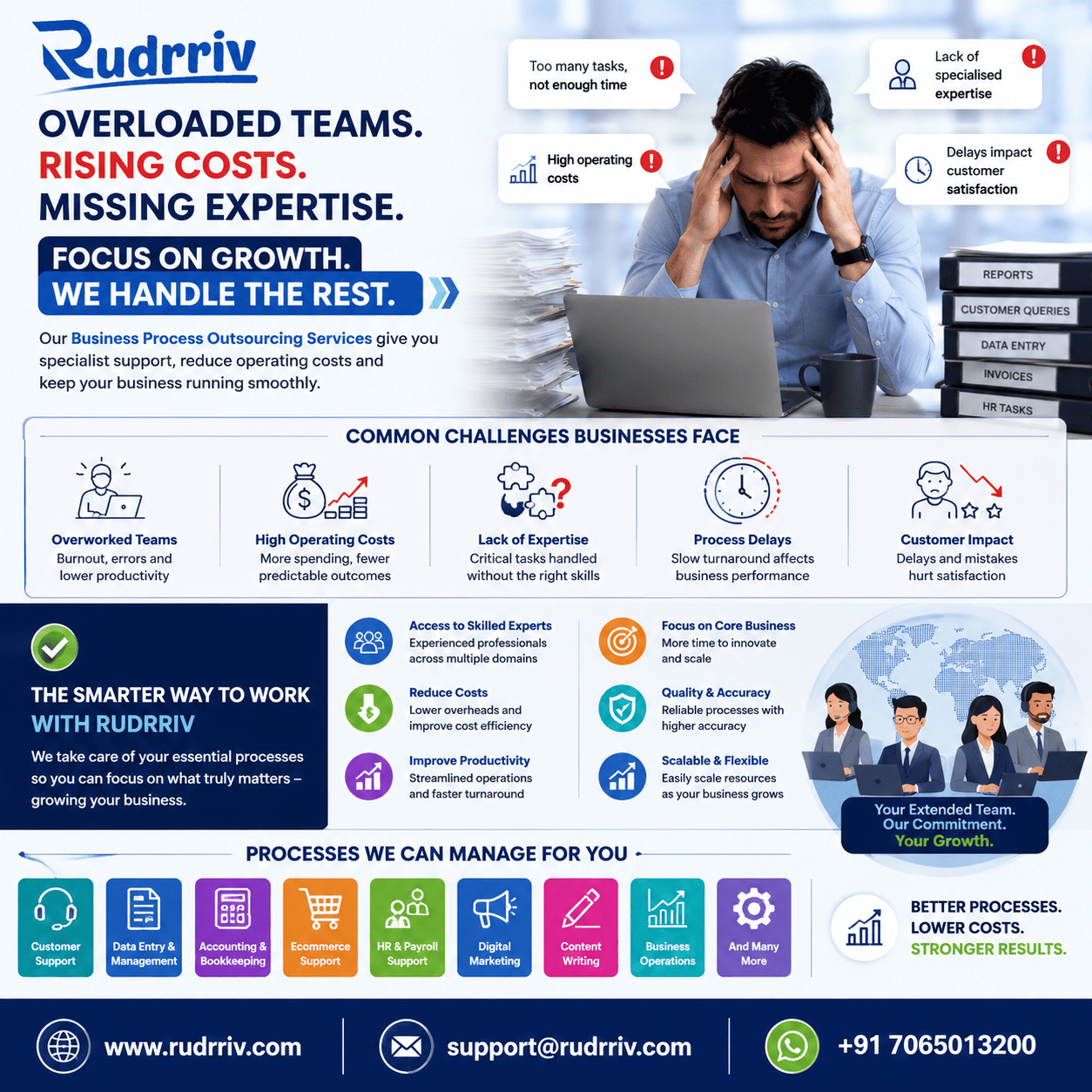
Through Rudrriv outsourcing support, businesses can access defined project assistance, dedicated professionals, ongoing operational support, or managed teams where measurement design and delivery governance are relevant to the scope. The appropriate model depends on the service, risk, internal capability, and level of coordination required.
Summary: A Practical Outsourcing Success Test
Outsourcing is successful when it creates the intended business value and remains healthy across cost, quality, turnaround time, and customer experience. Start with a comparable baseline, use accepted output rather than raw activity, and define each KPI so both parties can reproduce it from agreed data.
Use cost to test economic value, quality to protect usability and compliance, turnaround time to reveal service reliability, customer experience to understand journey effects, and business impact to decide whether the arrangement deserves renewal or expansion. Review these dimensions together; improvement in one area should not excuse material deterioration in another.
The final decision should consider trends, outliers, scope changes, risk, internal management effort, and whether corrective actions are working. A simple, governed scorecard that leads to decisions is more valuable than a complex dashboard that only reports activity.
FAQs About Measuring Outsourcing Success
How do you measure outsourcing success using cost, quality, turnaround time, customer experience, and business impact?
Use a balanced scorecard with a baseline, target, owner, data source, review frequency, and weighting for each dimension. Cost should include retained-team and rework costs; quality should track accepted work and defects; turnaround time should use median and late-case measures; customer experience should reflect the affected journey; and business impact should test whether outsourcing improved capacity, revenue, resilience, risk, or speed. Review the dimensions together so a gain in one area does not hide damage in another.
What is the most important outsourcing KPI?
There is no universal single KPI. The most important measure is the one tied to the business reason for outsourcing, such as faster launch cycles, dependable customer support, lower unit cost, stronger compliance, or access to scarce expertise. Pair that outcome measure with guardrails for quality, service speed, and customer experience. A provider should not be judged successful because it hits one service-level target while the broader outcome deteriorates.
How should outsourcing cost savings be calculated?
Compare like-for-like total costs against a documented baseline. Include supplier fees, transition work, governance, internal retained staff, software, rework, travel where relevant, and exit or continuity costs. Then divide by accepted output or another meaningful unit. Avoid presenting invoice reduction as savings when workload, service scope, quality, or demand has changed. Finance and operational owners should agree the assumptions before the engagement begins.
Which quality metrics work best for outsourced services?
Useful quality measures include first-pass acceptance, defect rate, error severity, rework hours, audit compliance, accuracy, and defects found after handover. Select measures that reflect the actual service. A software team may track escaped defects, while an operations team may track transaction accuracy. Define the sampling method and severity rules so the client and provider calculate quality consistently.
Is SLA attainment enough to prove outsourcing success?
No. SLA attainment shows whether selected service commitments were met, but it may not show customer friction, hidden backlog, rework, poor prioritisation, or weak business value. Combine service levels with quality, customer experience, cost-to-serve, and outcome measures. Review outliers and aged cases as well as averages, because a good monthly average can conceal a small group of seriously delayed or high-impact failures.
How can customer experience be linked to an outsourcing provider?
Map the provider’s work to the customer journey and measure the points it can influence. Depending on the service, use first-contact resolution, customer satisfaction, complaint rate, repeat contacts, customer effort, escalation rate, abandonment, or delivery accuracy. Segment results by channel, product, case type, or customer group. Avoid attributing the entire customer relationship to the provider when pricing, product design, or internal policies also shape the experience.
How often should an outsourcing scorecard be reviewed?
Operational measures may be reviewed weekly, while a formal scorecard is commonly reviewed monthly and business-impact measures quarterly. The right cadence depends on service volume, risk, seasonality, and how quickly corrective action can be taken. Use the same metric definitions over time, document exceptions, and hold a periodic value review to decide whether targets or weights should change as the service matures.
Should outsourcing KPIs change after the transition period?
Yes, when the change is deliberate and documented. Transition metrics should focus on knowledge transfer, staffing, access, backlog stability, and readiness. Steady-state metrics should focus more on efficiency, quality, service, customer experience, resilience, and business outcomes. Do not quietly lower targets because performance is weak. Any change should include the reason, effective date, revised baseline, and approval from both parties.
What are common mistakes when measuring outsourcing performance?
Common mistakes include using too many metrics, rewarding speed without quality, treating lower invoices as verified savings, relying only on averages, changing definitions mid-period, ignoring retained internal costs, and measuring activities instead of outcomes. Another mistake is allowing the provider to be the sole source of performance data. Important results should be reconcilable with client systems, samples, audits, or jointly governed dashboards.
When should a business seek specialist help with outsourcing measurement?
Specialist support is useful when the service spans several teams, data sources are inconsistent, outcome ownership is unclear, the contract lacks measurable acceptance criteria, or performance disputes are recurring. An external specialist can help define the baseline, select a small set of decision-relevant KPIs, set governance rules, and connect operational data to business outcomes. The business should still retain ownership of objectives, data access, and final decisions.
Need a Clear Outsourcing Scorecard?
Share the outsourced service, current reporting, baseline data, business objectives, and the decisions the scorecard must support. Rudrriv can help structure a practical measurement approach within a relevant defined project, dedicated-professional arrangement, ongoing support plan, or managed-team engagement.
Explore outsourcing supportAt Rudrriv, we make it easier for businesses to access the right expertise, execute important work, and scale with confidence.