
How to Choose a Graphic Designer for a Business Project
To choose a graphic designer for a business project based on portfolio, industry experience, and communication, evaluate evidence of relevant problem-solving rather than visual style alone. Review complete case studies, test whether the designer understands your market and audience, observe how clearly they ask questions and explain decisions, and put the scope, milestones, revisions, ownership, and handover requirements in writing.
A business design project is not simply the purchase of an attractive image. It may influence customer trust, sales conversations, product understanding, campaign performance, investor communication, packaging accuracy, or the consistency of a growing brand. The right designer must therefore combine craft with commercial judgement, reliable delivery, and the ability to work with people who may not speak in design terminology.
The selection becomes harder when several portfolios look polished. A portfolio can show taste, but it may not reveal who developed the concept, whether the designer followed a real brief, how they handled stakeholder feedback, or whether the final files worked across print, digital, accessibility, and production requirements. Industry experience can help, yet a designer who repeats familiar conventions without questioning them may be less useful than a thoughtful specialist who researches quickly and communicates well.
This guide gives founders, startups, marketing teams, ecommerce businesses, agencies, professional-service firms, and enterprise departments a practical way to compare designers. It covers portfolio review, sector fit, communication, project scope, engagement models, quality checks, pricing, revisions, intellectual-property ownership, and final handover. It also explains when a defined design project or ongoing support through Rudrriv design services may be appropriate.
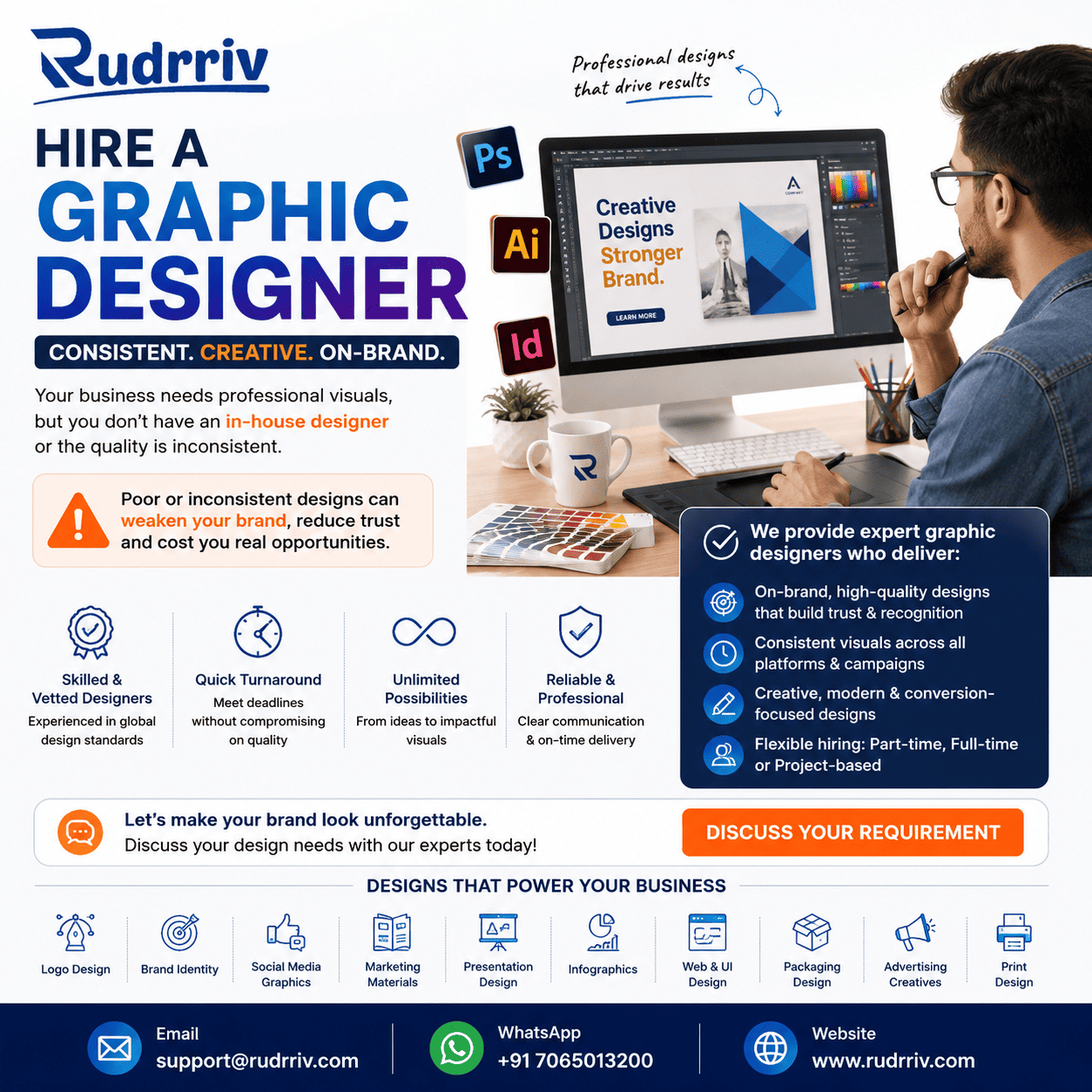
Quick Answer: How Should a Business Choose a Graphic Designer?
Start by defining the business outcome and deliverables. Then shortlist designers whose portfolios show comparable problems, audiences, formats, or constraints. Ask each shortlisted designer to walk through one or two projects: what the brief required, what options were considered, what changed after feedback, and how the final work was prepared for use.
Industry experience matters most when the work involves specialist terminology, regulated or technical claims, complex buying journeys, production constraints, or a highly specific audience. It matters less when the project is primarily about clear communication and the designer can demonstrate disciplined research, sound judgement, and transferable experience.
Communication should be evaluated before hiring, not assumed. Notice whether the designer listens, summarizes the requirement accurately, identifies risks, states what is excluded, explains design decisions in business language, and gives a workable review process. For an important or uncertain engagement, use a paid discovery phase or small pilot before committing to a large programme.
Key Takeaways
- Portfolio relevance is more important than portfolio size: look for comparable objectives, audiences, formats, and constraints.
- Ask for the story behind the work: strong case studies explain the brief, reasoning, collaboration, and outcome.
- Industry experience is a risk reducer, not an automatic quality guarantee: research ability and judgement still matter.
- Communication is part of the deliverable: the designer should clarify decisions, risks, feedback, and next steps.
- Scope must be specific: define concepts, formats, revision rounds, milestones, dependencies, licences, and exclusions.
- Ownership and handover require written terms: confirm source files, usage rights, third-party assets, and file organization.
- Choose the engagement model that matches the workload: a project, freelancer, agency, dedicated professional, or managed team serves different needs.
What This Page Covers
- How to turn a business need into a useful design brief.
- How to evaluate a portfolio without relying only on personal taste.
- How to judge industry experience and transferable capability.
- How to test communication, reliability, and feedback handling.
- How to compare freelancers, agencies, and managed design support.
- How to agree pricing, revisions, ownership, quality checks, and handover.
- How to identify red flags before they become delivery problems.
Table of Contents
- How this guide was prepared
- What a suitable graphic designer means
- Define the project before reviewing portfolios
- How to evaluate portfolio and industry experience
- Step-by-step designer selection
- Freelancer vs agency vs managed team
- Scope, pricing, communication, and revisions
- Quality assurance, ownership, and handover
- Common mistakes and red flags
- Final selection checklist and summary
How this guide was prepared
This guide is based on practical provider selection, creative briefing, design review, production handover, intellectual-property, and delivery-management considerations. It also reflects widely used professional guidance, including the AIGA standard agreement resources for design services, the W3C Web Content Accessibility Guidelines for relevant digital design, Adobe Creative Cloud resources for teams, and the UK government overview of intellectual-property rights and infringement.
Contracts, platform features, font and stock licences, production standards, accessibility expectations, and commercial rates can vary by jurisdiction and project. Use this article as a decision framework, then verify legal, licensing, regulatory, and channel-specific requirements with the appropriate authoritative source or qualified adviser.
What does a suitable graphic designer actually mean?
A suitable graphic designer is someone whose creative ability, experience, process, communication, and capacity match the business problem. Suitability is not the same as popularity. A designer with a large following or a fashionable visual style may still be wrong for a project that needs restrained corporate communication, complex information design, production accuracy, or fast collaboration with several stakeholders.
Graphic design is the planned use of typography, imagery, colour, layout, symbols, and visual systems to communicate. A business designer should therefore understand what the audience needs to notice, understand, trust, or do. The work may include a logo, brand identity, brochure, pitch deck, social campaign, packaging, website interface, infographic, report, sales collateral, or a coordinated group of assets.
The designer should also understand delivery realities. A concept is not complete if it cannot be produced correctly, adapted to required formats, approved by stakeholders, used accessibly, or handed to another team. Reliability is shown by the ability to move from brief to concepts, review, production, quality assurance, approval, and organized handover.
Define the project before reviewing portfolios
The best portfolio review starts with a clear definition of what the business needs. Without that definition, teams often shortlist designers whose style they like but whose experience, process, or capacity does not match the assignment.
Describe the business outcome, not only the item
“We need a brochure” is an output request. “We need a sales document that helps procurement teams understand our service model and gives account managers a consistent leave-behind” is a business requirement. The second version helps a designer judge information hierarchy, audience knowledge, message sequence, proof points, and production format.
Write down the primary audience, desired action, channels, deadline, known constraints, stakeholders, brand requirements, and how success will be reviewed. For a pitch deck, success may mean that an investor can follow the business model without verbal explanation. For packaging, success may include shelf visibility, correct mandatory information, and reliable print production. For campaign assets, success may involve rapid adaptation across formats without losing message clarity.
Separate essential deliverables from optional support
List every required item and format. A logo project may include research, visual directions, primary and secondary marks, colour specifications, typography recommendations, social avatars, usage guidance, and editable files. A website design project may include page templates, responsive states, a component library, interaction notes, and developer handoff. Optional services such as copywriting, illustration, photography, animation, printing, or template training should be identified separately.
Action step: ask every shortlisted designer to price the same core scope. This makes quotes easier to compare and reveals where assumptions differ.
How to evaluate portfolio relevance and industry experience
A portfolio should be evaluated as evidence of capability, not as a catalogue of attractive images. Look for projects that are relevant in at least two or three dimensions: business objective, audience, industry, channel, complexity, stakeholder environment, production method, or brand maturity.
Review complete case studies, not isolated mock-ups
Ask what the client needed, what information the designer received, which constraints shaped the work, what the designer personally created, and what changed during review. A credible case study may include rejected directions or explain why the final solution became simpler. That reasoning is often more informative than the final image.
Check consistency across applications. A visual identity should work on a website, document, presentation, social profile, and small-format asset. An infographic should remain understandable when data becomes dense. Packaging should show hierarchy, legibility, variant management, and production awareness. A presentation should demonstrate narrative flow, not merely decorative slides.
Assess design quality beyond personal taste
Personal preference matters, but it is not a sufficient quality standard. Evaluate whether the work has a clear hierarchy, readable typography, consistent spacing, appropriate contrast, purposeful imagery, and a coherent visual system. Check whether the designer can make different brands feel distinct rather than applying one recognizable style to every client.
For digital work, ask how accessibility, responsive behaviour, and implementation were considered. For print, ask about bleed, colour mode, image resolution, proofing, and supplier coordination. For data-heavy work, inspect labels, comparisons, annotation, and whether the visual makes the information easier to understand.
Decide how much industry experience is genuinely necessary
Direct sector experience can shorten discovery and reduce avoidable mistakes. It is especially useful in healthcare, financial services, industrial products, legal or professional services, technical software, government communication, education, and regulated packaging. The designer may already understand audience expectations, approval structures, terminology, and common production requirements.
However, industry familiarity can also create repetitive work. A designer from an adjacent field may bring a useful perspective when they can research the subject, ask disciplined questions, and show comparable communication challenges. Ask the designer to explain how they would learn your market during the first week. A clear research plan is stronger evidence than a vague claim of being able to design for any industry.
| Portfolio evidence | What it can demonstrate | What to verify |
|---|---|---|
| Comparable business objective | Understanding of persuasion, explanation, trust, or conversion | Whether the designer can describe the audience and intended action |
| Comparable format | Production knowledge for presentations, packaging, web, print, or campaigns | Whether final files were actually delivered and used |
| Comparable industry | Familiarity with terminology, buyers, restrictions, and conventions | Whether experience is recent and personally relevant |
| Multi-asset system | Ability to maintain consistency across channels and teams | Whether a usable system or guideline was created |
| Before-and-after case study | Problem diagnosis and improvement reasoning | Whether claims are supported by a clear starting point and scope |
| Complex stakeholder project | Ability to manage feedback, approvals, and competing priorities | How communication and version control were handled |
Step-by-step process for choosing a graphic designer
1. Build a shortlist from relevant evidence
Select three to five designers whose work reflects the project’s purpose, complexity, or audience. Recommendations can help, but review the work yourself. Confirm whether the portfolio belongs to the person who will actually work on your account.
2. Send the same structured brief
Provide the outcome, audience, deliverables, timing, stakeholders, brand assets, constraints, and budget range where possible. Ask candidates to identify questions and risks. Their response will reveal how they think before any design is produced.
3. Hold a discovery conversation
Use the call to evaluate listening and clarity. A capable designer should ask about priorities, not immediately suggest colours or styles. They should be able to restate the problem, distinguish assumptions from facts, and explain the next decision.
4. Ask for a project walkthrough
Choose one portfolio example and ask the designer to explain the brief, their role, major decisions, feedback, difficulties, and handover. This helps distinguish real involvement from a polished team case study where their contribution was limited.
5. Compare the proposed process
Look for defined stages such as discovery, direction setting, concepts, refinement, production, quality assurance, approval, and handover. The process should match the project; a small social template does not need the same governance as a global rebrand.
6. Verify capacity and continuity
Ask who will do the work, how many projects they are handling, what happens during absence, and whether specialists such as illustrators, copywriters, or production artists are subcontracted. Capacity should match the promised turnaround.
7. Review commercial and ownership terms
Confirm the fee basis, payment milestones, change-control method, revision limits, cancellation terms, confidentiality, rights transfer, third-party licences, source files, and post-delivery support. Unclear terms often cause more difficulty than creative disagreement.
8. Use a pilot when uncertainty remains
A paid discovery workshop, one campaign concept, a presentation section, or a small template system can test thinking and collaboration. The pilot should be meaningful enough to reveal the process but not ask for speculative unpaid work.
Freelancer, agency, in-house designer, or managed team?
The right engagement model depends on project complexity, continuity, stakeholder count, and the range of skills required. No model is automatically superior.
| Model | Best suited to | Advantages | Watch points |
|---|---|---|---|
| In-house designer | Frequent work, strong brand context, close daily collaboration | Continuity, internal knowledge, fast access to stakeholders | Recruitment time, limited specialist range, workload peaks |
| Freelance designer | Defined projects or specialist tasks with a clear owner | Direct communication, flexible scope, focused expertise | Capacity, absence cover, dependence on one person |
| Design agency | Strategic, multi-disciplinary, or high-visibility projects | Broader team, creative direction, production coordination | Higher overhead, account-team layers, possible team changes |
| Dedicated professional | Regular work that needs consistent capacity without a full internal hire | Brand familiarity, predictable availability, integrated workflow | Needs clear management, priorities, and utilization planning |
| Managed design team | Ongoing volume, several channels, multiple stakeholders, or business units | Governance, continuity, scalable skills, delivery coordination | Requires service levels, intake rules, and performance reviews |
A small company preparing one investor deck may benefit from a specialist freelancer. An ecommerce brand producing weekly campaigns, marketplace assets, landing-page graphics, and packaging updates may need ongoing capacity. An enterprise rebrand may require an agency or managed team with strategy, research, design, production, and stakeholder management.
Scope, pricing, communication, and revisions
A good proposal converts the brief into a controlled delivery plan. It should make it possible for both parties to know what has been completed, what requires approval, and what will happen when the requirement changes.
What the written scope should include
- Business objective, audience, and project background.
- Named deliverables, sizes, formats, quantities, and language versions.
- Discovery activities, concept count, and presentation method.
- Milestones, target dates, client dependencies, and approval windows.
- Revision rounds and a definition of what counts as a revision.
- Responsibilities for copy, images, data, legal review, printing, and implementation.
- Source files, export files, templates, guidelines, and handover contents.
- Rights transfer, confidentiality, licences, exclusions, and change requests.
How to compare pricing fairly
Design may be priced by project, day, hour, retainer, asset volume, or dedicated capacity. Compare the work behind each price. A proposal that includes discovery, multiple stakeholder presentations, production artwork, editable templates, and a detailed handover should not be compared directly with a quote for one concept and final exports.
Ask what happens when feedback is late, the brief changes, an extra format is requested, or a third-party asset must be licensed. A transparent designer will explain assumptions and additional-cost triggers before work begins.
How to assess communication in practice
Communication quality is visible in small behaviours: punctuality, concise summaries, useful questions, realistic commitments, organized files, and the ability to disagree professionally. The designer should distinguish subjective preference from objective requirements. They should also help stakeholders give actionable feedback by asking what is unclear, off-brand, inaccurate, or ineffective rather than accepting “make it pop” as sufficient direction.
Agree one project owner on the client side. Consolidated feedback is usually faster and more consistent than separate comments from several people. Use version numbers, decision logs, or a shared review tool for complex projects. The designer should record approvals so old directions are not unintentionally reintroduced.
Plan revision rounds without creating conflict
A revision cycle is a planned opportunity to improve work against the approved brief. It is not a restart caused by a new audience, new deliverable, or changed strategy. Define how many rounds are included, how long the client has to respond, and how out-of-scope changes are estimated. Unlimited revisions may sound customer-friendly, but without decision rules they can encourage endless iteration and make deadlines unreliable.
Quality assurance, ownership, and final handover
Design quality should be verified against the approved requirement and technical use, not only during the concept presentation. Final production checks protect the business from errors that may be expensive or embarrassing after publication.
Use acceptance criteria that match the channel
For a presentation, verify page size, editable content, font availability, image quality, alignment, chart accuracy, speaker use, and export behaviour. For print, check dimensions, bleed, safe areas, colour specifications, image resolution, barcodes, dielines, and proof approval. For digital assets, check responsive sizes, file weight, contrast, text readability, export formats, and platform restrictions.
For brand identity work, verify that the system covers realistic applications and that guidelines explain spacing, minimum size, colour use, typography, imagery, and common misuse. For templates, ask a non-designer in your team to use them. A template that only the original designer can operate is not a successful handover.
Clarify intellectual-property ownership and licences
The agreement should state what rights transfer to the client and when. Original design rights may transfer after final payment, while fonts, stock photographs, icons, plugins, templates, or generative tools may have separate licence conditions. Ask for a list of third-party assets and the licence holder. Do not assume that receiving a PDF or PNG gives the business ownership of every underlying element.
Source-file expectations should also be explicit. Editable files may include Illustrator, InDesign, Photoshop, Figma, PowerPoint, Canva, or other native formats. Confirm whether linked images, fonts, component libraries, and documentation are included, and whether the team needs software licences to edit them.
What a complete handover should contain
- Approved final exports in every agreed size and format.
- Editable source files with organized layers, pages, components, or masters.
- Linked assets, licence information, font details, and usage restrictions.
- Brand guidelines, template instructions, or production notes where included.
- A list of final versions and an archive of approved decisions.
- Access transfer for shared workspaces or project files.
- Outstanding issues, recommended next steps, and support terms.
Three practical business examples
Example 1: A startup needs an investor pitch deck
The founder initially prefers a designer with dramatic 3D visuals. However, the real need is to explain a complex product, market, traction, and financial model within a short meeting. The team selects a presentation specialist whose portfolio shows narrative structure, data visualization, editable PowerPoint delivery, and calm communication with founders. The designer’s industry experience is adjacent rather than exact, but the discovery questions and information-design examples are strong.
Example 2: An ecommerce company needs packaging and campaign assets
The business needs new packaging, marketplace images, paid-social creative, and seasonal variants. A single logo specialist would not provide enough production depth. The company chooses a small agency with packaging experience, a documented artwork-checking process, and capacity for recurring campaign adaptations. The scope separates brand direction, packaging production, photography coordination, and monthly creative support.
Example 3: A professional-services firm needs ongoing design support
The firm produces proposals, reports, webinars, social posts, and event materials across several departments. Repeated freelance sourcing creates inconsistent branding and slow onboarding. A dedicated designer or managed design team becomes more suitable because the requirement is continuous. The firm establishes an intake form, priority levels, turnaround targets, a shared template library, monthly capacity reviews, and a named internal approver.
Common hiring mistakes and red flags
Most design-project problems begin before the first concept. They come from an unclear brief, an unsuitable selection method, or unspoken assumptions about revisions, ownership, and timing.
- Selecting only by visual style: style can distract from weak problem-solving, production knowledge, or collaboration.
- Requesting extensive unpaid speculative work: this may discourage experienced designers and does not recreate a real working relationship.
- Ignoring who did the portfolio work: agency case studies may represent a team, while a freelancer may show work completed under another creative director.
- Assuming sector experience guarantees quality: familiarity is useful, but repeated or outdated solutions can still be ineffective.
- Using several uncontrolled feedback channels: conflicting comments increase revisions and weaken accountability.
- Leaving copy and content unresolved: design cannot compensate for late, inaccurate, or constantly changing content.
- Accepting vague ownership terms: the business may later discover that source files or third-party assets are excluded.
- Choosing the lowest quote without normalizing scope: missing formats, meetings, revisions, or production work may become additional costs.
- Skipping quality assurance: attractive files can still contain incorrect text, inaccessible contrast, broken links, or print errors.
- No handover plan: future updates become expensive when files, fonts, licences, and decisions are disorganized.
Red flag: be cautious when a designer refuses to explain process, cannot distinguish original work from team work, promises unlimited speed and revisions without conditions, or avoids written terms for ownership and source files.
Final graphic designer selection checklist
Before appointing a designer, confirm that the following statements are true:
- The business objective, audience, deliverables, formats, timing, and constraints are written down.
- The portfolio contains relevant evidence and the designer has explained their personal role.
- The designer’s industry knowledge or research plan is appropriate to the risk of the project.
- The discovery conversation demonstrated listening, clear questions, and practical explanation.
- The named person or team has enough capacity and the required specialist skills.
- The proposal defines stages, milestones, dependencies, approvals, revisions, and exclusions.
- Pricing assumptions and change-request rules are understandable.
- Confidentiality, intellectual-property rights, third-party licences, and source files are addressed.
- Quality checks and acceptance criteria match the final channels.
- The handover will leave the business with usable, organized files and necessary documentation.
Summary: How to Choose a Graphic Designer for a Business Project
Choosing a graphic designer is a business decision about communication, execution, and risk. The strongest choice is usually not the person with the largest portfolio or the closest industry label. It is the designer or team whose evidence matches the problem, whose process can be understood, and whose communication makes confident decisions possible.
Begin with a clear brief. Compare portfolios through complete case studies. Decide how much sector experience the work genuinely requires. Test communication during discovery. Then document scope, milestones, revisions, ownership, quality assurance, and handover. Internal delivery may be enough when the work is simple and your team has capacity. A freelancer may suit a defined project, while an agency, dedicated professional, or managed team can be more effective when the workload is broader, recurring, or coordination-heavy.
If your business needs help converting a design requirement into a workable brief or selecting an appropriate delivery model, Rudrriv can support requirement discovery, specialist matching, defined project delivery, dedicated professionals, ongoing design support, and managed creative teams.
FAQs on Choosing a Graphic Designer for a Business Project
How do I choose a graphic designer for a business project?
Choose a designer by comparing portfolio relevance, industry understanding, communication quality, delivery process, and commercial terms. Review complete case studies rather than isolated visuals, ask the designer to explain decisions, confirm who will do the work, and document deliverables, revisions, ownership, source files, deadlines, and approval responsibilities before the project starts.
What should I look for in a graphic design portfolio?
Look for work that resembles your project in purpose, audience, complexity, and channel. A useful portfolio shows the brief, constraints, design reasoning, system consistency, and final applications. Check typography, hierarchy, accessibility, production accuracy, and whether the designer can maintain quality across formats rather than judging only visual style.
How important is industry experience when hiring a graphic designer?
Industry experience is valuable when the project involves specialist terminology, regulated claims, complex audiences, technical products, packaging requirements, or established channel conventions. However, it should not replace design quality or curiosity. A strong designer from another sector may still be suitable when they demonstrate sound research, clear questions, and relevant problem-solving ability.
How can I assess a graphic designer's communication skills before hiring?
Use the discovery call and proposal as evidence. A good designer listens, clarifies objectives, identifies missing information, summarizes decisions, explains trade-offs without jargon, and sets realistic response times. A small paid test or discovery phase can reveal whether communication remains clear when feedback, ambiguity, and deadlines become real.
What questions should I ask a graphic designer before starting a project?
Ask who will create and review the work, which deliverables and file formats are included, how many concepts and revision rounds are planned, what the timeline depends on, how feedback should be consolidated, which assets your team must supply, what usage rights transfer, and how source files and brand guidance will be handed over.
Should I hire a freelancer, agency, or managed design team?
A freelancer often suits a defined project with a clear brief and limited stakeholder complexity. An agency can help when strategy, copy, production, and multiple design disciplines must be coordinated. A managed team is useful for ongoing design volume, several business units, recurring campaigns, or situations that need dedicated capacity, governance, and continuity.
How many revision rounds should a graphic design project include?
There is no universal number, but two or three structured rounds are common for a well-defined project. More important than the number is what counts as a revision, who consolidates feedback, when the brief becomes locked, and how changes outside scope are priced. Unlimited revisions can create uncertainty unless boundaries and timelines are still clearly documented.
Who should own the final graphic design files and intellectual property?
Ownership should be agreed in writing. The contract should state when rights transfer, which usage rights are included, whether fonts, stock assets, templates, or third-party materials have separate licences, and whether editable source files are included. Your business should also receive an organized handover that another qualified designer can understand and continue.
How can I compare quotes from different graphic designers fairly?
Compare equivalent scope rather than headline price. Check the number and type of deliverables, strategic discovery, concept options, revision rounds, meetings, copy or image support, production files, source-file handover, licensing, project management, turnaround assumptions, and post-delivery support. A lower quote may exclude work that another proposal includes.
Can Rudrriv help me hire a graphic designer for an ongoing business requirement?
Yes. Rudrriv can help clarify the requirement and structure a defined project, dedicated-professional arrangement, ongoing design support plan, or managed creative team. The suitable model depends on design volume, stakeholder count, turnaround expectations, brand complexity, required skills, and how much delivery coordination your internal team can manage.
Need help defining the right graphic design engagement?
Share the business objective, audience, deliverables, current brand assets, deadline, stakeholder structure, and expected design volume. Rudrriv can help structure a defined project, dedicated-professional arrangement, ongoing support plan, or managed creative team with clear responsibilities, review controls, and handover requirements.
Discuss your requirementAt Rudrriv, we make it easier for businesses to access the right expertise, execute important work, and scale with confidence.