
Common Ecommerce Mistakes That Reduce Store Growth
Common ecommerce mistakes that reduce traffic, conversion rates, average order value, and customer retention usually occur across the customer journey rather than in one isolated page. A store may attract the wrong visitors, make products difficult to discover, create doubt on product pages, add friction at checkout, recommend irrelevant items, or disappoint customers after purchase. The practical starting point is therefore not “redesign everything” or “spend more on ads.” It is to identify where qualified shoppers stop progressing and why.
The central caution is that ecommerce metrics interact. Increasing traffic can worsen profitability when campaign targeting is weak. Increasing average order value through heavy discounts can reduce margin or raise returns. Simplifying checkout may not help when delivery information is unclear earlier in the journey. A useful audit connects acquisition, merchandising, usability, technology, fulfilment, service, and retention evidence before selecting fixes.
This article provides a decision framework for prioritizing ecommerce improvements. It explains which mistakes commonly suppress each growth lever, how to distinguish symptoms from root causes, what to measure, and when design or development support may be justified.
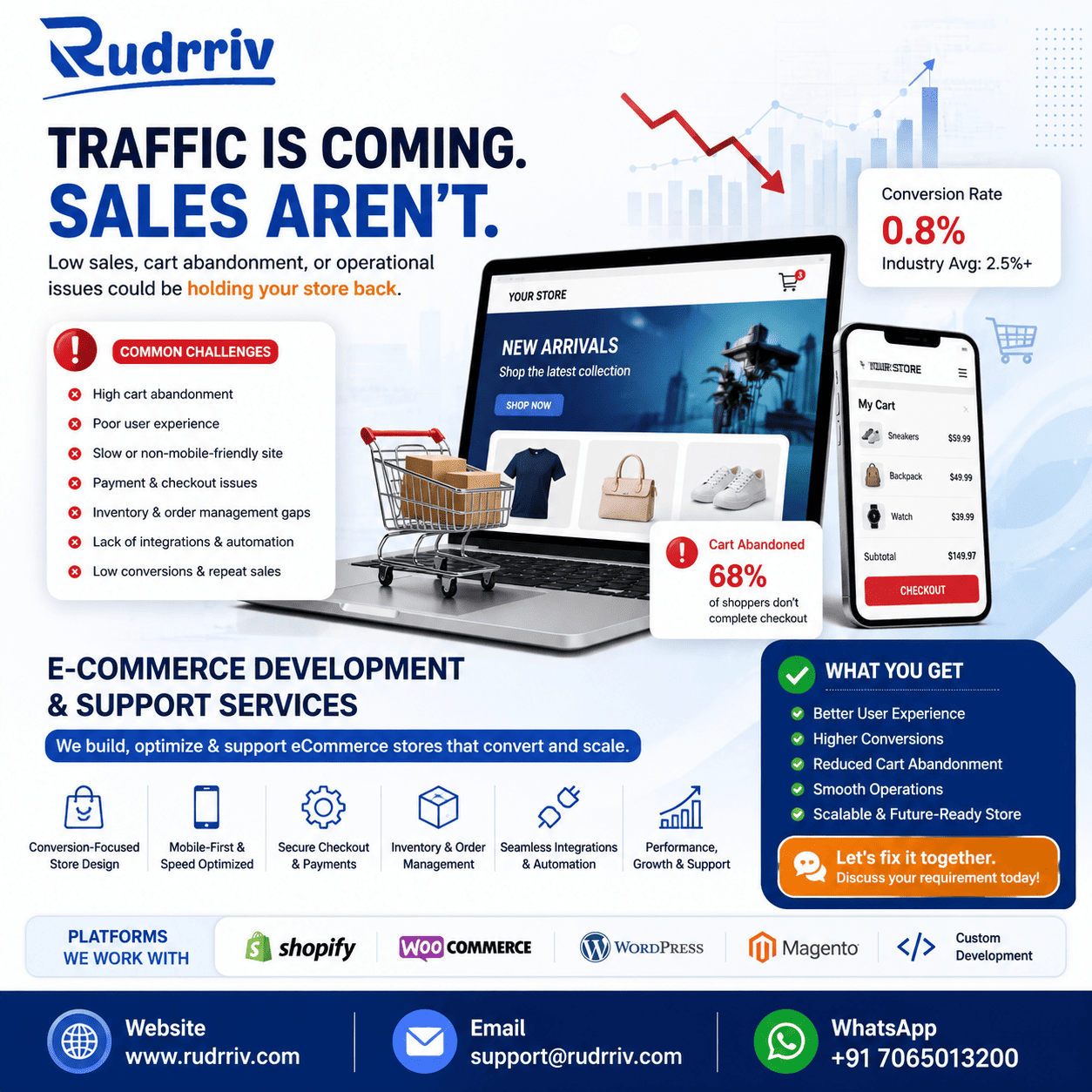
Quick Answer: Which Ecommerce Mistakes Matter Most?
The highest-priority ecommerce mistakes are those that affect many qualified shoppers, occur at a critical decision point, and can be verified with evidence. Typical examples include poor search discoverability, misleading campaign targeting, slow mobile pages, weak product information, unclear total cost, checkout errors, unsuitable recommendations, unreliable fulfilment communication, and difficult returns.
Start by mapping the customer journey from search or advertisement to product discovery, comparison, cart, checkout, delivery, support, and repeat purchase. For each stage, compare quantitative signals with customer feedback and direct testing. Then rank problems by customer impact, commercial impact, confidence in the diagnosis, implementation effort, and risk.
Do not treat conversion rate as the only success measure. A change should also be evaluated for margin, returns, support demand, customer satisfaction, repeat behaviour, accessibility, and technical stability.
Key Takeaways
- Traffic quality matters as much as volume: irrelevant keywords, feeds, audiences, or landing pages can increase visits without increasing useful demand.
- Mobile friction compounds quickly: slow pages, unstable layouts, small controls, and complicated forms weaken browsing and checkout.
- Product confidence drives conversion: unclear specifications, imagery, availability, delivery, returns, or trust information creates avoidable hesitation.
- Average order value should remain relevant and profitable: bundles and recommendations must help the customer complete the intended purchase.
- Checkout surprises are expensive: hidden charges, forced registration, payment failures, and unclear delivery dates cause late-stage abandonment.
- Retention starts before delivery: accurate promises, proactive updates, responsive support, and usable returns shape whether customers return.
- Prioritization requires evidence: combine analytics, technical checks, customer feedback, and journey testing before approving major changes.
Table of Contents
- Treat ecommerce growth as one connected system
- Fix traffic mistakes before buying more visits
- Remove product and mobile conversion friction
- Eliminate checkout uncertainty and failure
- Increase order value without damaging trust
- Protect retention after the first purchase
- Prioritize fixes with evidence and economics
- Apply the framework to realistic stores
- Use specialist support only where needed
- Summary
Treat Ecommerce Growth as One Connected System
An ecommerce store should be managed as a chain of customer decisions, because weakness at one stage changes the meaning of every later metric. High traffic with low product relevance creates poor conversion. Strong conversion with unsuitable recommendations can raise returns. Good first-purchase economics with unreliable fulfilment can destroy repeat purchasing.
| Growth lever | Common mistake | Evidence to review | Better decision |
|---|---|---|---|
| Traffic | Optimizing for visit volume rather than qualified intent | Channel, query, audience, landing page, engagement, contribution | Align acquisition promise with product and page intent |
| Conversion | Asking shoppers to resolve uncertainty themselves | Product exits, mobile recordings, search terms, support questions | Answer product, delivery, trust, and returns questions in context |
| Average order value | Using blanket discounts or irrelevant upsells | Margin, attachment rate, returns, item combinations | Recommend genuinely complementary products and bundles |
| Retention | Treating the order confirmation as the end of the journey | Delivery contacts, returns, complaints, repeat rate, cohort behaviour | Design the post-purchase experience as part of the product |
The decision rule is simple: identify the earliest meaningful point where qualified customers lose confidence or cannot progress. Fixing that point often improves several downstream metrics at once.
Fix Traffic Mistakes Before Buying More Visits
Traffic problems often originate in poor alignment between customer intent and the page presented. Stores lose organic visibility when category architecture is weak, product descriptions are duplicated, internal links do not expose important ranges, faceted navigation creates crawl waste, or structured data and merchant feeds contain inconsistent information. Paid traffic underperforms when broad audiences receive generic creative and land on pages that do not continue the advertisement’s promise.
Build pages around real shopping decisions
Category and collection pages should help customers narrow choices, understand differences, and reach suitable products. Product pages should contain original, decision-relevant information rather than only manufacturer copy. Search engines also need crawlable navigation, stable URLs, accurate canonical signals, and accessible content. Review Google Search guidance for ecommerce sites when evaluating discoverability.
Check acquisition quality before increasing budget
Segment traffic by source, campaign, query, device, geography, landing page, and new versus returning customer. A campaign should not be judged only by click-through rate or cost per visit. Review whether visitors reach relevant categories, interact with products, add suitable items, complete orders, return products, and purchase again.
Practical action: choose the five highest-spend or highest-traffic entry pages and compare the promise in the search result or advertisement with the first information visible on the landing page.
Remove Product and Mobile Conversion Friction
Conversion falls when shoppers cannot understand the product, compare options, trust the seller, or use the interface comfortably. Common mistakes include incomplete specifications, inconsistent imagery, hidden availability, weak size guidance, unclear returns, generic reviews, inaccessible controls, intrusive pop-ups, and mobile layouts that place essential actions below distractions.
Performance should be evaluated on real customer journeys, not only a home-page score. The Core Web Vitals documentation explains user-centred measures for loading, responsiveness, and visual stability. Test category, search, product, cart, and checkout templates on representative devices and network conditions.
Answer uncertainty where it occurs
Place delivery estimates near purchase decisions, show stock and variant status clearly, provide scale or size context, explain return conditions in plain language, and expose support without forcing the customer to leave the page. Accessibility is also a commercial requirement: labels, contrast, keyboard operation, error messages, and focus order should support a wider range of users. The W3C Web Content Accessibility Guidelines provide the relevant standard framework.
Eliminate Checkout Uncertainty and Failure
Late-stage abandonment commonly results from surprise costs, forced account creation, unclear delivery dates, insufficient payment methods, form validation problems, discount-code distraction, or payment failures that provide no recovery path. Because these shoppers have already shown purchase intent, checkout defects deserve urgent investigation.
- Show estimated total cost and delivery expectations before the final step.
- Allow guest checkout unless an account is essential to the service.
- Use address assistance carefully and allow manual correction.
- Preserve the cart when payment fails and explain the next action.
- Test promotions, taxes, shipping rules, stock changes, and payment methods across devices.
- Protect payment data and keep card-handling responsibilities aligned with PCI DSS requirements.
Review checkout by payment method, device, geography, delivery option, and error code. A single blended abandonment rate can hide a serious failure affecting one valuable segment.
Increase Order Value Without Damaging Trust
Average order value improves sustainably when the store helps customers complete a larger or more useful solution. It weakens when the business relies on blanket discounts, arbitrary thresholds, misleading urgency, or recommendations unrelated to the customer’s current need.
Use relevance before persuasion
Good options include compatible accessories, replenishment quantities, product bundles, tiered versions with clear differences, and delivery thresholds that remain commercially sensible. Measure recommendation click-through, attachment rate, margin, cancellations, and returns. A higher basket is not a success when customers later remove items, seek refunds, or feel manipulated.
Avoid discount dependency
Repeated discounts can train customers to delay purchases and can obscure whether the core proposition is competitive. Test non-price value such as useful bundles, service levels, warranties, samples, personalization, or convenient replenishment before assuming price is the only lever.
Protect Retention After the First Purchase
Customer retention is often lost through broken promises rather than weak loyalty campaigns. Inaccurate delivery estimates, sparse tracking, difficult support, confusing returns, inconsistent packaging, or irrelevant follow-up messages can erase the trust created during purchase.
Build post-purchase communication around customer questions: Was the order received? When will it dispatch? What changed? How can the delivery be managed? What should the customer do if the product is unsuitable or damaged? After fulfilment, use product type, lifecycle, and prior behaviour to determine whether replenishment, education, complementary items, or no immediate message is appropriate.
| Retention mistake | Customer effect | Operational correction |
|---|---|---|
| Promising dates the operation cannot meet | Loss of trust before delivery | Connect storefront promises to inventory and fulfilment reality |
| Making returns difficult to understand | Purchase hesitation and support escalation | Explain eligibility, process, timing, and refund method clearly |
| Sending generic promotions immediately | Message fatigue and low relevance | Use purchase context, expected product lifecycle, and consent |
| Ignoring service themes | Repeated preventable defects | Feed support and return reasons into product, content, and operations |
Prioritize Fixes with Evidence and Economics
Prioritization should balance customer impact, business value, confidence, effort, and risk. Begin with instrumentation quality: confirm that analytics events, consent behaviour, order data, payment outcomes, returns, and customer identifiers are sufficiently reliable for the decision. Then combine data with usability testing, customer interviews, onsite search terms, support contacts, review themes, and technical diagnostics.
- Define the broken customer outcome. Describe what the shopper cannot understand or complete.
- Locate the affected segment. Identify device, channel, category, geography, or customer type.
- Confirm the likely cause. Use at least two evidence sources where practical.
- Estimate commercial exposure. Consider volume, margin, returns, support, and retention.
- Select the smallest useful intervention. Avoid a full redesign when a focused change can validate the hypothesis.
- Set guardrail metrics. Monitor quality, accessibility, margin, errors, and downstream behaviour.
- Document ownership and handover. Ensure design, code, analytics, content, and operational changes remain maintainable.
Apply the Framework to Realistic Stores
A startup buying traffic before validating product pages
A new direct-to-consumer store assumes low sales require more advertising. Campaign clicks are acceptable, but mobile visitors leave product pages quickly and customer questions repeatedly concern sizing and delivery. The better decision is to improve product evidence, size guidance, delivery clarity, and mobile performance before increasing spend. Design and analytics specialists may help validate the page structure and measurement.
An established retailer using blanket discounts
A retailer raises average order value through a sitewide threshold, but margin declines and return rates rise. Basket analysis shows customers add low-relevance items merely to qualify. The better decision is to test category-specific bundles and compatible recommendations, while evaluating contribution margin and returns rather than basket value alone.
A specialist store losing repeat customers
First-order conversion is healthy, but repeat purchase is weak. Support logs reveal inconsistent dispatch updates and confusing returns. The business initially plans a loyalty programme, yet the better decision is to repair fulfilment communication, return instructions, and issue resolution first. Retention marketing should follow only after the basic experience is dependable.
Use Specialist Support Only Where Needed
External support is relevant when the diagnosis crosses ecommerce strategy, UX, analytics, content, platform engineering, quality assurance, or operational integration. Before commissioning work, define the customer problem, available evidence, desired outcome, constraints, dependencies, ownership, acceptance criteria, budget, timeline, maintenance responsibility, and handover requirements.
Rudrriv can support focused ecommerce design and development work through design specialists and development specialists. The appropriate model may be a defined diagnostic project, implementation support, a dedicated professional, or ongoing technical assistance; it should match the verified problem rather than expand the scope unnecessarily.
Summary
Common ecommerce mistakes reduce growth when acquisition, onsite experience, checkout, merchandising, and post-purchase operations are optimized separately. The strongest improvement plan finds the earliest verified point of customer friction and fixes it without creating new problems elsewhere.
Improve traffic by aligning intent, landing pages, catalogue structure, feeds, and discoverability. Improve conversion by making products understandable and mobile journeys usable. Improve average order value through relevant solutions rather than pressure. Improve retention by delivering accurate promises, clear communication, responsive support, and practical returns.
Before development begins, validate the problem, affected segment, commercial exposure, scope, budget, timeline, ownership, quality assurance, maintenance, and handover. A focused intervention is often safer than a complete redesign when the evidence supports a specific change.
Frequently Asked Questions
What are the most common ecommerce mistakes that reduce traffic, conversion rates, average order value, and customer retention?
The most damaging mistakes are weak search visibility, slow or confusing mobile experiences, unclear product information, unexpected checkout costs, limited payment or delivery options, poor merchandising, weak post-purchase communication, and failure to learn from customer behaviour. Audit the complete journey—from discovery to repeat purchase—rather than treating traffic, conversion, order value, and retention as separate problems.
Why can an ecommerce store lose traffic even when products are good?
Strong products do not guarantee discoverability. Traffic can fall when category pages are thin, product pages duplicate manufacturer copy, internal linking is weak, important pages are blocked or poorly indexed, or paid campaigns send users to irrelevant landing pages. Check search visibility, feed quality, campaign targeting, and landing-page relevance together.
Which ecommerce conversion mistakes should be fixed first?
Fix obstacles that affect many shoppers and occur close to purchase first: mobile usability failures, slow key pages, unclear pricing, unavailable stock information, forced account creation, checkout errors, and surprise shipping charges. Use analytics, session evidence, customer-service contacts, and checkout testing to confirm the problem before redesigning the entire store.
How can an online store increase average order value without aggressive discounting?
Use relevant bundles, complementary recommendations, quantity options, useful thresholds, and clear value comparisons. Recommendations should support the shopper’s original task, not distract from it. Measure margin and return behaviour as well as basket size, because a larger order is not valuable when it creates excessive discounting or unsuitable purchases.
What customer-retention mistakes are common after checkout?
Common errors include vague delivery updates, difficult returns, generic email sequences, poor support handoffs, and promotions that ignore purchase history. Retention improves when the post-purchase experience reduces uncertainty, resolves problems quickly, and gives customers a relevant reason to return rather than sending repeated blanket discounts.
Does site speed directly affect ecommerce performance?
Speed affects whether shoppers can browse, compare, and complete checkout without frustration, especially on mobile or slower connections. It is one factor among many, not a standalone guarantee. Review real-user performance for product, category, cart, and checkout pages, then prioritize issues that block interaction or cause layout instability.
How often should an ecommerce business audit its customer journey?
Review key performance signals continuously and conduct a structured journey audit at least quarterly, with additional checks before major campaigns, platform changes, catalogue migrations, or peak seasons. High-volume stores may need more frequent reviews. The audit should cover acquisition quality, onsite behaviour, checkout, fulfilment, support, returns, and repeat purchasing.
Should an ecommerce store redesign the whole website to improve conversion?
Not automatically. A full redesign can introduce new risk and obscure which changes created improvement. Start with evidence, isolate the highest-impact friction, test focused changes, and retain proven elements. A broader redesign is justified when the information architecture, platform constraints, brand system, or technical foundation prevents incremental improvement.
Which metrics should be reviewed together for ecommerce growth?
Review qualified traffic, product and category engagement, add-to-cart rate, checkout progression, conversion rate, average order value, gross margin, return rate, repeat purchase rate, customer acquisition cost, and customer-support themes. Segment by device, channel, customer type, geography, and product category so averages do not hide a serious local problem.
When should an ecommerce business seek specialist support?
Specialist help is useful when data is fragmented, the platform limits essential changes, performance problems cross design and development, or the team cannot diagnose why growth has stalled. Define the business problem, available evidence, ownership, scope, budget, timeline, quality checks, and handover expectations before selecting external support.
Need Help Diagnosing Ecommerce Friction?
Share the affected customer journey, available analytics, platform constraints, and the outcomes your team needs to improve. Rudrriv can help define a focused discovery, design, development, or ongoing-support scope with clear ownership and practical delivery controls.
Discuss your requirementAt Rudrriv, we make it easier for businesses to access the right expertise, execute important work, and scale with confidence.