
How Long Content Marketing Takes to Show Results
How long content marketing takes to produce measurable results and what affects performance depends on what the business calls a result. A team can measure publication quality, indexation, engagement, distribution response, and lead-path activity within weeks. More durable outcomes—such as consistent non-branded search visibility, qualified organic traffic, sales-pipeline influence, and lower dependence on paid acquisition—normally require several months of disciplined work.
The practical starting point is not a universal promise such as “results in 90 days.” It is a measurement ladder. First verify that useful content is being produced and discovered. Then test whether the right audience engages with it. Next measure whether content assists enquiries, sales conversations, account expansion, or another defined business action. The timeline becomes meaningful only when each stage has a clear baseline and owner.
Performance is shaped by the website’s existing authority, topic competition, audience demand, buying-cycle length, content usefulness, subject-matter access, technical health, distribution, internal linking, conversion design, budget, and consistency. A mature brand with an established audience may see traction faster than a new website entering a crowded category, even when both publish equally strong work.
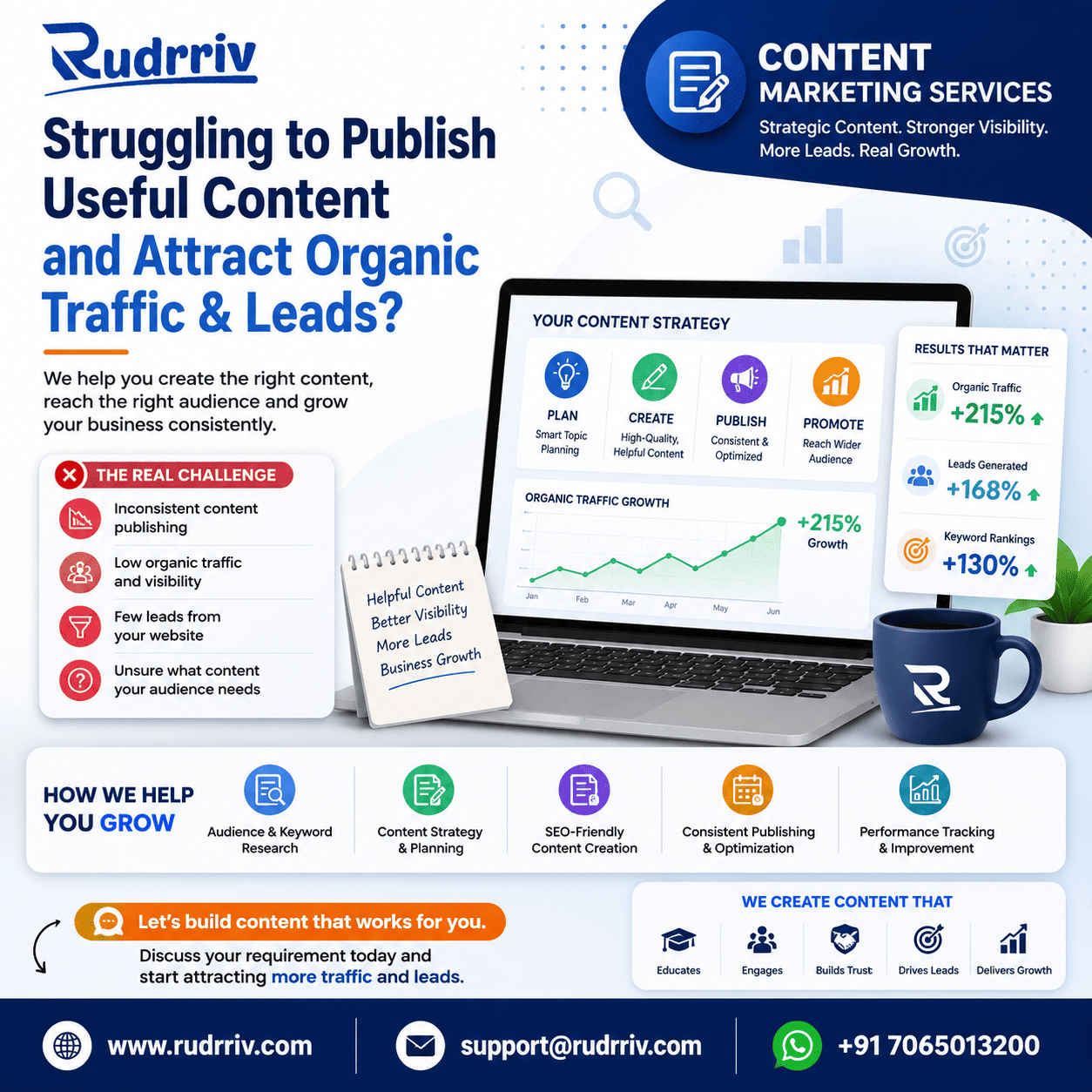
Quick Answer: When Content Marketing Shows Results
Useful leading indicators can appear within 30 to 60 days when the strategy, tracking, production, and distribution are ready. These indicators include content published, impressions, indexation, engaged sessions, email subscriptions, sales-team use, and early conversion activity.
Meaningful organic growth often needs a broader three-to-nine-month observation window. Highly competitive markets, long buying cycles, new domains, limited expertise, weak promotion, or technical problems can extend that period. Established brands, strong distribution networks, distinctive first-hand expertise, and focused topic selection can shorten the learning cycle.
Judge the programme in stages. Review execution immediately, audience response after enough distribution, organic visibility after search systems have had time to discover and reassess the content, and commercial contribution across the full buying cycle. Do not wait passively: improve weak topics, titles, internal links, calls to action, and distribution while evidence accumulates.
Key Takeaways
- Results have different clocks: production and engagement signals appear before dependable traffic or pipeline contribution.
- Three to nine months is a planning range, not a guarantee: market conditions and starting position can make progress faster or slower.
- Existing authority matters: established sites and recognised experts usually begin with more discoverability and trust.
- Distribution is part of the work: publishing without email, social, partnerships, sales enablement, or internal promotion slows learning.
- Measurement must connect to the buying journey: traffic alone cannot show whether content supports decisions or revenue.
- Quality includes usefulness and differentiation: original evidence, clear expertise, and complete answers are more defensible than volume.
- Optimisation is continuous: updates, consolidation, internal links, conversion improvements, and content retirement affect long-term performance.
Table of Contents
- A realistic content marketing timeline
- What measurable results should include
- Why performance speed differs
- Milestones by business stage
- A 90-day implementation plan
- Content marketing vs paid promotion
- Budget, people, and production capacity
- How to measure performance correctly
- Mistakes that delay results
- Summary and next decision
A Realistic Content Marketing Timeline
A useful timeline separates operational progress from market response. During the first month, the team should establish audience priorities, content themes, baselines, analytics, conversion events, editorial standards, subject-matter access, and a distribution process. The first outputs should prove that the workflow can produce accurate and genuinely useful material.
Between months two and three, the focus shifts to response. Look for query impressions, engaged visits, recurring audience behaviour, newsletter growth, sales-team adoption, backlinks or mentions earned naturally, and the first assisted conversions. These are not final outcomes, but they reveal whether the content is reaching the intended audience and answering relevant questions.
From months four to six, a consistent programme should have enough evidence to compare themes, formats, channels, authors, and conversion paths. Some pages may begin to compound through search visibility and internal linking. Others may need rewriting, stronger evidence, better distribution, or consolidation.
Beyond six months, the question becomes whether the programme is building an asset: a recognisable body of expertise that attracts, educates, and converts priority audiences more efficiently over time. Long-term performance depends on maintaining useful pages, filling genuine topic gaps, and retiring content that no longer serves a clear purpose.
| Period | What should be happening | Useful evidence | Decision |
|---|---|---|---|
| Weeks 1–4 | Strategy, baselines, tracking, workflow, first production | Quality reviews, publication pace, indexation, channel readiness | Can the team execute reliably? |
| Months 2–3 | Distribution, audience learning, early optimisation | Impressions, engagement, subscriptions, assisted actions | Are the topics and formats resonating? |
| Months 4–6 | Topic expansion, internal linking, updates, conversion tests | Qualified traffic trends, returning users, lead-path contribution | Which themes deserve more investment? |
| Months 7–12 | Compounding coverage, refresh cycles, portfolio management | Durable visibility, pipeline influence, content-assisted sales | Is the programme creating a defensible asset? |
What Measurable Content Results Should Include
Measurable results should include both leading and lagging indicators. Leading indicators show whether the programme is creating the conditions for performance. Lagging indicators show whether the content contributes to business outcomes after the audience has had time to discover, evaluate, and act.
Use the Google Search Console performance report to review search queries, pages, clicks, impressions, and changes in visibility. Configure meaningful actions in analytics using recommended Google Analytics events, then connect those actions to the buying journey.
- Execution: planned items completed, editorial quality, review time, and subject-matter participation.
- Discovery: indexation, search impressions, referrals, mentions, and distribution reach.
- Engagement: useful reading behaviour, return visits, subscriptions, downloads, and content journeys.
- Conversion: enquiries, demos, purchases, qualified sign-ups, assisted conversions, and sales usage.
- Efficiency: cost per useful asset, reuse across channels, maintenance burden, and contribution over time.
Why Content Performance Speeds Differ
The starting position is often the strongest explanation. A recognised brand with a large email list, active customers, trusted experts, and an established domain can distribute new content immediately. A new business must build audience access, authority, and topical coverage at the same time.
Competition and search demand
Broad commercial topics attract many experienced publishers. Narrow questions with clear audience value may offer a faster path to learning. Use Google Trends alongside customer interviews, sales questions, and internal search data to distinguish durable demand from temporary interest.
Expertise and originality
Content based on first-hand experience, proprietary data, expert interpretation, or a distinctive operating method is easier to differentiate. Google’s guidance on helpful, reliable, people-first content emphasises usefulness, original value, clear sourcing, and trustworthy expertise rather than publishing for search engines alone.
Buying-cycle length
A low-consideration purchase may convert during the first visit. An enterprise technology, professional service, or high-value B2B decision may involve months of research and several stakeholders. Content can influence that journey before a lead form or sales opportunity appears, so attribution windows must reflect real behaviour.
Technical and conversion readiness
Slow pages, poor mobile usability, weak internal linking, duplicate content, crawl barriers, unclear offers, and broken analytics reduce measurable performance. Content strategy cannot compensate indefinitely for a website that prevents discovery or makes the next action difficult.
Milestones Change by Business Stage
A startup validating demand should not copy the publishing plan of an established enterprise. The correct milestone depends on the business question being answered.
| Business stage | Primary content goal | Early milestone | Longer-term proof |
|---|---|---|---|
| New startup | Validate audience problems and language | Useful conversations, sign-ups, sales feedback | Repeatable demand and a focused topic position |
| Growing SMB | Build qualified demand and sales support | Engaged traffic, lead assists, content reuse | Pipeline influence and lower acquisition dependence |
| Ecommerce business | Improve discovery and purchase confidence | Category engagement, product education, email growth | Assisted sales, repeat purchase, organic category demand |
| Established enterprise | Strengthen authority across complex journeys | Stakeholder use, expert participation, topic coverage | Share of relevant demand and measurable account influence |
Example 1: A new professional-services firm publishes broad thought leadership but receives little qualified traffic. The better decision is to focus on the exact questions prospects ask before hiring, capture expert answers, and distribute them through founder networks and email. Early success is better sales conversations, not immediate high-volume search traffic.
Example 2: An ecommerce company already has demand but weak category education. Detailed buying guides, comparison content, and improved internal links may influence discovery and conversion faster because the site already has products, customers, and transaction data. Performance should be measured by assisted purchases and category journeys, not only article sessions.
Build a 90-Day Learning System
The first 90 days should create a reliable learning system rather than a large content library. Start with a small set of commercially relevant audience questions, assign subject-matter owners, define quality standards, and establish measurement before scaling.
- Days 1–30: define audiences, decisions, topic priorities, baselines, conversion events, editorial roles, and distribution channels.
- Days 31–60: publish the first focused cluster, distribute it actively, collect customer and sales feedback, and fix technical or conversion barriers.
- Days 61–90: compare themes and formats, update weak pages, strengthen internal links, document repeatable workflows, and decide what to expand or stop.
Do not lock the full annual plan before the first evidence arrives. Reserve capacity for updates, experiments, and unexpected customer questions. A content programme improves when research, production, distribution, measurement, and revision operate as one cycle.
Content Marketing vs Paid Promotion
Paid promotion can produce reach immediately, while content marketing is designed to build reusable assets and accumulated audience value. They solve different timing problems and often work better together.
| Dimension | Content marketing | Paid promotion |
|---|---|---|
| Speed of reach | Usually gradual | Immediate after launch |
| Duration | Can continue producing value when maintained | Usually declines when spending stops |
| Learning | Builds insight through ongoing audience behaviour | Supports rapid message and audience testing |
| Cost pattern | Upfront and ongoing production, expertise, distribution, maintenance | Media spend plus creative, landing-page, and optimisation costs |
| Best use | Education, authority, search discovery, sales enablement | Launches, targeted reach, demand capture, retargeting |
Example 3: A B2B software company needs pipeline this quarter but also wants lower long-term acquisition dependence. It can use paid campaigns for immediate demand capture while building expert comparison pages, implementation guidance, and customer education. The channels should have separate measurement, with shared learning on messaging and audience quality.
Budget, People, and Capacity Affect Speed
Content performance is constrained by the slowest critical resource. A budget may fund writers but still fail if experts cannot contribute, legal reviews take weeks, design support is unavailable, or no one owns distribution and analytics.
Plan for strategy, research, expert interviews, writing, editing, design, search optimisation, publishing, distribution, analytics, updates, and governance. Not every organisation needs separate people for each task, but every responsibility needs an owner and enough capacity.
Decision rule: reduce publishing volume before reducing research, accuracy, differentiation, or distribution. A smaller portfolio of useful, maintained assets is easier to measure and improve than a large backlog of shallow pages.
Measure Content Without Misreading the Data
Start with a baseline and a measurement hierarchy. Compare like-for-like periods, account for seasonality, and segment performance by topic, audience, page type, source, and intended action. A single total-traffic chart can hide both strong commercial pages and irrelevant growth.
- Use annotations for launches, campaigns, site changes, and major updates.
- Separate branded from non-branded discovery where possible.
- Review assisted and multi-session journeys for longer buying cycles.
- Combine analytics with sales feedback, customer interviews, and content-use evidence.
- Evaluate portfolios and topic clusters, not only individual pages.
- Document assumptions so the team knows what the data can and cannot prove.
Attribution will remain imperfect. The aim is not to assign every sale to one article; it is to make progressively better investment decisions using multiple forms of evidence.
Mistakes That Delay or Hide Results
The most damaging mistake is publishing without a defined audience decision. Other delays come from chasing broad keywords too early, copying competitors, measuring only sessions, neglecting distribution, changing direction before evidence accumulates, and leaving strong pages unmaintained.
Another common error is treating volume as strategy. A high publishing cadence can consume review and promotion capacity while creating overlapping pages that compete with each other. Consolidation, internal linking, and updates often improve a mature library more than adding another similar article.
Finally, do not reset the clock after every organisational change. Preserve baselines, annotations, ownership, source files, briefs, performance history, and update decisions so the programme can learn across team transitions.
How Rudrriv Can Support the Programme
External support is relevant when a business has clear audience and commercial priorities but lacks specialist capacity across strategy, research, writing, design, analytics, or ongoing optimisation. Rudrriv can help structure a defined content project, provide dedicated specialist support, or coordinate an ongoing team around agreed responsibilities, review cycles, ownership, measurement, and handover.
The engagement should begin with the audience, business decision, existing evidence, internal expertise, approval process, distribution capacity, and measurement readiness. Explore specialist talent options or outsourcing support only when those models match the actual capacity gap.
Summary: Set Milestones, Not Promises
Content marketing can produce early operational and audience signals within weeks, but dependable organic visibility and commercial contribution usually need several months. The correct timeline depends on the starting authority, competitive difficulty, buying cycle, quality, expertise, technical readiness, distribution, conversion design, and available resources.
Use the first 90 days to establish strategy, measurement, production, distribution, and a learning rhythm. Evaluate execution first, audience response next, and business contribution across the full decision journey. Continue only what evidence supports, and improve or retire work that does not serve a clear audience need.
Before increasing investment, confirm scope, budget, timeline, ownership, quality review, analytics, maintenance, and handover. These controls make performance easier to interpret and reduce dependence on unrealistic result promises.
FAQs About Content Marketing Results
How long does content marketing take to produce measurable results?
Most businesses can measure execution and early audience response within the first month, but dependable organic visibility, qualified traffic, lead contribution, and commercial influence usually require several months of consistent publishing, distribution, and improvement. The exact pace depends on existing authority, competition, content quality, promotion, conversion paths, and measurement discipline. Set milestone ranges rather than promising a fixed result date.
Can content marketing show useful results within 30 days?
Yes, but the useful results are usually leading indicators: content published, indexation, engagement, email sign-ups, sales-team use, referral activity, and early query impressions. A 30-day period is generally too short to judge the full organic-search or revenue effect. Use it to verify execution quality, tracking, audience response, and whether the programme is learning quickly.
Why do some content marketing programmes take longer than others?
Programmes take longer when the website has little authority, the market is highly competitive, the buying cycle is long, subject-matter access is weak, publishing is inconsistent, or content is not distributed. Technical barriers, unclear offers, slow approvals, and poor conversion paths also delay measurable impact. Diagnose these constraints before increasing content volume.
How often should a business publish content to get results?
Publish at a pace the team can sustain without sacrificing usefulness, accuracy, and promotion. One strong article supported by distribution and updates can outperform several shallow pieces. The right cadence depends on topic demand, internal expertise, review capacity, competitive pressure, and channel mix. Consistency and coverage matter more than an arbitrary weekly target.
Which metrics should be used in the first three months?
Track production quality, publication pace, indexation, impressions, engaged sessions, returning users, newsletter growth, assisted conversions, sales usage, and conversion-path performance. Separate leading indicators from business outcomes. Compare trends by topic, format, audience segment, and distribution channel rather than relying on total traffic alone.
Does a new website need more time for content marketing to work?
Usually. A new website often has limited authority, few internal links, little branded demand, and limited historical performance data. It may need more time to build topical coverage and earn recognition. A focused niche, strong expertise, useful original information, and active distribution can improve the learning cycle, but they do not remove the need for sustained execution.
Can paid promotion make content marketing results appear faster?
Paid promotion can generate immediate reach, traffic, and audience feedback, but it does not automatically create durable organic performance. Use paid distribution to test messages, reach priority audiences, support launches, or retarget engaged visitors. Evaluate paid and organic effects separately so temporary media-driven traffic is not mistaken for long-term content momentum.
When should underperforming content be updated or replaced?
Review content after it has had enough time to be discovered and promoted, then examine query relevance, engagement, conversion contribution, freshness, internal links, and competitive quality. Update a page when the intent remains valid but the answer, evidence, structure, or offer is weak. Consolidate or retire content when it duplicates stronger pages or no longer serves a real audience need.
What is the biggest mistake when judging content marketing performance?
The biggest mistake is judging the programme only by short-term traffic or by the number of items published. Content can create value through sales enablement, email growth, branded demand, assisted conversions, customer education, and reduced buying friction. Define the intended business role first, then use a balanced measurement model and an appropriate observation window.
When should a business seek external content marketing support?
External support is useful when strategy, specialist writing, design, analytics, search optimisation, distribution, or production capacity is missing internally. Before engaging support, define the audience, commercial priorities, subject-matter access, approval process, measurement plan, and ownership. A clear scope makes it easier to select a defined project, dedicated specialist, or ongoing support model.
Need a Clearer Content Performance Plan?
Share your audience, business priorities, current content, internal capacity, and measurement challenges. Rudrriv can help define a focused scope and the specialist support needed to execute and improve it responsibly.
Discuss your requirementAt Rudrriv, we make it easier for businesses to access the right expertise, execute important work, and scale with confidence.