
How to Choose a Secure, Scalable Outsourcing Partner
Knowing how to choose an outsourcing partner based on expertise, process quality, security, communication, and scalability starts with one practical rule: evaluate the provider against the work and risk you will actually transfer, not against a generic capability presentation. The right partner should show relevant expertise, make its operating process inspectable, protect access and information, communicate in a way your team can govern, and add capacity without allowing quality to drift.
The main caution is that a provider can appear strong in one area while creating unacceptable exposure in another. A technically capable team may have weak access controls. A highly certified supplier may assign inexperienced staff. A responsive account manager may compensate for an unclear delivery process only until the workload grows. Selection therefore needs both pass-or-fail requirements and a comparative scorecard.
Begin by defining the outcome, scope boundaries, data sensitivity, systems involved, service levels, internal owners, likely demand changes, and exit needs. Then ask each shortlisted provider for evidence that can be tested through references, working sessions, sample deliverables, security due diligence, and a representative pilot. This guide provides the questions, comparison criteria, and practical decision rules needed to do that.
Quick Answer: Choosing an Outsourcing Partner
Choose an outsourcing partner only after it has demonstrated five things with evidence: people who have handled comparable work; a documented process with clear quality and change controls; security practices matched to your data and system access; communication routines that work across real time zones and stakeholders; and a capacity model that can grow without replacing experienced people with unapproved resources.
Treat security, legal eligibility, and essential service continuity as minimum gates. Do not allow a high score in expertise or price to offset a failure in access control, data ownership, incident response, regulatory obligations, or exit readiness. Among providers that clear those gates, compare delivery quality, communication, scalability, and total operating cost.
For a material engagement, use paid discovery or a limited pilot before scaling. Give the provider representative work, realistic dependencies, named decision-makers, measurable acceptance criteria, and only the access needed for the test. Expand the relationship when the evidence supports it, not simply because the proposal was persuasive.
Key Takeaways
- Define the transferred responsibility first: the provider cannot be evaluated properly until the outcome, boundaries, dependencies, access, and acceptance criteria are clear.
- Relevant expertise is role-specific: verify the people assigned to your work, not only the company portfolio or sales team.
- Process quality must be observable: requirements, planning, quality assurance, change control, reporting, escalation, and handover should leave usable evidence.
- Security is a minimum gate: access, data handling, incident response, subcontractors, privacy, and exit controls must match the risk of the engagement.
- Communication should be tested: assess written clarity, working-hour overlap, escalation behavior, decision logging, and early risk reporting during a pilot.
- Scalability needs safeguards: added capacity should preserve skill standards, knowledge, supervision, and service levels.
- Compare total operating cost: include transition effort, internal oversight, quality failures, tools, rework, knowledge transfer, and exit—not only the quoted rate.
Table of Contents
- Define the work before comparing partners
- Verify expertise against the work
- Test process quality and governance
- Assess security and data handling
- Judge communication in real conditions
- Confirm scalable capacity and continuity
- Compare cost, capacity, and engagement fit
- Use a pilot before scaling delivery
- Apply the framework to practical scenarios
- Summary: select for control and growth
Define the Work Before Comparing Outsourcing Partners
A useful provider comparison begins with a written service requirement. State what the partner will own, what remains with your team, what inputs are required, which systems or data are involved, who can approve changes, and how completed work will be accepted. Without this baseline, each bidder may price a different interpretation of the assignment.
Separate the requirement into four layers: the business outcome, the work products or services, the operating conditions, and the risk constraints. For example, “provide customer support” is too broad. A usable requirement identifies channels, languages, operating hours, case types, expected volumes, escalation boundaries, tools, data categories, quality standards, and the decisions the provider may or may not make.
Decide whether outsourcing is suitable
Outsourcing is suitable when external expertise or capacity can be governed more effectively than it can be built internally within the required time. A defined project can work for a bounded outcome. A dedicated specialist can fill a skill gap. Ongoing support can cover recurring work. A managed team can take responsibility for a coordinated service. In-house hiring may be preferable when the work is inseparable from core leadership decisions, requires constant informal context, or creates risk that cannot be acceptably transferred.
Use the following scorecard only after mandatory legal, security, and continuity requirements have been met. The weights are an illustrative starting point; adjust them to the consequences of failure in your engagement.
| Criterion | Evidence to request | Strong signal | Warning signal | Illustrative weight |
|---|---|---|---|---|
| Expertise | Named team profiles, comparable work, samples, references, technical discussion | Explains trade-offs and constraints specific to your work | Relies on broad claims or substitutes sales credentials for delivery evidence | 25% |
| Process quality | Workflow, quality checks, change control, reporting, defect and handover examples | Responsibilities, inputs, outputs, and acceptance rules are explicit | Process exists only as a high-level diagram with no operating evidence | 20% |
| Security | Access model, policies, incident process, audit evidence, subcontractor controls | Controls match the data, systems, and impact of the engagement | Certification is presented as a substitute for answering risk-specific questions | 25% |
| Communication | Meeting rhythm, status format, overlap hours, escalation path, decision log | Raises uncertainty early and records ownership clearly | Updates are activity lists without decisions, risks, or next actions | 15% |
| Scalability | Capacity plan, hiring standards, backup roles, onboarding, knowledge system | Growth preserves supervision, skill standards, and continuity | Additional volume is passed to unnamed or unapproved resources | 15% |
Do not collapse the result into one number without judgment. A provider that fails a critical security requirement should not win because it scored well elsewhere. Use the score to structure discussion, then record the reasons for the decision.
Verify Expertise Against Your Actual Work
Relevant expertise means the assigned people can perform the specific work under your constraints. Industry familiarity can help, but it is not enough. A provider may understand ecommerce terminology yet lack experience with high-volume catalogue operations, regulated customer data, multilingual support, or the technology stack your team uses.
Ask the provider to walk through a comparable problem from requirement to handover. Listen for the decisions made, alternatives rejected, quality checks used, dependencies managed, and lessons learned. Request sanitized samples where confidentiality permits. Speak with references about the quality of the work, the stability of the assigned team, and how the provider behaved when something went wrong.
Verify the team, not only the company
Record the names or role profiles of the people expected to lead and perform the work. Clarify senior-review time, replacement rules, subcontracting, location, language capability, and availability. Include approval requirements for material team changes. If the provider cannot name the likely delivery roles or explain how skills will be matched, the proposal is not ready for commitment.
A strong expert should also identify where the requirement is incomplete. Thoughtful questions about edge cases, data, dependencies, user impact, acceptance, or maintenance are often more valuable than instant agreement with every requested feature or task.
Test Process Quality Before Trusting the Proposal
Process quality is the provider’s ability to turn requirements into repeatable, reviewable outcomes. It should remain visible in working documents and systems—not only in a methodology slide. Ask how work enters the system, who validates it, how priorities are set, where decisions are recorded, how quality is checked, and how accepted work is released or handed over.
For project work, inspect discovery, estimation, planning, review, testing, acceptance, and change-control practices. For ongoing operations, inspect queue management, service levels, sampling, coaching, incident handling, trend review, and continuous improvement. In both cases, define what evidence the client receives and how quickly a disagreement or defect is escalated.
Practical rule: ask the shortlisted provider to demonstrate one real workflow using a representative task. A credible process should show the input, owner, status, quality check, approval, output, and audit trail without requiring a long verbal explanation.
Make ownership and acceptance explicit
Use a responsibility matrix or equivalent written allocation for client and provider duties. Specify who supplies source information, approves scope changes, owns environments and accounts, accepts deliverables, and resolves blockers. Tie acceptance to observable criteria. “High quality” is not an acceptance test; a defined checklist, response standard, test result, reconciliation, or approved sample is.
Maintenance and handover should be part of the process from the beginning. Require current documentation, change history, repository discipline, decision records, and knowledge transfer throughout the engagement. This reduces dependence on individual team members and makes scaling or exit more controlled.
Treat Security as a Contracted Operating Requirement
Security should be proportionate to the information, systems, decisions, and business continuity placed with the provider. Begin with a risk classification: what can the provider access, what could go wrong, how quickly would harm occur, and what recovery would be required? Then translate the answers into minimum controls, evidence requests, contract terms, and ongoing review.
Useful reference points include the NIST supplier due diligence guidance, the UK NCSC supplier assurance questions, and CISA procurement guidance for secure technology. These resources support a risk-based discussion with suppliers; they do not remove the need to adapt controls to your engagement.
Check controls, evidence, and responsibility
Depending on the scope, review identity and access management, multi-factor authentication, device security, encryption, network protection, logging, vulnerability management, secure development, backup and recovery, incident response, privacy, data retention, business continuity, personnel screening where lawful, and subcontractor management. Ask who owns each control and how exceptions are approved.
An ISO/IEC 27001 information security management system certification can contribute useful assurance, but it is not a universal guarantee. Confirm the certification scope, issuing body, dates, locations, services covered, and whether the controls relevant to your work are included. Request additional evidence when the risk warrants it.
Contract terms should cover incident notification, cooperation, audit or assurance rights, data location where relevant, return or deletion of data, access revocation, subcontractor obligations, confidentiality, intellectual-property ownership, and transition support. Use individual accounts and least-privilege access; avoid shared credentials and unnecessary production access.
Judge Communication in Real Working Conditions
Good communication is not constant messaging. It is the timely transfer of decisions, risks, evidence, and actions to the people who need them. Define the operating rhythm: status frequency, working-hour overlap, response targets, meeting purpose, escalation path, decision authority, and the format for risks, dependencies, and changes.
Evaluate communication behavior during discovery or a pilot. Does the team confirm assumptions in writing? Does it distinguish facts from estimates? Does it raise a likely delay before the deadline? Can specialists explain technical issues to business stakeholders? Are actions assigned with owners and dates? These behaviors predict governance quality better than a polished introductory call.
Account for users, customers, and time zones
When the provider interacts with customers or internal users, assess language clarity, cultural context, empathy, accessibility, escalation judgment, and handling of sensitive situations. Review samples or simulations that resemble actual interactions. For distributed teams, define where asynchronous documentation is required and where live overlap is essential. A low-cost time-zone model can become expensive if every decision waits a full day.
Confirm Scalability Without Accepting Quality Drift
Scalability means the provider can increase or reduce capacity while maintaining agreed capability, control, and continuity. Headcount alone does not prove this. Ask for a capacity model that explains demand forecasting, recruitment or allocation lead times, skill standards, onboarding, supervision, quality sampling, backup roles, and how institutional knowledge is preserved.
Test both growth and disruption. What happens if volume doubles, a key specialist leaves, a delivery location is unavailable, or a new language or technology is added? The provider should explain which service levels can be protected, which assumptions must change, and how the client will approve additional cost or team changes.
Use scalable engagement models deliberately
A defined project suits a bounded deliverable with clear acceptance. A dedicated professional suits sustained work that benefits from close integration with your team. Ongoing support suits recurring needs with variable volume. A managed team suits a broader outcome requiring several roles, coordination, quality governance, and continuity. Select the model that matches responsibility, not the one with the most attractive label.
For startups, begin with the smallest model that can test the business assumption. Growing SMBs may need dedicated or ongoing support once demand becomes predictable. Enterprise programmes usually require stronger governance, resilience, security assurance, service management, and transition planning before volume is moved.
Compare Total Cost, Capacity, and Engagement Fit
Normalize proposals before comparing price. Require each provider to state scope, roles, estimated effort or capacity, location, working hours, management coverage, quality assurance, tools, third-party charges, security obligations, assumptions, exclusions, change rates, transition effort, and exit support. A cheaper proposal may simply omit work another provider has included.
Total operating cost also includes your internal product owner, subject-matter experts, approvals, access administration, training, review, rework, delays, and knowledge-transfer effort. Consider the business cost of poor continuity or weak control, but avoid speculative savings claims. Compare scenarios using the same demand and risk assumptions.
Match commercial terms to uncertainty
Use fixed-price terms when the outcome and acceptance criteria are stable enough to estimate. Use time-and-materials or capacity-based terms when priorities will evolve and the client can govern the backlog. Use service-based pricing when volumes, service levels, and quality measures are defined. Hybrid structures can separate discovery from delivery or base capacity from variable demand.
Document rate changes, currency, taxes, invoicing, minimum commitments, ramp-up and ramp-down notice, overtime, unused capacity, travel, tools, and termination assistance. The commercial model should encourage the behavior you need rather than reward speed without quality or activity without outcomes.
Use a Pilot to Validate Delivery Before Scaling
A pilot should reduce a specific uncertainty. It is not a discounted version of the full engagement. Select work that represents the real complexity, dependencies, quality expectations, and communication pattern. Limit data and system access, but do not make the test so artificial that it proves nothing.
Define the pilot decision before it begins. Useful criteria may include requirement understanding, work quality, defect rate or correction effort, documentation, timeliness, security compliance, stakeholder communication, escalation behavior, and the provider’s ability to improve after feedback. Record what would lead to expansion, remediation, or termination.
Plan onboarding and implementation
Prepare named owners, access approvals, repositories, tools, process documents, training, sample work, service measures, meeting cadence, escalation contacts, and a first-period delivery plan. Start with least-privilege access and expand only when required. Confirm that the provider can operate the agreed process before transferring a large volume.
Scale in controlled stages. Increase scope or capacity after quality and communication are stable, knowledge is documented, and security controls are working. Hold periodic service reviews that cover outcomes, delivery evidence, risks, improvement actions, capacity forecasts, and upcoming changes—not just invoice or activity summaries.
Learn from Three Outsourcing Selection Scenarios
Startup: validate the workflow before adding a team
A software startup needed product-support coverage and initially assumed it should hire a large low-cost team immediately. The better decision was a limited pilot with two experienced specialists, representative tickets, clear escalation boundaries, and a weekly review with the product lead. This matched uncertain demand and exposed gaps in the knowledge base before scale. Specialist guidance helped define the support taxonomy, access model, and quality checks.
Ecommerce business: scale seasonal work with controls
An ecommerce company expected a seasonal surge and focused first on how many people a provider could supply. That ignored the risk of inconsistent catalogue updates and customer communication. The stronger choice was a partner with documented onboarding, sample-based quality assurance, backup supervisors, volume forecasts, and approval rules for team changes. Capacity mattered, but process made the capacity usable.
Enterprise team: make security and exit testable
An enterprise planned to outsource application maintenance and treated a security certification as sufficient evidence. Due diligence found that privileged access, subcontractor approval, incident notification, repository ownership, and transition support were not specific enough. The team improved the requirement, used named accounts and staged access, tested documentation during the pilot, and made handover obligations measurable before expanding the service.
Selection mistakes that distort the decision
- Choosing from presentations before defining the outcome, risk, and operating conditions.
- Scoring the provider’s brand instead of verifying the assigned team.
- Letting a low rate hide missing management, quality, security, or transition work.
- Treating certification, references, or a pilot as proof beyond their actual scope.
- Ignoring subcontractors, team replacement, documentation, and exit until after signing.
- Testing communication only with account managers rather than the delivery team.
- Scaling volume before acceptance quality and governance are stable.
Summary: Select for Control, Fit, and Growth
The right outsourcing partner is the provider whose expertise matches the assigned work, whose process can be inspected, whose security controls fit the risk, whose communication supports timely decisions, and whose capacity can expand without losing quality or continuity. Start with a precise requirement and make critical security, legal, ownership, and service-continuity conditions non-negotiable.
Compare qualified providers with consistent evidence requests and a scorecard adapted to the engagement. Review the actual delivery team, not only the company profile. Normalize commercial proposals against the same scope and include internal oversight, transition, tools, quality assurance, maintenance, documentation, and exit in the cost discussion.
When uncertainty remains, use paid discovery or a representative pilot with clear acceptance criteria and limited access. Scale only after the provider has demonstrated delivery quality, communication, security compliance, learning, and handover discipline under realistic conditions.
FAQs About Choosing an Outsourcing Partner
How do I choose an outsourcing partner based on expertise, process quality, security, communication, and scalability?
Start by defining the work, expected outcomes, access requirements, decision rights, service levels, and likely growth. Then request evidence for each criterion: relevant work samples and named specialists for expertise; workflows and acceptance controls for process quality; access, incident, privacy, and subcontractor controls for security; operating rhythms and escalation routes for communication; and capacity, continuity, and quality safeguards for scalability. Use a pilot or paid discovery when important assumptions remain untested.
What proof of expertise should an outsourcing provider show?
Ask for evidence that matches the work you are buying, not just the provider’s industry label. Useful proof includes anonymized deliverables, architecture or process examples, named role profiles, reference conversations, quality metrics, certifications where relevant, and an explanation of similar constraints previously handled. Verify who will actually perform the work, because a strong sales presentation does not establish delivery-team capability.
How can I assess process quality before signing a contract?
Review how the provider receives requirements, plans work, controls changes, performs quality checks, records decisions, manages dependencies, accepts deliverables, and handles defects. Ask to see sample status reports, checklists, review templates, and escalation procedures. A process is credible when responsibilities, inputs, outputs, acceptance criteria, and exceptions are clear enough for both teams to follow.
Which security controls matter most when choosing an outsourcing partner?
The required controls depend on the data, systems, and business impact involved. Common priorities include least-privilege access, individual accounts, multi-factor authentication, secure devices, encryption, logging, vulnerability management, incident notification, backup and recovery, data-location rules, subcontractor oversight, and secure access removal. Confirm the controls contractually and verify evidence rather than relying only on a policy document or certification badge.
How should I evaluate communication across countries and time zones?
Test communication using the conditions the engagement will face. Confirm working-hour overlap, response expectations, meeting cadence, written-status standards, decision owners, language clarity, escalation routes, and how urgent issues are handled outside normal hours. During a pilot, observe whether the provider raises risks early, asks useful questions, records decisions, and distinguishes completed work from work that is merely in progress.
How can an outsourcing partner scale without reducing quality?
Ask how the provider forecasts demand, approves additional staff, maintains role standards, transfers knowledge, reviews new team members, and protects service levels during rapid growth or absence. Require notice and approval for material team changes. Scalable delivery should add capacity through documented systems and qualified people, not by quietly moving work to unfamiliar staff or unmanaged subcontractors.
Should I choose the lowest-priced outsourcing proposal?
Usually not without comparing the complete operating cost and risk. A lower fee may exclude discovery, management, quality assurance, documentation, specialist review, security controls, transition work, or support after delivery. Normalize proposals against the same scope, roles, assumptions, service levels, third-party costs, change rules, and exit obligations. The best value is the model that meets the required outcome with acceptable risk and management effort.
When should I use a pilot before a larger outsourcing engagement?
Use a pilot when the relationship is new, the work is complex, access is sensitive, quality is hard to judge from samples, or future scale depends on untested collaboration. The pilot should use representative work, named team members, real acceptance criteria, realistic communication routines, and limited access. Define in advance what would justify expansion, correction, or termination.
What should an outsourcing contract include for handover and exit?
Include ownership of work products and data, documentation requirements, account control, return or deletion of information, access revocation, knowledge-transfer duties, open-work status, dependency records, transition assistance, subcontractor obligations, and a clear timeline for handover. Test these provisions during the engagement by keeping repositories, decisions, credentials, and operating documentation current rather than waiting until termination.
Need Help Evaluating an Outsourcing Partner?
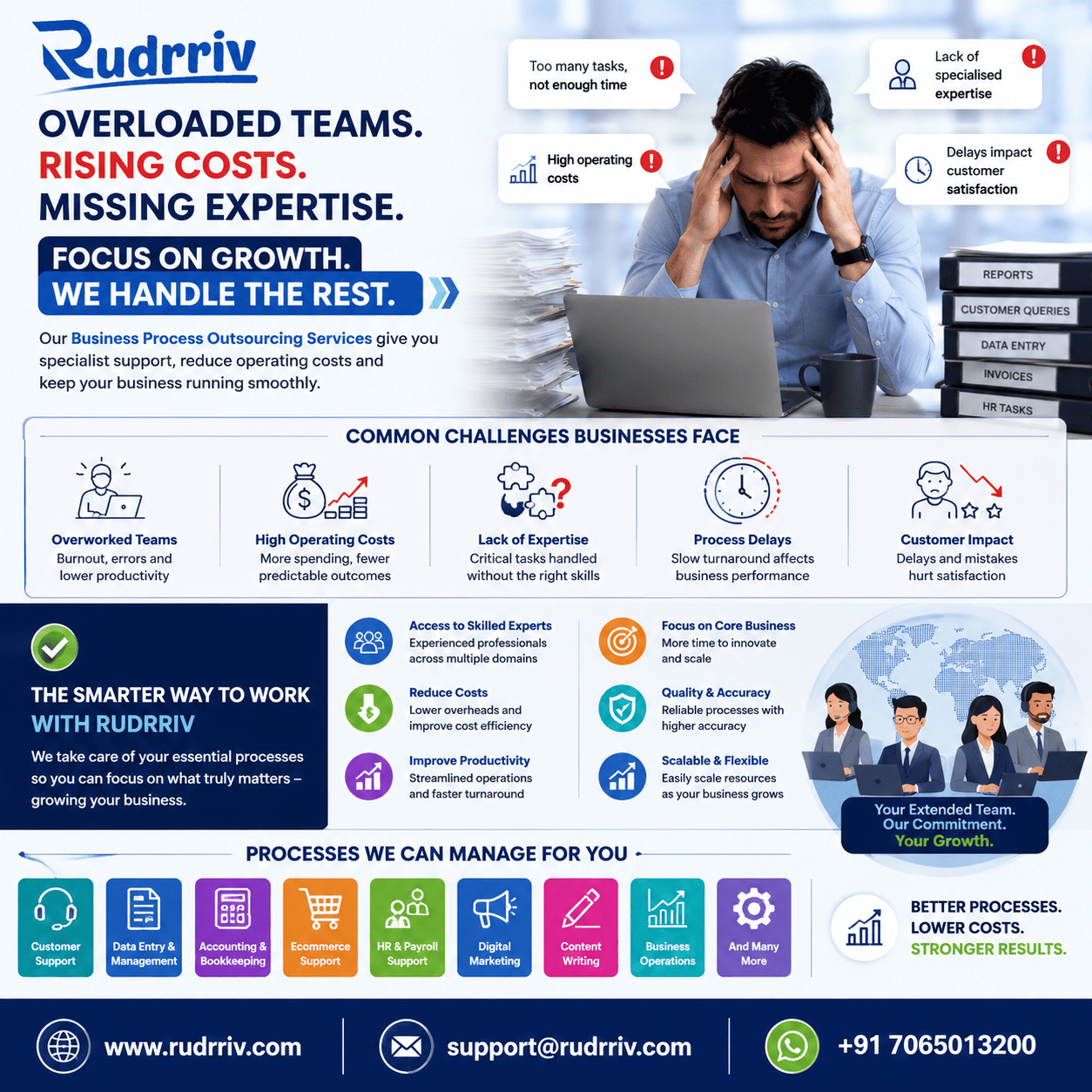
Share the outcome, scope, current capacity, access needs, risk constraints, and expected growth. Rudrriv can help structure discovery, a defined project, dedicated specialist support, ongoing assistance, or a managed team with clear responsibilities, quality controls, communication routines, and handover expectations.
Discuss your requirementAt Rudrriv, we make it easier for businesses to access the right expertise, execute important work, and scale with confidence.