
Benefits of AI-Powered Data Analytics for Marketing
Benefits of using AI-powered data analytics services for marketing include faster insight, more precise segmentation, better forecasting, earlier detection of campaign problems, and more disciplined budget allocation. The strongest benefit, however, is not automation by itself. It is the ability to connect large, fragmented datasets to a clear marketing decision: whom to target, what to offer, when to intervene, which channel deserves investment, and where human review is still required.
Businesses should not adopt AI analytics simply because their reporting feels slow or competitors mention artificial intelligence. The practical starting point is a measurable use case, trustworthy data, a baseline for comparison, and an owner who can act on the output. Without those conditions, sophisticated models may only produce faster confusion.
This guide explains where AI-powered marketing analytics creates genuine value, which organizations are ready, how it differs from conventional reporting, what it costs to operate, how to implement it responsibly, and when external specialist support is appropriate.
Quick Answer: Why AI Analytics Helps Marketing
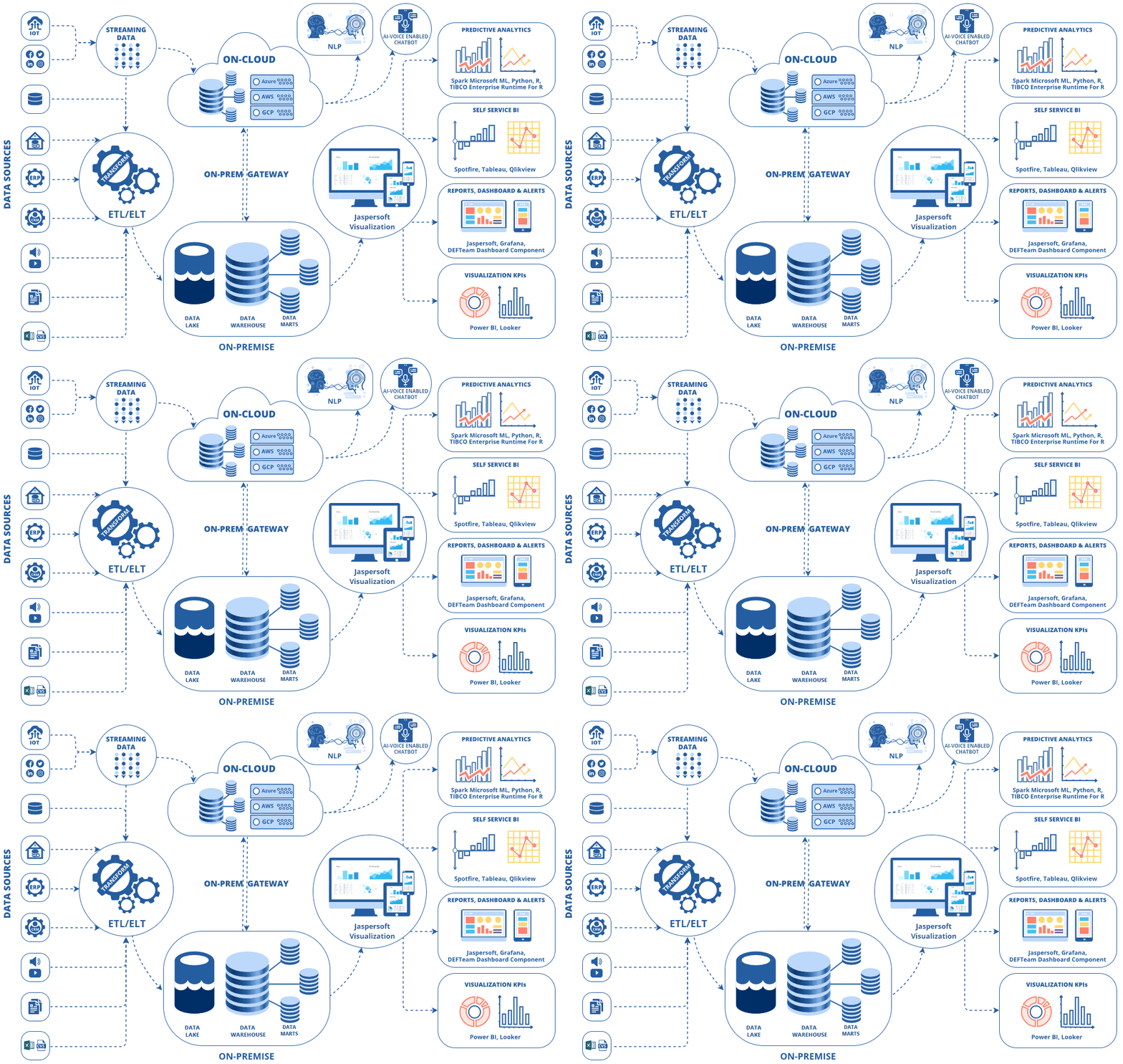
AI-powered data analytics services help marketing teams process more information than manual analysis can handle, identify patterns that are difficult to see in standard dashboards, and support decisions with forecasts, classifications, recommendations, and anomaly alerts. Typical applications include customer segmentation, propensity scoring, churn prediction, media-budget optimization, demand forecasting, personalization, attribution analysis, and lead prioritization.
The most suitable use cases are repetitive, data-rich decisions where the result can be tested. A model that predicts which leads are more likely to convert can be useful because the sales and marketing teams can compare outcomes against a baseline. A vague objective such as “use AI to improve marketing” is not a sufficient business case.
The main caution is that AI does not repair weak tracking, inconsistent definitions, missing consent, or poor campaign execution. Validate the data and decision process before scaling the technology.
Key Takeaways
- Better decisions are the goal: the value comes from changing targeting, timing, spend, content, or customer treatment—not from producing more reports.
- Predictive insight adds a new layer: AI can estimate likely outcomes and surface risk before conventional reporting confirms it.
- Data readiness determines value: connected, lawful, consistent data matters more than choosing the most advanced algorithm.
- Start with one measurable use case: a focused pilot reduces cost, exposes data problems, and creates a credible baseline.
- Human judgment remains essential: teams must interpret context, review sensitive decisions, and challenge misleading outputs.
- Maintenance is continuous: models, data pipelines, definitions, permissions, and dashboards require monitoring after launch.
- External support can accelerate delivery: specialists are most useful when they fill specific gaps in data engineering, modeling, governance, or implementation.
Table of Contents
- The marketing decisions AI analytics improves
- When a business is ready to adopt it
- AI analytics versus traditional reporting
- High-value use cases across the funnel
- Benefits, requirements, and limitations
- Cost, resources, and operating model
- A practical implementation path
- Risks and common adoption mistakes
- Summary and decision checklist
The Marketing Decisions AI Analytics Improves
AI analytics is most valuable when it improves a recurring decision with enough data to learn from. Marketing teams often have abundant data but limited ability to connect it across advertising platforms, websites, CRM systems, ecommerce transactions, email tools, customer service, and offline sales. AI methods can help identify relationships across those sources and convert them into operational signals.
Audience selection and prioritization
Instead of relying only on broad demographics or manually defined segments, a model can group customers by observed behavior, value, purchase patterns, engagement, or likelihood of taking a specific action. This may help a B2B team prioritize accounts, an ecommerce business identify repeat-purchase potential, or a subscription company detect customers at risk of leaving.
Budget and channel allocation
AI can combine spend, reach, conversion, margin, seasonality, and audience quality to highlight where additional investment may have the greatest expected value. This does not make attribution certain. It gives the team a more structured basis for testing budget changes than last-click reports or platform-reported conversions alone.
Timing, content, and next-best action
Models can estimate when a customer is likely to respond, which content category is relevant, or which offer should be tested next. The practical benefit is reduced waste and more relevant communication. Sensitive or high-impact decisions should still have business rules and human oversight.
Decision rule: prioritize AI analytics when the decision repeats frequently, the outcome can be observed, and the team can act differently based on the result.
When a Business Is Ready to Adopt AI Analytics
A business is ready when it has a defined problem, accessible data, an accountable owner, and a way to test whether the output improves decisions. Large data volume helps some use cases, but readiness is not simply a matter of company size.
- Clear objective: for example, reduce unqualified leads, improve repeat purchase, identify campaign anomalies, or forecast demand.
- Observable outcome: conversion, retention, response, revenue, margin, lead quality, or another measurable result.
- Usable data: identifiers, timestamps, campaign information, customer events, and outcome labels are sufficiently complete and consistent.
- Operational capacity: someone can review the insight, approve action, and coordinate changes across marketing, sales, product, or technology.
- Governance: consent, access, retention, security, fairness, and permitted uses are documented.
A startup with limited history may gain more from clean instrumentation, cohort analysis, and controlled experiments than from a complex predictive model. An established ecommerce or subscription business with recurring transactions may be ready for demand forecasting, churn scoring, or recommendation models. An enterprise may need to resolve identity, data ownership, and governance before pursuing advanced personalization.
AI Analytics Versus Traditional Reporting
Traditional reporting remains necessary because teams need a reliable record of what happened. AI analytics adds value when the question moves from description to prediction, classification, recommendation, or automated detection.
| Decision need | Traditional reporting | AI-powered analytics | Practical caution |
|---|---|---|---|
| Campaign performance | Shows spend, clicks, conversions, and trends | Detects unusual changes and estimates likely future performance | Alerts require thresholds and human review |
| Audience segmentation | Uses fixed rules and known attributes | Finds behavioral groups and propensity patterns | Segments can reflect biased or incomplete data |
| Lead prioritization | Ranks by manually assigned criteria | Scores likelihood or expected value from historical outcomes | Sales feedback and drift monitoring are essential |
| Budget allocation | Compares channel-level efficiency | Models scenarios and marginal response | Attribution uncertainty must remain visible |
| Retention | Reports churn after it occurs | Identifies customers with elevated churn risk | Interventions must be tested for incrementality |
| Personalization | Uses broad segments and campaign rules | Recommends content, timing, or offer by context | Privacy, relevance, and frequency controls matter |
The best operating model combines both approaches: trusted descriptive reporting for accountability, experiments for causal learning, and AI analysis for prioritization and forecasting.
High-Value Use Cases Across the Funnel
Example 1: Ecommerce repeat purchase
An ecommerce business assumes that sending more promotional email will increase repeat sales. AI analysis instead identifies purchase intervals, product affinity, discount sensitivity, and inactivity patterns. The better decision is to test different timing and messages by predicted need, while keeping a control group. Specialist support may be useful for event design, customer identity, model validation, and experimentation.
Example 2: B2B lead quality
A B2B company optimizes campaigns for form submissions, but sales rejects many leads. By connecting campaign, website, CRM, and opportunity data, a scoring model can prioritize sources and behaviors associated with qualified pipeline. The marketing team then shifts spend and content toward higher-value patterns rather than maximizing lead volume.
Example 3: Subscription churn prevention
A subscription platform reacts after cancellations rise. AI analytics combines product usage, support interactions, payment behavior, and engagement to flag accounts with increasing risk. The business tests targeted education or service interventions. The model is useful only if teams can act before cancellation and measure whether the intervention changes outcomes.
Example 4: Campaign anomaly detection
An enterprise marketing team reviews dozens of regional campaigns manually. Automated anomaly detection highlights unexpected changes in spend, conversion, tracking, or audience mix. Analysts investigate the exceptions rather than scanning every dashboard. This improves response time without delegating final judgment to the model.
Benefits, Requirements, and Limitations
The business case should balance expected benefits against the technical and operational work required to sustain them.
| Potential benefit | What enables it | What can weaken it |
|---|---|---|
| Faster insight from large datasets | Connected sources, automated pipelines, clear definitions | Missing events, duplicated customers, inconsistent taxonomy |
| More precise targeting | Relevant behavioral and outcome data | Small samples, biased history, privacy constraints |
| Better forecasting | Stable patterns, seasonality controls, scenario testing | Market shocks, product changes, weak historical coverage |
| Earlier risk detection | Timely data and monitored thresholds | Delayed feeds, excessive false alerts, no response owner |
| Improved personalization | Real-time context, content options, business rules | Intrusive experiences, poor consent, narrow optimization |
| Stronger budget allocation | Cost, conversion, value, and incrementality measures | Platform bias, attribution gaps, optimization to vanity metrics |
AI analytics should be treated as a decision system, not only a model. Data collection, feature definitions, permissions, interfaces, review workflows, documentation, and monitoring all affect whether the output becomes useful.
Cost, Resources, and the Operating Model
Costs vary with the number of data sources, data quality, refresh frequency, model complexity, privacy requirements, deployment environment, dashboard needs, and level of ongoing support. A narrow pilot may use existing cloud and analytics tools. A production capability may require data engineering, analytics, machine learning, marketing operations, security, legal review, and change management.
Budget for the complete lifecycle: discovery, data audit, integration, model development, validation, deployment, user training, monitoring, recalibration, and documentation. The cost of internal time is often overlooked. Marketing teams must define outcomes, review assumptions, label data, test actions, and provide feedback after launch.
Build internally when the capability is strategically important, data access is mature, and the organization can retain the necessary skills. Use an external service when you need independent discovery, specialist implementation, temporary acceleration, or ongoing managed support. The commercial model should match the need: a defined pilot for validation, dedicated specialists for capability gaps, or a managed team for continuous operation.
A Practical Implementation Path
- Choose one decision: specify the user, action, prediction, and measurable outcome.
- Establish the baseline: document current performance, process time, decision quality, and known limitations.
- Audit data and governance: confirm sources, identity, quality, consent, access, retention, and security.
- Select the simplest viable method: a rule, statistical model, or existing platform feature may be sufficient before custom machine learning.
- Run a controlled pilot: validate usefulness with real users and compare against the baseline or a control group.
- Integrate into workflow: define alerts, approvals, handoffs, dashboards, and responsibilities.
- Monitor and improve: track model performance, data drift, business outcomes, fairness, and user feedback.
Success should be measured at three levels: technical quality, operational adoption, and business effect. A highly accurate model has limited value when marketers do not trust it, cannot understand the recommendation, or lack authority to act.
Risks and Common Adoption Mistakes
- Starting with a tool rather than a decision: this creates features without a measurable business purpose.
- Training on biased historical outcomes: the model may reproduce poor targeting or unequal treatment.
- Using platform-reported data as unquestioned truth: attribution and conversion reporting can differ across systems.
- Automating sensitive actions too early: pricing, exclusion, eligibility, and high-impact customer treatment need stronger controls.
- Ignoring model drift: campaigns, products, competitors, customer behavior, and tracking all change over time.
- Optimizing a proxy: clicks, leads, or engagement may rise while profit, retention, or customer value does not.
- Failing to document ownership: data, code, dashboards, credentials, model artifacts, and handover responsibilities should be explicit.
Responsible adoption requires traceability. Teams should be able to explain which data was used, what the output means, where uncertainty exists, who approved the action, and how an incorrect recommendation can be challenged or reversed.
Summary
The benefits of AI-powered data analytics services for marketing are strongest when a business needs to make frequent, evidence-based decisions across large or fragmented datasets. AI can improve segmentation, forecasting, anomaly detection, lead prioritization, retention analysis, personalization, and budget planning. These benefits are not automatic; they depend on reliable data, a defined outcome, operational adoption, and continuous monitoring.
Use conventional reporting when the primary need is accurate visibility into what happened. Add AI analytics when prediction, prioritization, or pattern detection can change a decision. Start with a focused pilot, compare it with a baseline, and scale only after the team proves usefulness, governance, and maintainability.
Before approval, confirm scope, budget, timeline, data ownership, privacy, quality assurance, monitoring, documentation, and handover. A good service provider should explain assumptions and limitations as clearly as expected benefits.
FAQs on AI-Powered Marketing Analytics
What are the main benefits of using AI-powered data analytics services for marketing?
The main benefits are faster analysis, more precise audience segmentation, better forecasting, earlier detection of campaign problems, improved personalization, stronger budget allocation, and clearer measurement across channels. The value is highest when the service connects reliable data to a specific decision rather than producing another dashboard.
Is AI-powered marketing analytics suitable for small businesses?
Yes, provided the use case is narrow and the data is sufficient. A small business may begin with lead scoring, campaign anomaly detection, customer segmentation, or product-demand forecasting. It should avoid complex models that require more data, maintenance, and specialist capacity than the business can support.
How is AI analytics different from traditional marketing reporting?
Traditional reporting mainly describes what happened. AI analytics can also identify patterns, estimate likely outcomes, classify customers, recommend actions, and detect unusual changes. It does not eliminate the need for sound tracking, interpretation, experimentation, or human judgment.
What data is needed for AI marketing analytics?
Useful inputs may include website and app events, CRM records, transactions, campaign costs, product data, customer-service interactions, consent records, and offline conversions. The data must be sufficiently complete, consistent, lawful, and connected to the business outcome being predicted or optimized.
Can AI analytics improve marketing ROI?
It can improve the quality and speed of budget decisions, but it cannot guarantee ROI. Benefits depend on data quality, model suitability, execution, market conditions, and whether teams act on the findings. Measure incremental improvement through controlled tests where possible.
How long does implementation usually take?
A focused pilot may be completed in weeks, while an enterprise programme involving identity resolution, data engineering, governance, multiple channels, and production models can take months. Timeline depends more on data readiness and integration complexity than on the model itself.
What are the main risks of AI-powered marketing analytics?
Key risks include poor-quality data, privacy violations, biased predictions, misleading attribution, model drift, over-automation, weak security, and decisions that cannot be explained. Governance should define approved data, human review, monitoring, access controls, and escalation procedures.
Do marketing teams still need analysts after adopting AI tools?
Yes. Analysts frame questions, validate data, evaluate model performance, explain uncertainty, design tests, and connect findings to commercial context. AI can increase analyst productivity, but unsupervised outputs can lead to confident and costly mistakes.
Should a business build an internal solution or use an external analytics service?
Build internally when analytics is strategically differentiating and the organization can sustain data engineering, modeling, governance, and maintenance. External support is useful for discovery, acceleration, specialist skills, independent validation, or a managed capability when internal capacity is limited.
How should success be measured?
Use operational and business measures together: data completeness, model accuracy, alert usefulness, decision speed, campaign efficiency, conversion quality, retention, and incremental revenue or cost avoidance. Define a baseline and test whether the analytics changes decisions and outcomes.
Need a Practical AI Analytics Roadmap?
Rudrriv can help define a focused marketing analytics use case, assess data readiness, structure a pilot, and provide specialist or managed support for data engineering, analysis, dashboards, governance, and ongoing improvement.
Discuss your requirementAt Rudrriv, we make it easier for businesses to access the right expertise, execute important work, and scale with confidence.