
Advertising Mistakes That Cause Low Conversions and Waste Spend
The common advertising mistakes that cause low conversion rates and wasted media spend are usually connected: the campaign optimizes for the wrong action, reaches people with weak intent, makes a promise the landing page cannot support, or relies on tracking that does not represent real business value. Increasing budget before resolving those gaps normally buys more of the same problem.
Trace one complete path: who saw the ad, why they clicked, what they expected, which action was recorded, and whether it became a qualified lead, purchase, booking, or other useful outcome. This separates traffic problems from offer, experience, measurement, or follow-up problems.
Treat poor advertising performance as a system diagnosis rather than a creative-only issue. The correction may be better targeting, a clearer offer, stronger message continuity, accurate tracking, a simpler form, improved checkout, or slower scaling. Find where qualified demand is lost and fix that constraint first.
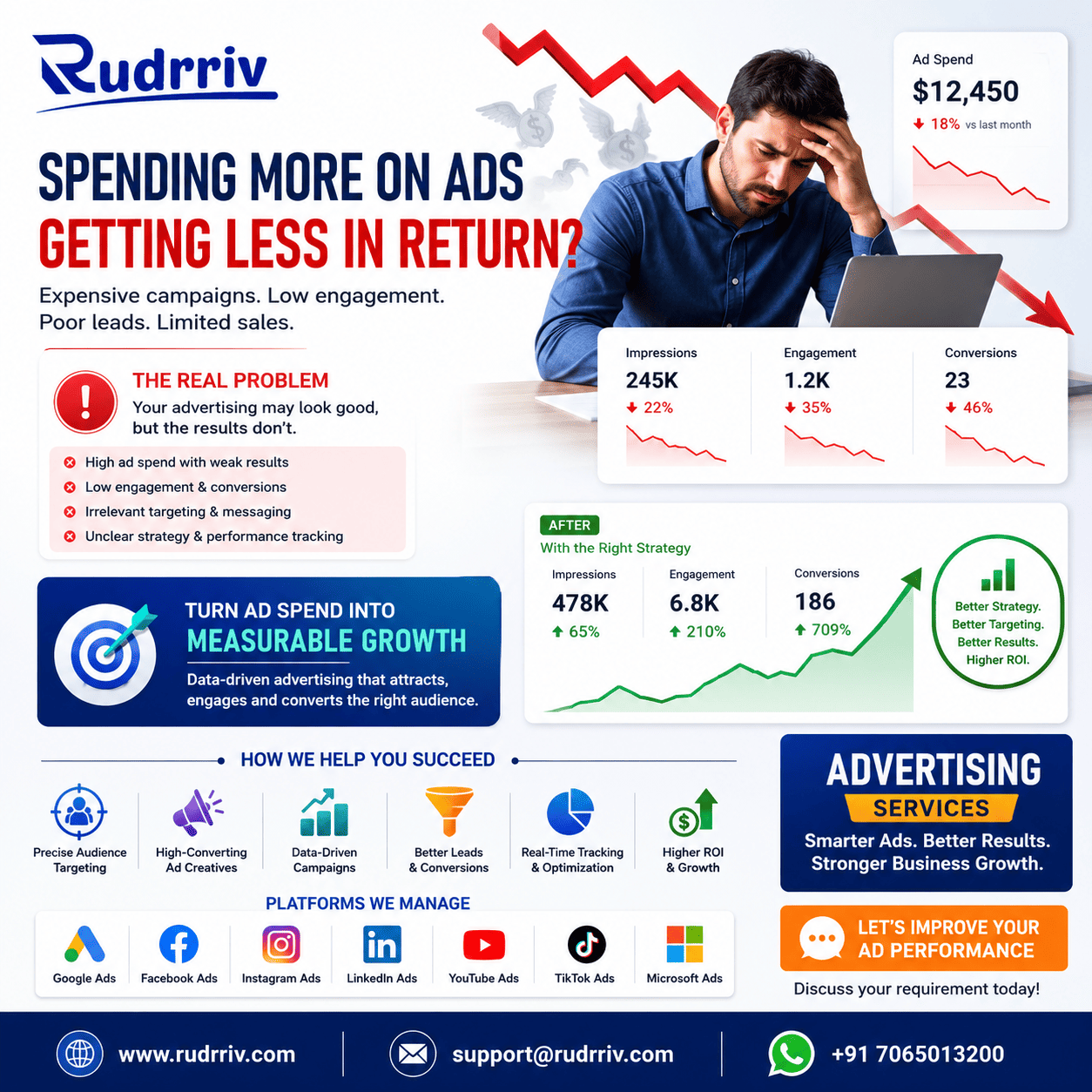
Quick Answer: Why Ads Convert Poorly and Waste Budget
Low-converting campaigns usually fail because the advertising objective, audience intent, offer, creative, landing page, and conversion signal are not aligned. Start by confirming the business outcome that should guide the campaign. Then test whether the ad attracts the right person, makes a precise promise, sends the click to a relevant experience, and records the completed outcome accurately.
Do not make several major changes at once. First verify tracking and conversion definitions. Next compare audience and search intent, message, landing-page behavior, and lead or order quality. Change the largest constraint, preserve a control where practical, and allow enough time for conversion delay before judging the result.
The main caution is that platform-reported improvement can still hide business waste. A lower cost per lead is not useful when leads are unqualified, duplicate, outside the service area, or unlikely to buy. Connect advertising data with CRM, order, booking, or sales-quality information before scaling.
Key Takeaways
- Optimize for business value: choose purchases, qualified leads, bookings, or another verified outcome instead of an easy activity that inflates conversion volume.
- Match intent before reach: an audience that can click is not necessarily an audience that is ready, eligible, or able to buy.
- Keep the promise continuous: the landing page should immediately confirm the ad's offer, audience, price context, and next action.
- Validate measurement first: duplicate, missing, or misclassified events can direct automated bidding toward the wrong behavior.
- Avoid unnecessary fragmentation: too many small campaigns, ad sets, audiences, or creative variations can leave each segment with weak evidence.
- Scale the constraint, not the spend: increase budget only after the campaign and conversion path are stable enough to interpret.
- Review quality after conversion: revenue, margin, qualified-lead rate, return rate, and sales acceptance can matter more than platform conversion count.
Table of Contents
- Define the conversion before optimization
- Match audience intent to the offer
- Keep the ad and landing page consistent
- Fix tracking before automated bidding
- Scale budget only after useful evidence
- Use the campaign correction matrix
- Match complexity to business stage
- Read the full conversion path
- Review practical advertising examples
- Apply a 30-day correction plan
Define the Conversion Before Optimizing the Campaign
The first mistake is allowing the advertising platform to optimize for an action that is easy to record but weakly connected to revenue or qualified demand. A page view, button click, form start, video view, or add-to-cart event can help explain behavior, but it should not automatically carry the same decision weight as a completed purchase, accepted lead, booked appointment, or another meaningful result.
Write a one-sentence conversion definition for each campaign. For example: “A valid lead is a completed consultation request from a supported market with a business email and a relevant service need.” That definition clarifies form fields, exclusions, CRM status, reporting, and which event should guide bidding.
Google Ads distinguishes between primary and secondary conversion actions. The important operational point is to keep diagnostic events available without letting low-value actions distort optimization. Audit goal settings whenever campaigns are copied, account defaults change, analytics events are imported, or a new checkout or form is launched.
Decision rule: if the platform can improve its reported conversion rate without improving qualified leads, completed orders, or another defined business outcome, the conversion setup is not yet strong enough for scaling decisions.
Match Audience Intent to the Offer and Channel
Low conversion can come from reaching the wrong person, but it can also come from reaching the right person at the wrong moment. Search advertising often captures expressed demand, while social and display formats can create or shape demand. The same offer, message, and expectation should not be copied across channels without accounting for that difference.
For high-intent searches, check query meaning, location, device, schedule, exclusions, and whether the page answers the exact need. For interest- or behavior-based audiences, the creative may need to establish the problem, qualify the buyer, and explain why the offer is relevant before asking for a commitment.
Overly broad targeting is not automatically wrong, and narrow targeting is not automatically efficient. Broad delivery needs reliable conversion signals and clear creative qualification. Narrow delivery needs enough audience volume and may become expensive or repetitive. Compare approaches using the same downstream outcome, not only cost per click or platform-reported lead count.
Before changing bids, review search terms, placements, geography, devices, frequency, and lead or order quality. Remove obvious mismatch, then test whether the offer converts qualified demand.
Keep the Ad Promise Consistent With the Landing Page
An ad can earn a click and still waste spend when the landing page does not continue the same promise. Common breaks include sending all traffic to a generic homepage, changing the price or eligibility context, hiding the advertised product, using a different headline, asking for too much information, or making the next step difficult on mobile.
Google's guidance on optimizing ads and landing pages emphasizes close alignment between the ad, keywords, and destination experience. In practical terms, the first screen should confirm that the visitor is in the right place, state the value clearly, address the main objection, and present one understandable next action.
Review mobile speed, form errors, checkout steps, availability, payment methods, trust information, and confirmation. The failure may occur after submission when data is incomplete or follow-up is slow.
Use dedicated landing pages when the audience, offer, or decision context is materially different. Do not create a separate page merely to repeat generic marketing copy. The page should reduce uncertainty for that specific visitor.
Fix Tracking Before Trusting Automated Bidding
Automated bidding can only respond to the signals it receives. Missing events, duplicate purchases, test submissions, internal traffic, inconsistent values, broken cross-domain journeys, and delayed offline updates can make an efficient-looking campaign optimize toward the wrong result.
Use the platform's official conversion measurement setup as a baseline, then test each important path on real devices. Confirm that the event fires once, carries the expected value and currency where relevant, uses the correct counting method, and appears in both analytics and advertising reports within the expected delay.
Where browser restrictions, consent choices, CRM stages, app events, or offline sales affect visibility, document what the platform can and cannot observe. Meta describes its Conversions API as a direct connection between business data and its optimization systems. Server-side or offline connections can improve signal coverage, but they still require accurate event design, deduplication, consent handling, security, and ongoing monitoring.
Do not treat attribution as a perfect ledger. Compare it with order data, CRM outcomes, feasible incrementality tests, and total qualified demand because systems can credit the same journey differently.
Scale Budget Only After the Campaign Has Useful Data
Budget waste often appears when teams scale before they can explain why a campaign is working. A few conversions can come from brand demand, returning customers, sales promotions, or random variation. Raising spend, widening audiences, and launching new creative at the same time removes the ability to identify the actual driver.
Splitting a limited budget across too many campaigns, locations, products, or audiences leaves each segment with weak evidence. Consolidate around the highest-priority outcome and separate campaigns only when budget, geography, compliance, inventory, or intent genuinely requires it.
Set a test plan before launch: the hypothesis, primary outcome, guardrail metrics, audience, creative difference, landing page, budget limit, review date, and decision rule. Give the test enough time to include conversion delay and normal weekday or seasonal variation. Pause quickly for technical failure or irrelevant spend, but avoid frequent strategic edits based on a single day.
Scale in controlled increments after tracking, lead or order quality, landing-page operation, and unit economics are understood. A platform recommendation is useful context, not a substitute for business judgment.
Diagnose Waste With a Campaign Correction Matrix
Use this matrix to locate the first broken stage. The same headline symptom can have several causes, so confirm the evidence before selecting a fix.
| Observed symptom | Likely mistake | Evidence to inspect | First corrective action |
|---|---|---|---|
| High impressions, weak click response | Message or audience does not match the need | Search terms, placement, audience, creative angle, offer clarity | Qualify the audience and test a clearer problem-to-offer message |
| Clicks but few meaningful actions | Ad promise and landing page are disconnected | Page relevance, mobile behavior, speed, form or checkout drop-off | Align the first screen and remove the largest completion barrier |
| Many leads, weak sales acceptance | Campaign optimizes for easy form fills | CRM stage, geography, eligibility, duplicate and spam rate | Define a qualified lead and feed quality information into reporting |
| Unstable results after frequent edits | Too many simultaneous changes | Change history, test duration, conversion delay, segment volume | Restore a control and test one material hypothesis at a time |
| Low reported cost, weak business return | Incorrect conversion value or attribution dependence | Order value, margin, refunds, offline sales, repeat purchases | Connect platform data with financial and CRM outcomes |
| Budget spends but learning remains weak | Campaign structure is over-fragmented | Conversions per segment, audience overlap, budget distribution | Consolidate around the highest-priority objective and audience |
After identifying the likely cause, choose one corrective action and define the evidence that would confirm improvement. Do not use the matrix as a reason to rebuild the entire account at once.
Match Advertising Complexity to the Business Stage
The right campaign design depends on how much the business already knows. A startup validating demand should not build a complex full-funnel account before it has a stable offer and a clear buyer. A growing ecommerce business may need product-level value, inventory, margin, and repeat-purchase data. An enterprise may need market-specific governance, consent controls, CRM integration, brand safeguards, and coordinated approvals.
- Early validation: test one audience problem, offer, and conversion path.
- Repeatable acquisition: improve measurement, creative, landing pages, and lead quality before expanding.
- Scaling: add channels only when data quality, production, and follow-up can support them.
- Mature programmes: evaluate incrementality, customer value, margin, saturation, and creative fatigue.
Resource constraints matter. A campaign that requires weekly creative production, landing-page experiments, CRM feedback, and technical tagging will underperform when no one owns those tasks. Match the plan to available design, copy, analytics, development, sales, and approval capacity.
Read User Behavior Across the Full Conversion Path
A single platform metric cannot explain the journey. Read performance as delivery, attention, qualified click, landing-page engagement, conversion completion, lead or order quality, and business value. The aim is to identify where the largest share of qualified demand disappears.
A strong click-through rate can reflect curiosity, and a high form-completion rate can attract unsuitable leads. Return on ad spend can hide low margin or discounts, while immediate return can undervalue a longer sales cycle. Define the metric hierarchy before reviewing the dashboard.
Segment by device, location, audience, creative, landing page, customer type, and conversion quality where appropriate. Look for consistent patterns and use sales feedback, customer questions, usability testing, or page recordings to explain them.
Maintenance should cover event tests after releases, ad limitations, exclusions, creative fatigue, page availability, consent changes, CRM mappings, and lead response. Any connected-system change can reduce performance.
Three Examples of Advertising Waste and Better Decisions
A local professional-service firm
The firm judged broad lead-generation ads by form submissions, but many enquiries were outside its service area or irrelevant. The better decision was to define a qualified enquiry, clarify eligibility in the ad and page, add one qualifying field, and report sales acceptance by campaign. Specialist guidance may help connect CRM outcomes with reporting.
An ecommerce business with strong clicks
The retailer's creative attracted clicks, but mobile product pages were slow and the advertised discount was unclear at checkout. Instead of replacing the ads, the team aligned the page message, tested checkout, verified price and stock, and measured margin after discounts. Design and development support was more useful than additional media at this stage.
A startup scaling before product validation
The startup divided a modest budget across several channels and objectives, leaving each segment with weak evidence. Bidding optimized for trial starts that rarely activated. The better decision was to consolidate around one buyer problem, use activation as the outcome, interview non-converting users, and delay expansion until the offer and onboarding were more stable.
Use a 30-Day Plan to Correct Low-Conversion Campaigns
A correction plan should reduce uncertainty in a controlled order. The following sequence avoids paying for more traffic before the measurement and conversion path are trustworthy.
- Days 1–5: verify the outcome. Define the primary business conversion, supporting events, qualification criteria, value, counting method, ownership, and data source.
- Days 6–10: test the journey. Complete the path on major devices, confirm event firing, inspect search terms or placements, and review forms, checkout, confirmation, and lead routing.
- Days 11–15: isolate the main constraint. Compare audience fit, creative promise, offer strength, page relevance, and downstream quality. Select one material hypothesis.
- Days 16–23: run the correction. Keep a control where practical, set a budget limit, document changes, and avoid unrelated restructuring.
- Days 24–30: judge the business result. Account for conversion delay, compare qualified outcomes, record what changed, and decide whether to keep, revise, stop, or scale the test.
Continue monthly checks for tracking, goal settings, page availability, creative fatigue, exclusions, budget allocation, lead quality, order value, and handoff.
When Advertising Specialist Support Is Justified
External support is useful when the problem crosses media buying, analytics, creative, UX, development, CRM, or sales operations and no internal owner can coordinate the diagnosis. It may also be appropriate when spend is significant, tracking is disputed, new markets are involved, or the team needs a defined experiment rather than ongoing account activity.
Rudrriv can help businesses structure a focused performance-improvement project, access a dedicated specialist, or assemble support across design, technical implementation, analytics, and campaign operations. The engagement should begin with the business outcome, existing evidence, known constraints, scope, responsibilities, review points, ownership, quality checks, and handover. Explore Rudrriv solutions or specialist talent options when the correction requires skills or capacity beyond the internal team.
Summary: Correct the System Before Increasing Spend
Advertising waste is rarely solved by changing one headline or raising one bid. The stronger decision is to verify the conversion definition, tracking, audience intent, offer, ad promise, landing-page experience, campaign structure, and downstream quality in that order.
Keep the campaign simple when the business is still validating demand. Add automation, segmentation, channels, and budget only when the data and operating capacity can support them. Judge performance using qualified business outcomes, not an isolated platform metric.
The next practical action is to select the largest confirmed constraint, run one controlled correction, and document the decision rule before the test begins. That creates evidence for the next budget decision and reduces the risk of scaling an unproven system.
FAQs on Advertising Mistakes and Wasted Spend
What are the common advertising mistakes that cause low conversion rates and wasted media spend?
The main mistakes are optimizing for the wrong conversion, targeting weak intent, using an unclear offer, disconnecting the ad from the landing page, relying on incomplete tracking, fragmenting campaigns, and scaling too early. Diagnose the path from impression to qualified sale or lead before changing one isolated setting.
How can I tell whether the problem is the ad or the landing page?
Compare the stages. Weak click response can indicate an audience, message, or creative problem. Healthy click engagement followed by poor completion usually points to the offer, page relevance, speed, form, checkout, trust, or price. Review page behavior and lead quality rather than click-through rate alone.
Should a startup increase ad spend when conversion volume is low?
Usually not until the offer, audience, tracking, and conversion path work consistently. Run a controlled validation test with a clear learning objective first. More budget can accelerate learning, but it can also multiply a structural problem. Scale after usable evidence, not only because a platform recommends it.
Can broad targeting cause wasted media spend?
Broad targeting can waste spend when the offer is weak, signals are poor, exclusions are missing, or the budget is too limited to learn. It can work when conversion data is reliable and creative clearly qualifies the audience. Compare broad and constrained approaches using the same business outcome.
Why do campaigns get clicks but no qualified leads?
Clicks without qualified leads often come from ambiguous messaging, curiosity-driven creative, broad keywords or audiences, weak location controls, or an offer that attracts low intent. Define a useful lead, pass quality information into reporting where appropriate, and compare quality by campaign, audience, message, and landing page.
Which conversion actions should be used for campaign optimization?
Use the action that best represents the objective, such as a completed purchase, qualified lead, or booked consultation. Keep supporting actions for analysis, but do not let easy micro-actions dominate bidding when they do not predict value. Review primary and secondary settings and test every event.
How much budget is needed to diagnose a low-converting campaign?
There is no universal amount because click costs, sales cycles, audience size, and product value vary. Build the budget around enough meaningful observations to compare a small set of hypotheses. If the budget cannot support fragmented campaigns, simplify the structure and test the highest-priority audience, offer, and landing page first.
How often should advertising campaigns be reviewed?
Review technical failures and spend anomalies frequently, but judge strategy over a period that reflects conversion delay and sales cycle. Daily reactions to normal variation can obscure the cause. Separate urgent checks, weekly operational analysis, creative reviews, and monthly business-outcome evaluation.
When should a business seek specialist help with advertising performance?
Specialist support is useful when tracking is unreliable, channels conflict, landing-page changes need design or development, lead quality is unclear, or the team lacks testing capacity. Start with diagnosis and a defined correction plan rather than an immediate promise to scale.
Need a Clearer Advertising Performance Plan?
Share the business outcome, channels, current tracking, audience, offer, landing pages, spend constraints, and lead or order quality. Rudrriv can help define a focused diagnostic project or the specialist support needed to correct the highest-impact issue.
Discuss your requirementAt Rudrriv, we make it easier for businesses to access the right expertise, execute important work, and scale with confidence.